DexForce targets cheaper humanoid robot training in simulation
Shenzhen startup DexForce is using simulated workplaces to train humanoid robots, betting that synthetic data can reduce the cost of teaching machines useful tasks, according to Reuters. The company trains robots in virtual environments and transfers the learned skills to physical machines, an approach it says is faster and cheaper than collecting repeated demonstrations from human trainers.
Reuters described a simulation at DexForce’s offices in which a virtual robot repeatedly placed objects on a table while its arm angles, the table’s colour and the objects changed. Those variations address a central problem in humanoid robot training: performing a task despite changes in the surroundings, rather than simply repeating a fixed movement.
DexForce develops software to simulate physical environments and models intended to predict how objects move and interact. The company says human trainers may need to repeat a movement more than 100 times to generate precise examples. Its argument is about the economics of acquiring training data, not just the ability to run a task in simulation.
Most Chinese robot makers already combine simulated and real world data, Reuters reported, so simulation itself is not the distinguishing feature. DexForce is placing greater emphasis on synthetic data while dozens of humanoid data training centres are being built across China, often with substantial government support.
Funding backs the simulation strategy
Chief executive Jia Kui told Reuters that collecting data manually for the range of tasks humans perform is fundamentally inefficient. He argued that simulation could accelerate a broader breakthrough in robot capability, comparing the potential impact with ChatGPT’s release. That is Jia’s ambition for the approach, rather than a demonstrated level of general robot competence.
Jia, a machine learning professor at the Chinese University of Hong Kong, Shenzhen, founded DexForce in 2021. The roughly 500 employee company recently raised 1 billion yuan (about $150 million) in Series B funding at a valuation above 10 billion yuan (about $1.5 billion). Backers include Lenovo Capital, Lens Technology and several state owned funds, according to Reuters.
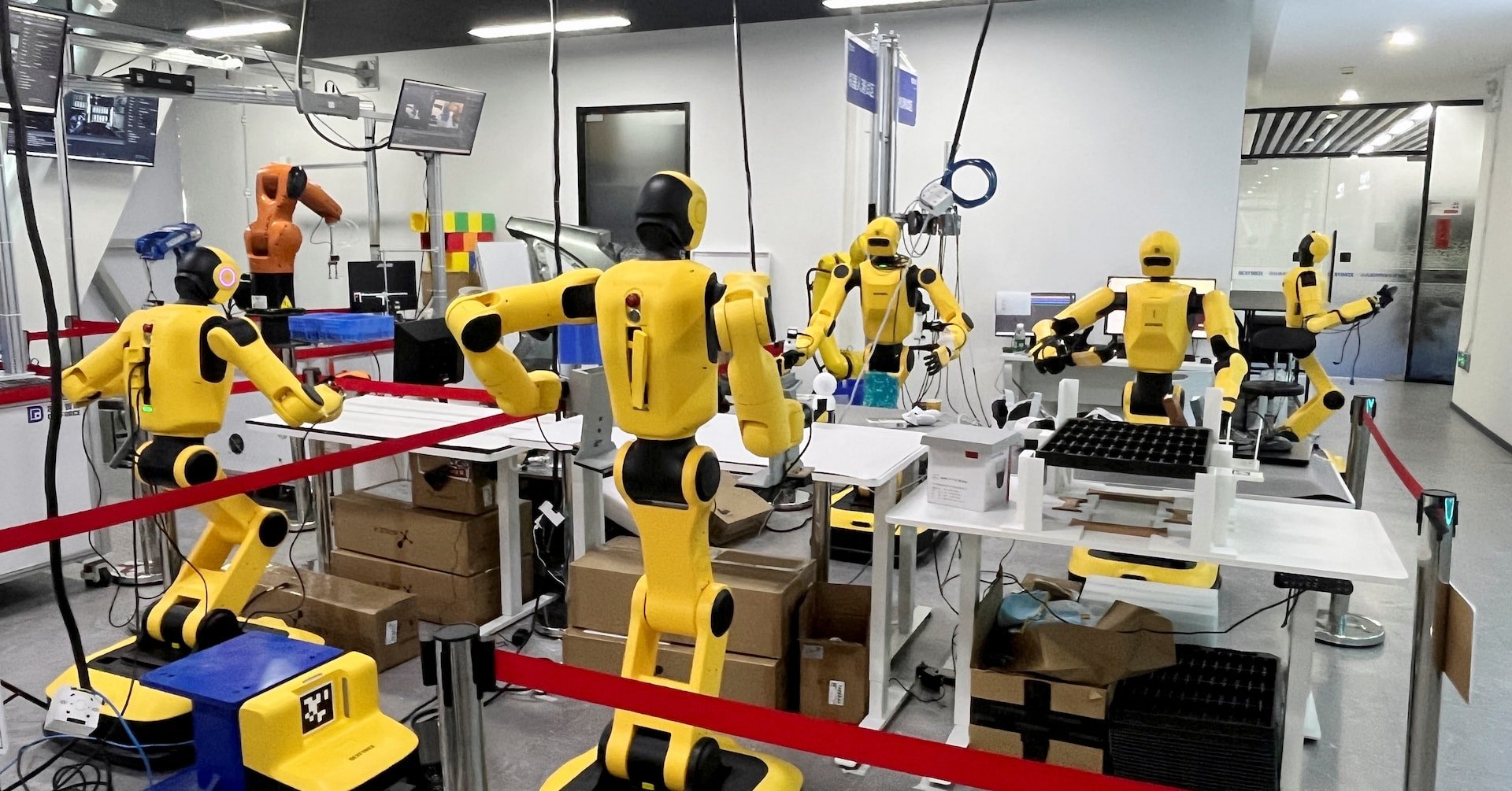
Reuters photographed DexForce’s W1 Pro humanoids demonstrating object sorting at an industrial deployment testing facility at its Shenzhen headquarters. The report also distinguishes two parts of the business: DexForce’s software is used by manufacturers including Toyota, Samsung, Panasonic and Foxconn, while its humanoid robots make coffee and serve customers at malls and tourist sites in more than 15 Chinese cities.
Source: Reuters