Faraday Future launches $2,490 FF Nova humanoid for schools
Faraday Future and FF EAI Robotics Ecosystem (FFR) have launched the $2,490 FF Nova humanoid for developers and educational institutions, with the initial release restricted to 100 invitation only units. According to The Next Web, the companies announced Nova and the $299 Nova Mini on October 15, with 20 Nova units described as ready for immediate shipment.
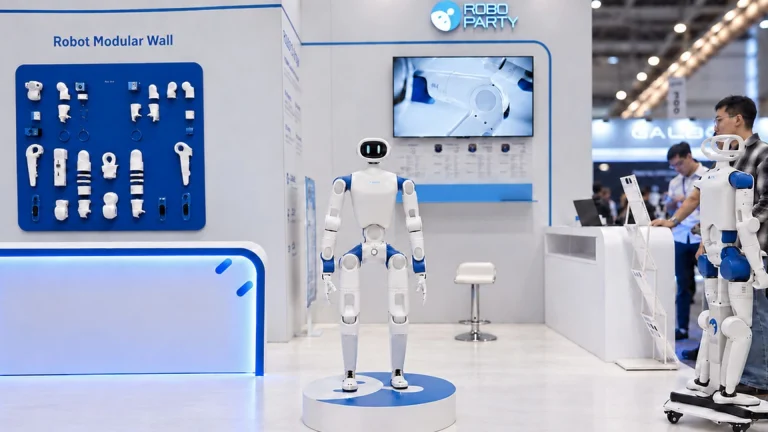
Nova is a small research and teaching platform rather than a full size industrial humanoid. Unite.AI, citing its product page, reports a height of 49.7 cm, a weight of 2.8 kg and 20 degrees of freedom: two in the head, six across the arms and twelve across the legs. The companies say it can walk, turn, wave and recover to standing after being knocked over.
A biped with a separate wheeled mode
According to the specifications reported by Unite.AI, Nova walks at 0.1 meters per second and can travel at 0.8 meters per second on a detachable wheeled base. Those are distinct mobility modes: the higher travel speed is not a bipedal walking figure.
Unite.AI also reports 10 TOPS of onboard compute, 8 GB of RAM and 32 GB of storage. The sensor package includes a top mounted 2D LiDAR, a wide angle camera, a 3D time of flight sensor and a three microphone array. These give developers more to work with than a platform limited to programmed joint movements.
The Next Web reports that Nova supports ROS 2 and that a developer software package costs an additional $390. Unite.AI describes the developer platform as including an open SDK and software updates delivered remotely. The companies also plan to open a simulation to hardware reinforcement learning pipeline and offer a Skills Store for sharing and potentially monetizing developer capabilities.
The accompanying reinforcement learning program uses Nvidia’s Isaac platform. According to Unite.AI, its proposed workflow covers parallel simulation training, reward function tuning and domain randomization before trained policies are tested on the physical Nova.
Limited developer access and a smaller classroom robot
The Next Web reports that broader developer and education sales are planned for a second phase, followed by a consumer launch. The initial allocation therefore represents limited developer access, not general retail availability.
Nova Mini targets children aged eight and older. Unite.AI reports that the $299 humanoid stands 34.9 cm tall, weighs 0.94 kg and uses 17 servos. It supports visual block programming and teaching movements by physically posing the robot. The Next Web reports a separate $499 course comprising 16 live online classes.
The launch accompanies a proposed restructuring of the robotics business. According to The Next Web, FFR has agreed to acquire Faraday Future’s robotics operations in an all stock transaction valuing them at about $200 million. Faraday Future would own approximately 65.7% of FFR after closing, which the companies expect by the end of October.
Sources: TNW | Artificial-intelligence, Engineering.com, Unite.AI