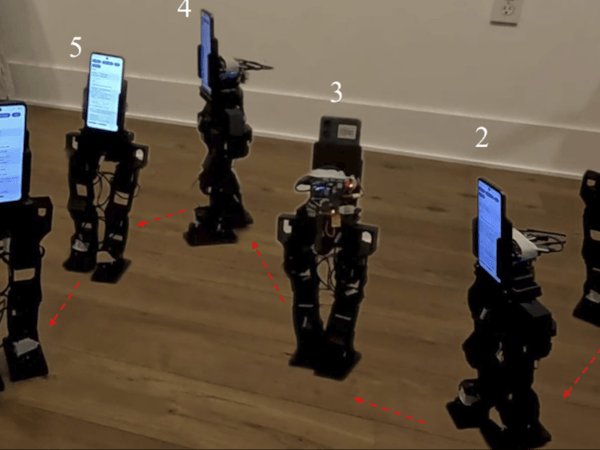
PhoneBot humanoid robot uses old Android phones for control
UCLA researchers have built PhoneBot, an open source humanoid robot that uses an Android smartphone as its primary computer and sensor suite. According to Hackster.io, the robot costs around $400 to build, excluding the phone, and can walk, track people with its camera and stand up after falling.
The PhoneBot humanoid robot is a compact locomotion platform rather than a complete human shaped machine. It stands approximately 19 inches tall, weighs four pounds and has neither arms nor a head. Its phone sits above the hips, combining processing, a camera, an inertial measurement unit and wireless connectivity in one replaceable device.
The researchers tested four Android smartphones, including an Honor 9 from 2017 and three budget models priced at approximately $50 to $80 each. Hackster.io reports that all four handled the robot’s core functions. That is a useful demonstration of hardware reuse, though it does not establish performance across Android phones generally.
A phone handles control, but not alone
A custom Android application runs movement and control neural networks through TensorFlow Lite. The phone’s inertial measurement unit monitors body orientation and movement, while its camera supports object detection, human tracking and visual navigation.
The smartphone does not connect directly to the actuators. It sends commands over Wi-Fi to a small onboard computer, which relays them to the servos. This arrangement allows phones to be swapped without changing the robot’s electronics.
PhoneBot has 12 degrees of freedom in its lower body: three joints at each hip, one at each knee and two at each ankle. A thirteenth joint rotates the torso so the camera can track objects without repositioning the feet. All joints use DYNAMIXEL XL430-W250-T servo motors.
Training out an uneven gait
The researchers trained the locomotion controller using reinforcement learning in simulation, accounting for the motors’ limited torque. Early attempts produced an asymmetric gait, with one leg doing most of the work.
Their correction was sagittal mirroring: duplicating training examples with the left and right sides reversed, without requiring additional physics simulations. Hackster.io reports that this reduced joint angle asymmetry from 0.254 to 0.003 radians in simulation and improved training speed and consistency. The reported asymmetry result is a simulation measurement, not a quantified hardware walking benchmark.
The walking controller was trained only on flat terrain, and motor capability limits payload. The researchers hope to add lightweight arms and improve locomotion on uneven surfaces. Conversational AI processing currently requires an external laptop; running it on the smartphone remains a planned extension.
Source: Hackster.io