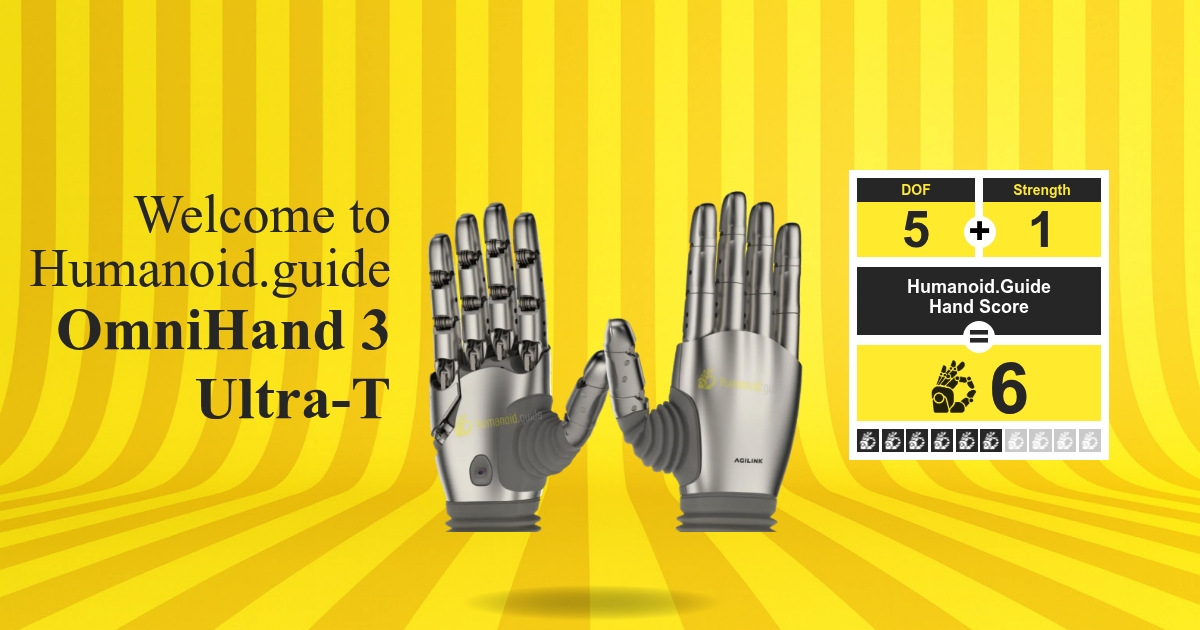
Welcome, OmniHand 3 Ultra T!
OmniHand 3 Ultra T is a capable robotic hand designed for close contact manipulation where dexterity and controlled gripping matter. Its overall Humanoid.Guide Hand Score of 6 places it in the capable or mature range. The hand receives a top tier rating of 5 out of 5 for degrees of freedom, indicating strong dexterity for expressive hand postures and nuanced object handling. Its strength rating of 1 out of 5 places force output in a lower tier, directing attention toward precision sensitive tasks rather than heavy duty gripping. OmniHand 3 Ultra T uses a tendon driven architecture with actuation mounted toward the rear, a layout intended to keep the hand portion compact and responsive. Five fingers provide a familiar human hand format for interaction with everyday objects, tools, components, and materials. The design emphasizes close range contact, carefully managed grasping, and repeatable manipulation. It is aimed at robotic systems that benefit from articulated finger motion and adaptable contact handling, including research platforms and industrial automation setups.
Technical emphasis centers on the relationship between its high degrees of freedom rating and its lower strength tier. This profile supports work in which finger placement, pose selection, contact timing, and controlled release carry more value than maximum gripping force. A tendon driven arrangement supports coordinated motion across the fingers while moving major actuation hardware away from the hand structure. The five finger configuration also gives developers a familiar basis for designing grasps around irregular objects and handling varied shapes. Suitable deployment contexts include component sorting, bench top assembly, laboratory manipulation, and research into contact rich robotic interaction. The 6 out of 10 overall score describes a mature level of hand capability, with dexterity as its clearest comparative advantage.
OmniHand 3 Ultra T is in production, positioning it as a hardware option for organizations seeking an articulated robotic hand rather than an early concept. AGILINK, Shanghai AGILINK Innovation Intelligent Technology Co., Ltd., manufactures the system in China. Its combination of a mature overall score and top degrees of freedom tier contributes to the continuing shift from simple industrial end effectors toward hands built for more varied object interaction. For system integrators, the product provides a focused platform for applications where the form and motion range of the hand influence task design. For researchers, it offers a commercial example of tendon driven hand engineering and articulated manipulation. Its significance lies in addressing contact focused work that demands richer finger motion, while prioritizing dexterity over high force output.