Welcome, OpenArm 02!
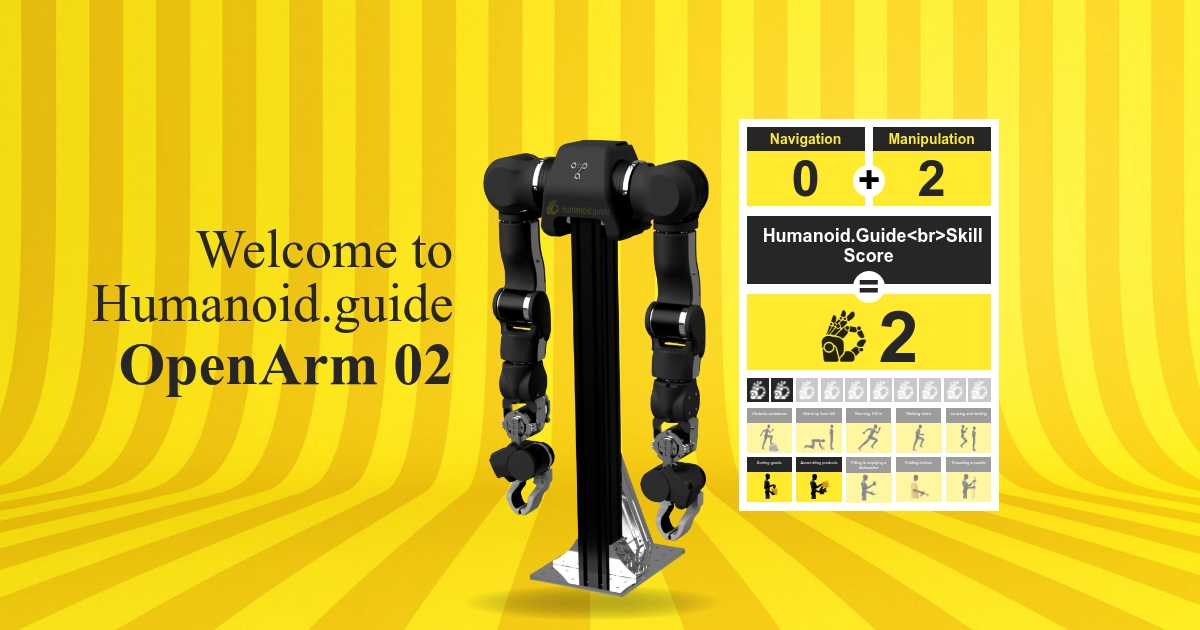
OpenArm 02 is a human scale robotic arm created by Tokyo based Enactic for physical AI research, teleoperation, and reproducible robot learning benchmarks. Built as a fixed workspace platform, it combines a humanlike arm layout with 14 overall degrees of freedom and two finger grippers. The 30 kilogram system is specified for 15 kilograms of strength and uses aluminum, stainless steel, and an aluminum frame. Quasi direct drive brushless motors, together with low ratio planetary gearboxes, support backdrivability and responsive control. An in hand RGB camera provides a close view of handled objects, while an optional ZED stereo camera can observe the workspace from above. OpenArm 02 is driven from a Linux host through ROS 2, SocketCAN, and a wired CAN FD control bus operating at one thousand cycles per second. Its total skill score of 2 places it at an early stage, with navigation rated 0 and manipulation rated 2 out of 5.
OpenArm 02 is designed for sorting goods and assembling products, two tasks that suit its teleoperated physical AI workflow. The system enables teams to collect repeatable demonstrations, build training datasets, and evaluate robot learning policies in a controlled workspace. Its in hand camera strengthens object focused data collection by observing items directly at the gripper, while the optional overhead stereo camera adds broader workspace context. The arm can connect with external vision language action models through frameworks such as Hugging Face LeRobot, with model inference running on the user’s own computing hardware. This arrangement gives researchers flexibility to pair the arm with different perception, control, and learning systems while retaining access to a consistent hardware platform for sorting and assembly experiments.
OpenArm 02 is in production and originates from Japan. Enactic positions the system as an open source platform, publishing CAD files, firmware, control code, and simulation tools so research teams can inspect, modify, and reproduce the full robotic stack. Organizations can build an arm themselves or purchase a fully assembled unit through manufacturers worldwide. This openness gives universities, laboratories, and embodied AI teams an alternative to closed robotic systems that restrict hardware access or software customization. By combining accessible mechanical designs with modern robot learning tools, OpenArm 02 supports broader experimentation in teleoperation, training data collection, and physical AI development.