
OpenArm 02
6 500 USD

OpenArm
An open-source, human-scale robotic arm from Tokyo’s Enactic, built for physical AI research, teleoperation, and reproducible robot-learning benchmarks.
Skill Score
 2
2

Specifications and details:
| Availability | In production |
|---|---|
| Nationality | Japan |
| Website | https://openarm.dev/ |
| Degrees of freedom, overall | 14 |
| Degrees of freedom, hands | 1 DoF grippers each hand |
| Height [cm] | N/A |
| Max speed (km/h) | 0 |
| Strength [kg] | 15 |
| Weight [kg] | 30 |
| Runtime pr charge (hours) | N/A |
| Safe with humans | Yes |
| CPU/GPU | N/A |
| Ingress protection | N/A |
| Camera resolution | Built-in in-hand RGB camera on the gripper (resolution unpublished), optional ZED-121210 stereo camera add-on for a top-down workspace view |
| Connectivity | CAN-FD control bus (1 kHz), wired — no built-in Wi-Fi/Bluetooth, networking depends on the host computer |
| Operating system | None onboard; driven from a Linux host (Ubuntu 22.04/24.04) via ROS 2 and SocketCAN |
| LLM integration | Compatible with external vision-language-action (VLA) models via Hugging Face's LeRobot and similar frameworks, run on the user's own compute |
| Latency glass to action | Not a fixed hardware spec — depends on the external AI model and host PC. The CAN-FD control bus itself runs at 1 kHz (1 ms cycle) |
| Motor tech | DAMIAO quasi-direct-drive (QDD) brushless motors (DM-J4310, DM-J8009P), plus one higher-torque non-QDD motor (DM4340) at the base joint |
| Gear tech | Low-ratio planetary gearboxes (9:1 to 40:1 depending on joint), which preserve backdrivability |
| Main structural material | Aluminum and stainless steel, with MISUMI aluminum-frame support pillars |
| Number of fingers | 2-finger gripping claws |
| Main market | physical-AI/embodied-AI teams worldwide — data collection, teleoperation, and VLA model training, Robotics research labs, universities |
| Verified | Not verified |
| Walking Speed [km/h] | 0 |
| Shipping Size | N/A |
| Manufacturer | OpenArm |
Description
Enactic builds OpenArm, and the Tokyo-based startup designed it as an open-source arm for physical AI research. Unlike closed commercial platforms, every part of OpenArm stays public: CAD files, firmware, control code, and simulation tools. Researchers can build their own unit, or buy one fully assembled from manufacturers worldwide. That openness sets OpenArm apart in a field where most hardware stays locked behind proprietary walls.
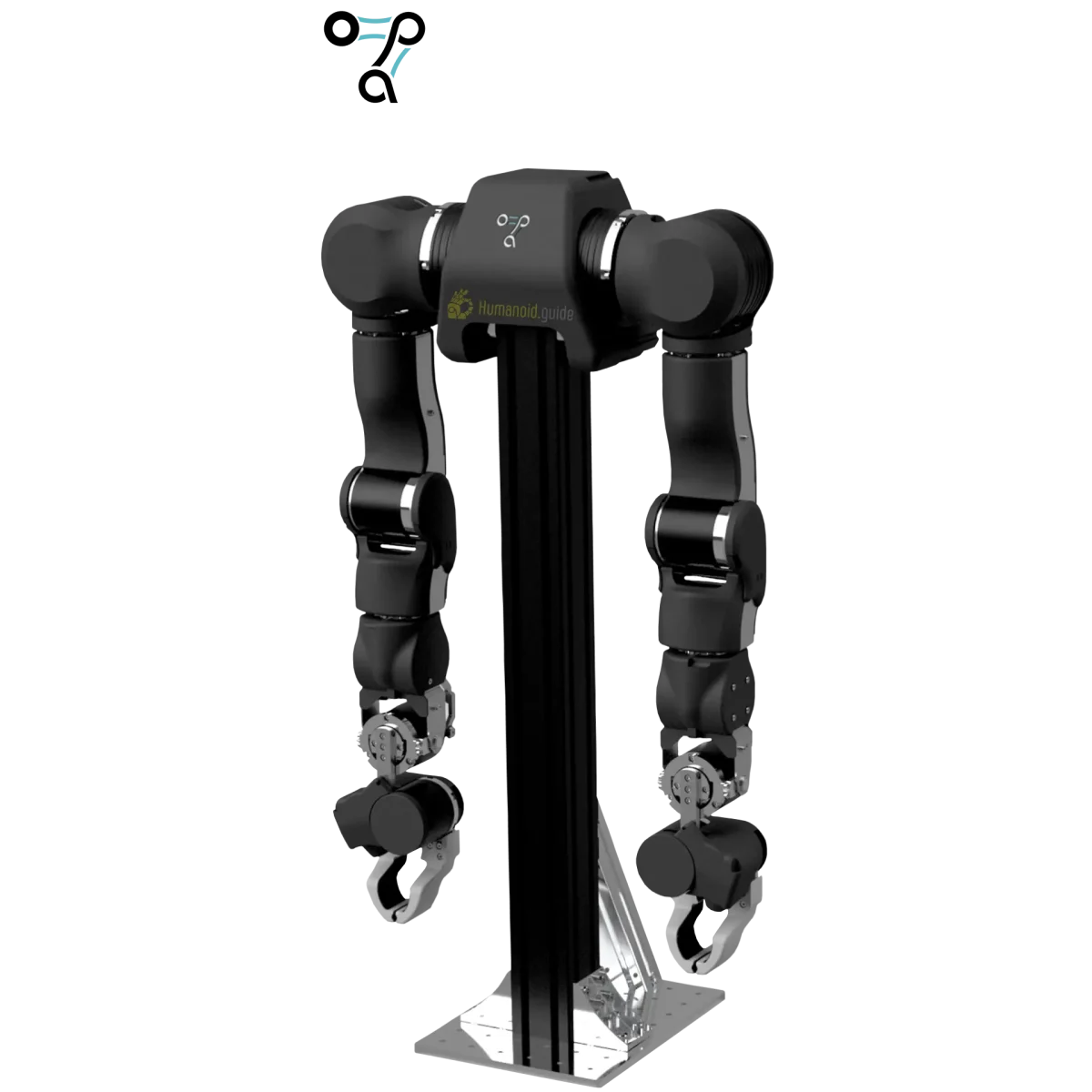
OpenArm looks and moves like a human arm, scaled to fit someone about 160 to 165 centimeters tall. Black aluminum segments form the arm itself, while a light aluminum frame holds it upright on a small base plate. A compact gripper sits at the end, with two parallel fingers and a tiny camera built right into the case. As a result, the in-hand camera lets it see exactly what it grips, sharpening data quality for AI training. OpenArm has no legs, wheels, or wings. Bolted to a table or bench, it stays fixed in one spot rather than roaming a room.
New! 2026 Humanoid
Robot Market Report
198 pages of exclusive insight from global robotics experts — uncover funding trends, technology challenges, leading manufacturers, supply chain shifts, and surveys and forecasts on future humanoid applications.

now Google DeepMind
Engineers built OpenArm mainly for two jobs: collecting robot training data and running fair, repeatable AI evaluations. Its backdrivable motors let it yield to touch, so operators can guide it by hand during teleoperation. OpenArm Cell, a standardized testing rig, lets teams compare AI models under identical lighting, camera angles, and starting positions. A separate accessory, OpenArm KER, adds a lightweight leader arm that mirrors the same joints for smoother, lower-fatigue control. Together, these pieces turn scattered lab experiments into results that other researchers can actually reproduce.
I’m Olivia, Humanoid Analyst at Humanoid.Guide
My mission, together with the team, is to help your organization understand the landscape, compare solutions, and move toward successful robot deployments.
OpenArm is already for sale, not just a lab prototype, unlike many research robots still stuck in development. Enactic partners with manufacturers in Japan, China, and Taiwan, and prices for a two-arm setup start around 6,500 dollars. That price undercuts most commercial research arms by a wide margin, since comparable proprietary hardware often costs several times more. Universities, robotics labs, and AI startups make up the core audience, especially teams building vision-language-action models. Enactic itself uses OpenArm as a stepping stone toward Ena, its own planned care-facility humanoid. So the open hardware doubles as the company’s own research backbone.
Download the Humanoid Robot Market Report here
Website: docs.openarm.dev