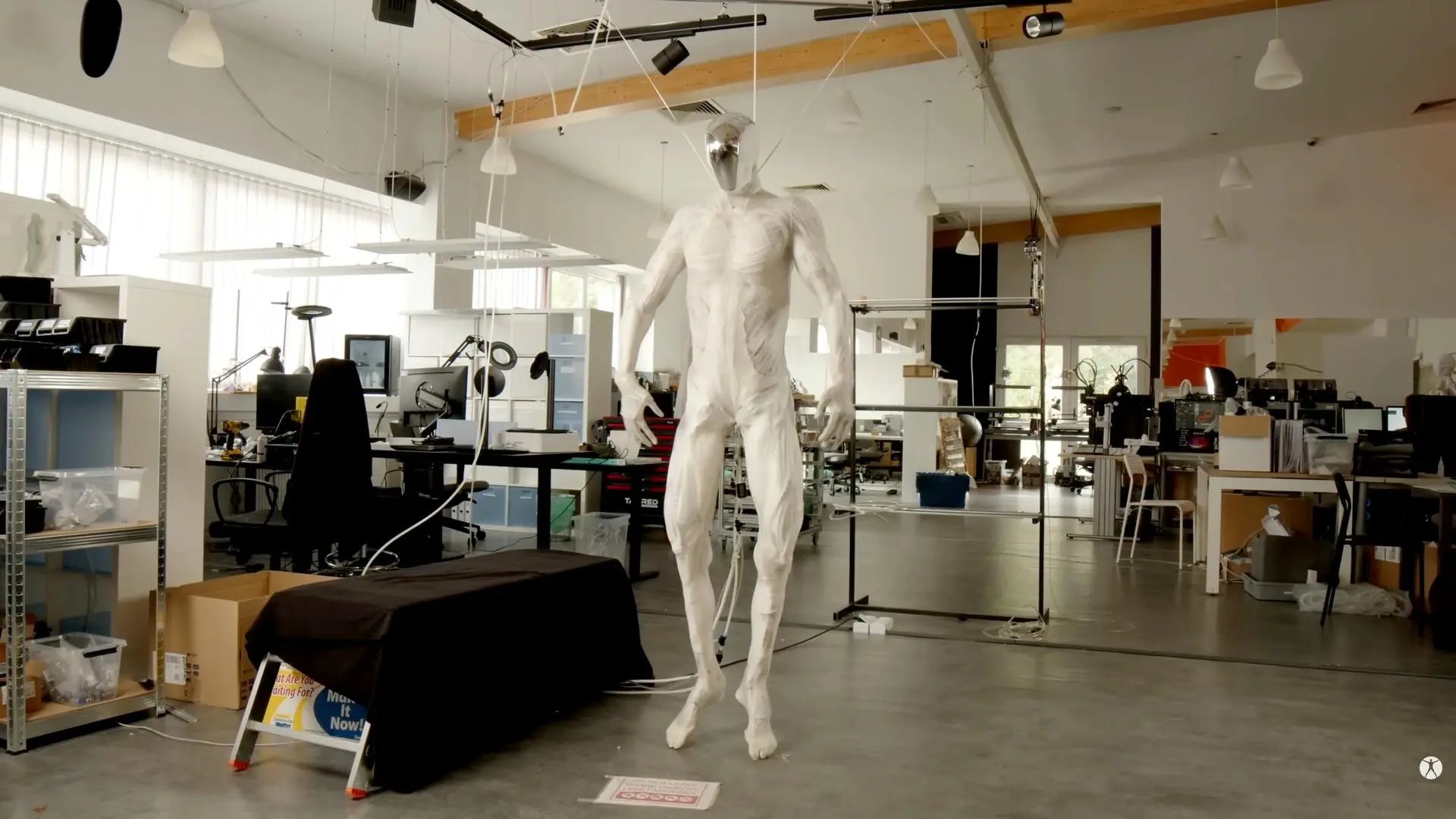
Clone Robotics details Protoclone V1 humanoid design
Clone Robotics’ Protoclone V1 is being presented as a full body humanoid built around a biomimetic architecture rather than the exposed rotary joints and rigid metal limbs common in many current platforms, according to Futura. The Warsaw based startup’s prototype uses a polymer skeleton, structural cables and synthetic muscle tendon units, with a reflective black mask covering the face.
The technical claim is clear enough, even if the public evidence remains thin. Futura says a 40 second video of the robot operating its limbs drew millions of views within hours, but the more relevant point for humanoid developers is the architecture underneath: Clone is attempting to reproduce human anatomy mechanically, not just humanoid appearance.
A musculoskeletal humanoid, not a conventional linkage design
Futura describes the Protoclone V1 as a full scale polymer chassis that replicates all 206 bones in the human body. The actuation system uses more than 1,000 Myofibers, described as synthetic muscle tendon units weighing 3 grams each, reacting in under 50 milliseconds and generating up to 1 kilogram of force.
The sensing layer is also dense. The source reports 500 integrated sensors monitoring joint position, localized torque, muscle length and structural force, with data feeding back into NVIDIA Jetson processing chips. Compared with source cited examples such as Boston Dynamics’ Atlas and Figure AI’s Figure 02, the difference is structural rather than cosmetic.
The current prototype uses a pneumatic setup driven by pressurized air. Clone’s roadmap, as reported by Futura, calls for a closed loop hydraulic system using water circulated by a 500 watt internal pump. The company frames that fluid driven system as a route to higher force output and finer adjustments across overlapping muscle groups.
“We’re not building tools, we’re building bodies.”Dhanush Radhakrishnan, Clone Robotics founder
Clone started with the hand
Clone Robotics was launched in 2021 by founder Dhanush Radhakrishnan and CTO Łukasz Koźlik, according to the article. The company started with $500,000 in angel funding and later increased its capital baseline to more than $7.1 million, with backers including Y Combinator co founder Trevor Blackwell.
The engineering sequence is significant for practitioners because Clone began with one of the hardest mechanical subsystems in humanoid robotics: the hand. Futura says the team spent 18 months reproducing the coordination of 27 bones and dozens of tendons before building a durable robotic arm with integrated artificial ligaments. Scaling the architecture to a full body chassis then took one additional year, according to the same report.
That approach is a sharp contrast with many industrial humanoid programs, which tend to optimize for robust electromechanical joints, maintainability and repeatable task execution. Clone is making the opposite bet: that copying biology can reduce mechanical design complexity and improve movement quality in human built environments.
Software is now the hard part
Futura reports that the first commercial version, called Clone Alpha, is entering a limited production run. The company’s roadmap points to a consumer facing household variant, with initial deployments aimed at industrial manufacturing, hospitality and assisted living facilities before private residences.
The article identifies software control as the main engineering blockage now that the physical hardware is stabilizing. Clone is building simulation tools to model how synthetic tissues interact under biological motion, then using a digital twin to run movement scenarios before transferring learned behaviors to the physical robot.
The control stack is described as a foundation model trained on human motion capture, egocentric video and direct teleoperation, rather than a system based only on rigid pre programmed commands. The open technical issue is whether the Protoclone V1 humanoid can turn its anatomical fidelity into reliable locomotion and manipulation outside controlled demonstrations.
Source: futura-sciences.com