Humanoid Robots Are Leaving the Demo Stage. Now Comes the Hard Part.
A new Bloomberg Primer episode captures the current humanoid moment: huge ambition, serious investment and a growing shift from polished demos to real industrial testing.
Humanoid Robots Move From Hype to Real Warehouse Work
Humanoid robots are no longer just viral clips, futuristic keynotes or carefully staged lab demos. A new Bloomberg Primer episode puts the industry’s central question into focus: can humanoids move from hype to useful work at scale?
The timing is important. Over the past two years, humanoid robotics has become one of the most closely watched areas in artificial intelligence. Investors are backing the idea that AI should not stop at screens, chatbots or software agents. It should eventually move through the physical world, using a body that can walk, lift, carry, sort, learn and adapt inside environments already built for humans.
That is the promise. Bloomberg’s episode makes clear that the reality is more complicated.
The shift from spectacle to work
The humanoid robot race has been dominated by impressive videos: robots walking, recovering from pushes, folding clothes, handling tools or moving boxes. These demos are useful because they show technical progress. But they do not answer the question that matters most to customers: can the robot work reliably, safely and economically for thousands of repetitions in a real facility?
This is where the industry is starting to change. The most meaningful humanoid deployments are not happening in living rooms. They are happening in warehouses, factories and logistics facilities where the tasks are repetitive, physically demanding and measurable.
That matters because industrial environments create a clearer test. A humanoid robot moving totes in a fulfillment center is not being judged by how futuristic it looks. It is being judged on uptime, safety, throughput, integration cost, error rate and whether it can fit into existing workflows without forcing a complete redesign of the building.
Why warehouses are becoming the first real test
Warehouses are a logical starting point for humanoid robots. They are built for people, but they also contain structured tasks that can be repeated, measured and improved over time. A robot does not need to solve every household problem to be valuable. It can start by doing one or two useful jobs consistently.
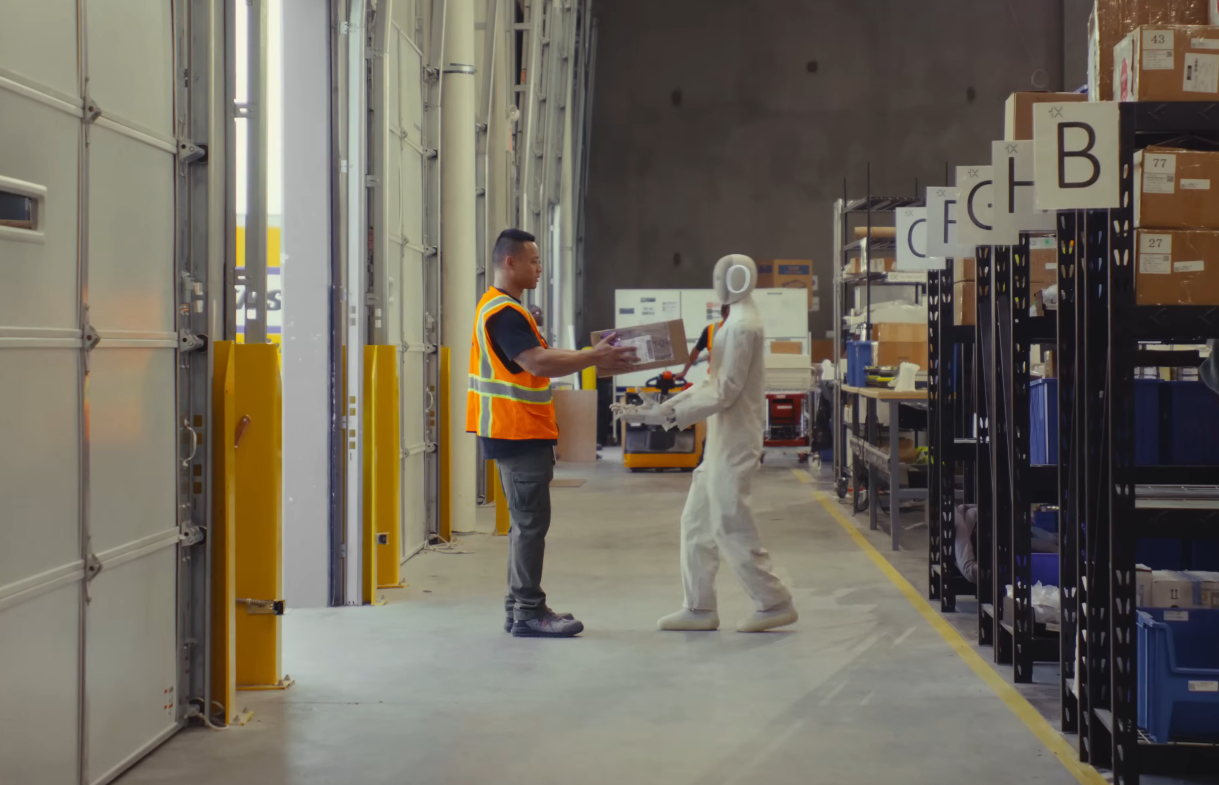
GXO Logistics has become one of the most visible examples of this transition. The company has trialed humanoid prototypes in live logistics environments and has described the technology as a potential way to take on repetitive and physically demanding work while letting human employees move into other roles.
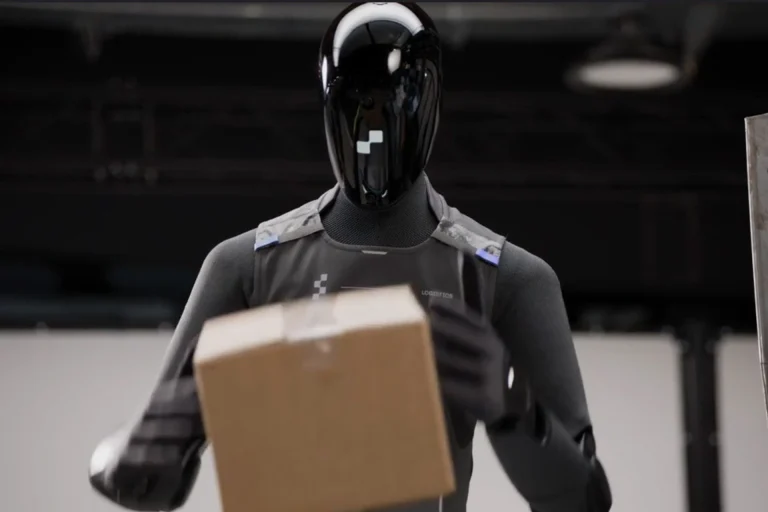
Agility Robotics’ Digit is one of the clearest examples of humanoids moving beyond novelty. The company has said Digit moved more than 100,000 totes at GXO’s Flowery Branch facility, a milestone that gives the sector something it badly needs: real operational evidence rather than another short demo clip.
This is why the Bloomberg episode is useful. It does not treat humanoid robots as either science fiction or an overnight revolution. It frames them as machines entering a difficult validation phase. The hype is still there, but the questions are becoming more practical.
The real bottleneck is not just hardware
A common assumption is that humanoid robotics is mainly a hardware race. Better actuators, batteries, sensors and hands are certainly important. But the deeper challenge is intelligence.
Robots need to understand the physical world in a way that software-only AI systems do not. A language model can be wrong and correct itself in text. A humanoid robot making a mistake while carrying a tote, stepping around a worker or handling a fragile object creates a very different kind of risk.
That is why data is becoming one of the industry’s biggest bottlenecks. Humanoid robots need vast amounts of training data from real and simulated environments. They need to learn how objects behave, how floors vary, how lighting changes, how people move nearby and how small errors can compound into failure.
Simulation is becoming a key part of the answer. Companies such as Agility Robotics use simulation and reinforcement learning to train whole-body control before deploying robots in real facilities. This can compress years of trial and error into faster training cycles, but the final exam still happens in the real world.
China, supply chains and the speed question
Another important theme is the role of global supply chains. Humanoid robots are not only AI products. They are manufactured machines with motors, joints, sensors, batteries, compute systems and precision components. The countries and companies that can produce these parts at scale may gain a major advantage.
This is one reason China is central to the conversation. Chinese robotics companies are moving quickly, supported by strong manufacturing ecosystems, aggressive hardware iteration and a growing domestic market for automation. Western companies may still lead in some areas of AI, software and industrial partnerships, but humanoid robotics will likely be won by teams that can combine software intelligence with manufacturing discipline.
That makes the race different from the chatbot boom. In humanoids, a breakthrough model is not enough. The winner needs a supply chain, a service model, a safety case, customer support and machines that can survive daily work.
What still needs to be proven
The biggest misconception about humanoid robots is that human shape automatically means human capability. It does not.
Walking on two legs is hard. Manipulating unfamiliar objects is harder. Doing both safely around people, all day, with predictable economics, is harder still.
The industry still needs to prove several things before humanoids become common in workplaces:
- Reliability: robots must work for long periods without frequent intervention.
- Safety: they must operate near people without creating unacceptable risk.
- Cost: the business case must compete with human labor, fixed automation and simpler mobile robots.
- Generalization: robots must learn new tasks without months of custom engineering.
- Maintenance: customers need service models that work at industrial scale.
These are not small hurdles. They are the difference between a compelling prototype and a useful product.
The second wave looks more serious
Humanoid robots have had hype cycles before. The difference now is that several enabling technologies have matured at the same time. AI models are stronger. Simulation tools are better. Components are improving. Investors are more willing to fund long development cycles. Customers in logistics and manufacturing are under pressure to automate repetitive work.
That does not mean humanoid robots are ready to transform every workplace. It means the sector has moved into a more serious phase. The next few years will likely separate companies with polished demos from companies with machines that can generate measurable value.
Bloomberg’s Primer episode captures this moment well. The humanoid robot industry is still full of ambition, but the conversation is becoming more grounded. The winners will not be the robots that look best on video. They will be the robots that can show up, perform useful work, collect better data, improve over time and make economic sense for customers.