Humanoid factory deployment expands at Schaeffler through 2032
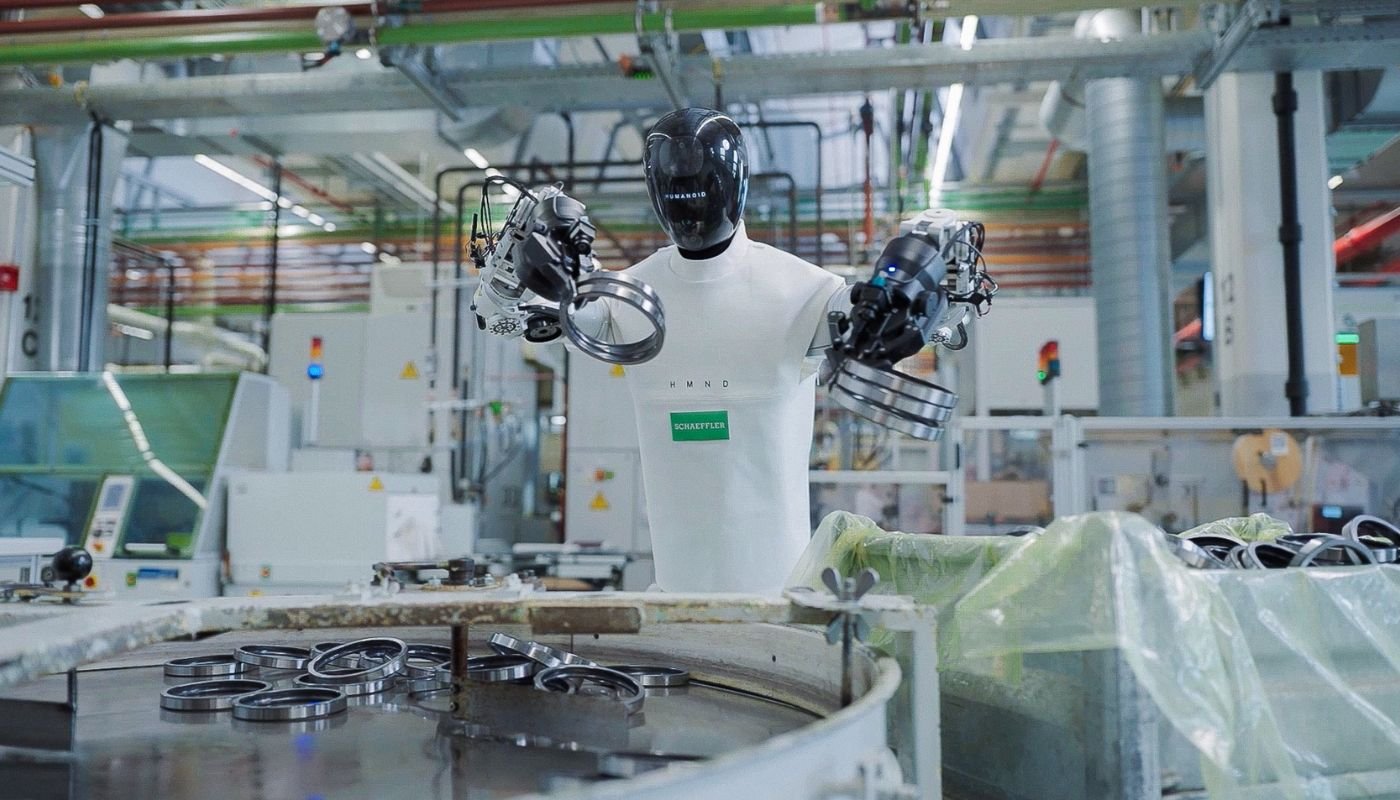
The Humanoid factory deployment at Schaeffler is moving from proof of concept to a binding rollout, with more than 1,000 humanoid robots planned across the manufacturer’s global operations by 2032. The London-based startup Humanoid says the first units are expected to begin work in live production environments in Germany before the end of 2026, marking a shift from pilot work to contracted factory use.
How the Humanoid factory deployment begins
As eWeek reports, the agreement covers a staged rollout that starts with two Schaeffler factories in Germany and then expands toward global integration by 2032. The companies say the partnership builds on earlier proof-of-concept work and now moves into what they describe as full industrial validation.
The first deployment phase is scheduled to run from December 2026 to June 2027. At Schaeffler’s Herzogenaurach site, the robots will be tested on box-handling tasks inside active production lines, while the Schweinfurt facility will begin with a structured testing phase followed by on-site validation aimed at stable, near-full-scale operations.
The practical question is whether these systems can work reliably in live manufacturing conditions rather than controlled lab settings. Reuters, cited by eWeek, reported that the initial deployment is estimated at 1,000 to 2,000 robots across Schaeffler’s global manufacturing sites by 2032.
Service model and factory integration
The agreement is structured as Robot-as-a-Service, which means Schaeffler is not only receiving hardware. According to the source, the package also includes software, maintenance, fleet management tools, updates, and 24/7 technical support from Humanoid.
That service structure matters because deployment inside an operating factory depends on more than the robot itself. Humanoid is also expected to integrate the systems into Schaeffler’s existing safety standards, IT infrastructure, and production workflows, which is often where industrial robotics projects face delays or added cost.
Humanoid founder and CEO Artem Sokolov said the company had already seen strong results from the earlier proof of concept and that the next step is staged deployment in real operations. His framing is consistent with the broader test now underway, whether humanoid robots can produce value inside normal production environments rather than in isolated demonstrations.
Supply agreement points to larger scale
Alongside the deployment plan, the companies also signed a five-year actuator supply agreement. Under that arrangement, Schaeffler becomes Humanoid’s preferred supplier for more than half of its joint actuator needs for wheeled humanoid platforms through 2031, with the deal expected to result in a seven-figure number of actuators.
eWeek notes that this component agreement may be as important as the robot rollout itself because it signals intended manufacturing scale. The article also cites Forbes, which said analysts interpreted the actuator volume, at least one million units, as enough to support up to 100,000 humanoid robots over the coming years, though that remains an extrapolation from parts supply rather than a stated deployment commitment.
Even without adopting the higher analyst estimate, the actuator contract changes the discussion from site pilots to production planning. For suppliers and factory operators, that suggests Humanoid and Schaeffler are trying to address both deployment and the upstream component base needed for broader rollout.
What comes next for Schaeffler’s rollout
After the initial 2026 to 2027 phase, the companies plan to extend deployment into additional factory processes, including more complex tasks such as assembly and packaging. The full agreement runs through 2032, leaving several years for Humanoid to improve reliability, autonomy, and cost efficiency before reaching the full contracted scale.
For the humanoid sector, the near-term signal is not simply that another factory pilot has been announced. The more important test is whether a long-duration service agreement, tied to factory integration and component supply, can keep humanoid systems running inside active plants. Results from the first two German sites are likely to determine how quickly this rollout expands across more processes and regions.
Source: eweek.com