XPENG demonstrates IRON humanoid’s social interaction stack
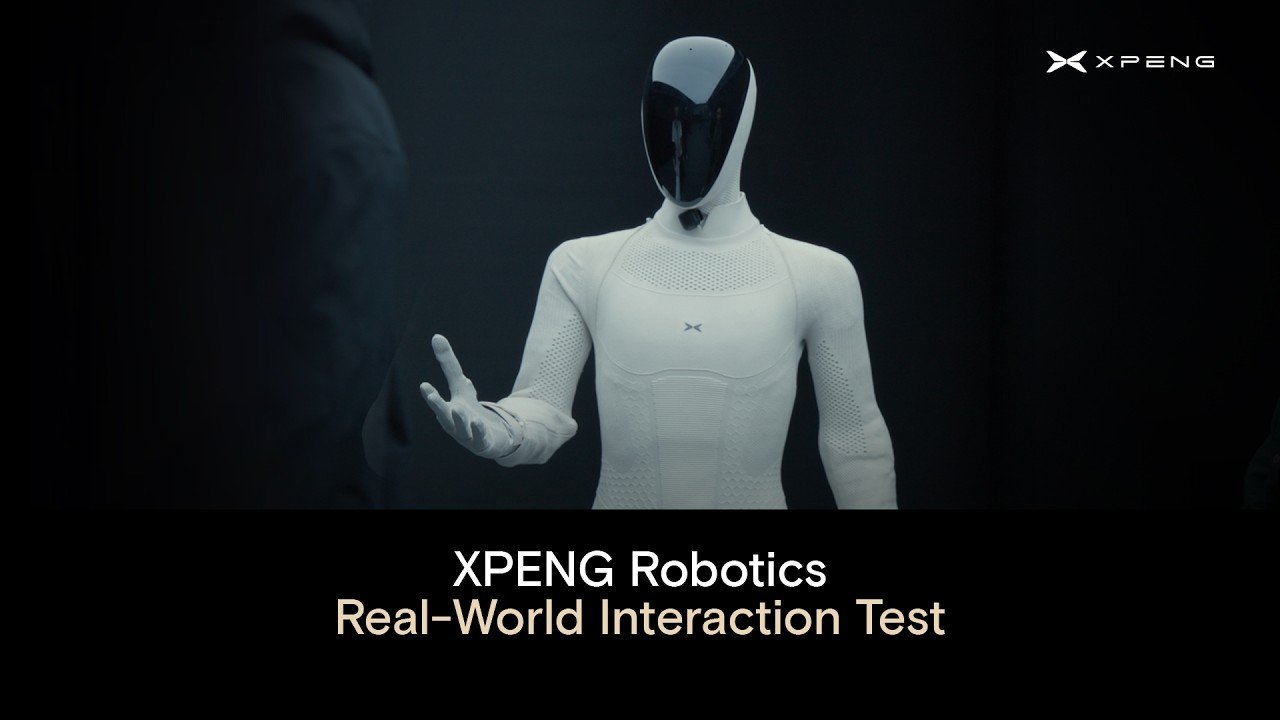
XPENG has demonstrated an interaction system for its IRON humanoid that tracks speakers, changes languages without a separate instruction and recalls people after they swap clothes and positions. In a video published on the company’s YouTube channel, IRON held sales conversations with three testers in Chinese, English and German while adjusting its head, waist and body toward the active speaker.
The controlled studio presentation is a company demonstration rather than an independent evaluation. It nevertheless gives a detailed view of the perception, compute and memory components XPENG intends to use when placing the robot in customer facing roles. The company said store guide work will be among IRON’s first jobs, although it did not provide a deployment date.
Speaker tracking coordinates audio, vision and motion
For orientation tracking, XPENG said a nine microphone array estimates the direction of incoming speech. A multimodal system then uses lip movement to identify the speaker, while a tracking policy coordinates the robot’s head, waist and legs.
The video shows IRON making small head turns, larger waist movements and full body turns as testers change position. In some cases, it steps toward a speaker instead of rotating in place. The demonstration focuses on making the robot’s posture less abrupt during conversation, a practical concern for humanoids expected to operate around customers or coworkers.
XPENG attributes this behavior to coordination across acoustic perception, computer vision and motion control. The video does not quantify tracking accuracy, response latency or performance with background noise and larger groups.
Multilingual responses and persistent identity profiles
IRON also responds in the language used by each tester, including switching between Chinese, English and German. XPENG said the capability combines a multilingual foundation model, post training and a balanced multilingual training dataset. No additional spoken command was used to trigger the language changes in the demonstration.
The identity test was more demanding. After the three participants changed clothing and positions, IRON continued associating each person with an earlier vehicle preference. It also corrected one tester who introduced himself using another participant’s name.
According to XPENG, IRON creates a digital memory profile by combining facial characteristics, voiceprints and conversation content, then updates that profile during later interactions. The company did not explain retention limits, enrollment requirements or how such profiles would be managed in a public deployment.
Three Turing chips provide local robot compute
XPENG said IRON carries three locally deployed, in house Turing chips with combined effective compute of 2,250 TOPS. The system can query a local knowledge base or retrieve information online, according to the company, supporting product recommendations informed by previous conversations.
The demo was built around vehicle sales, with IRON recalling family size, camping needs and parking concerns before recommending XPENG models. This makes the intended application unusually explicit, but the clip does not establish how the interaction stack performs through a full working day, in a busy store or without a prepared set of participants and topics.
Source: youtube.com – XPENG