Welcome, YMBot H!
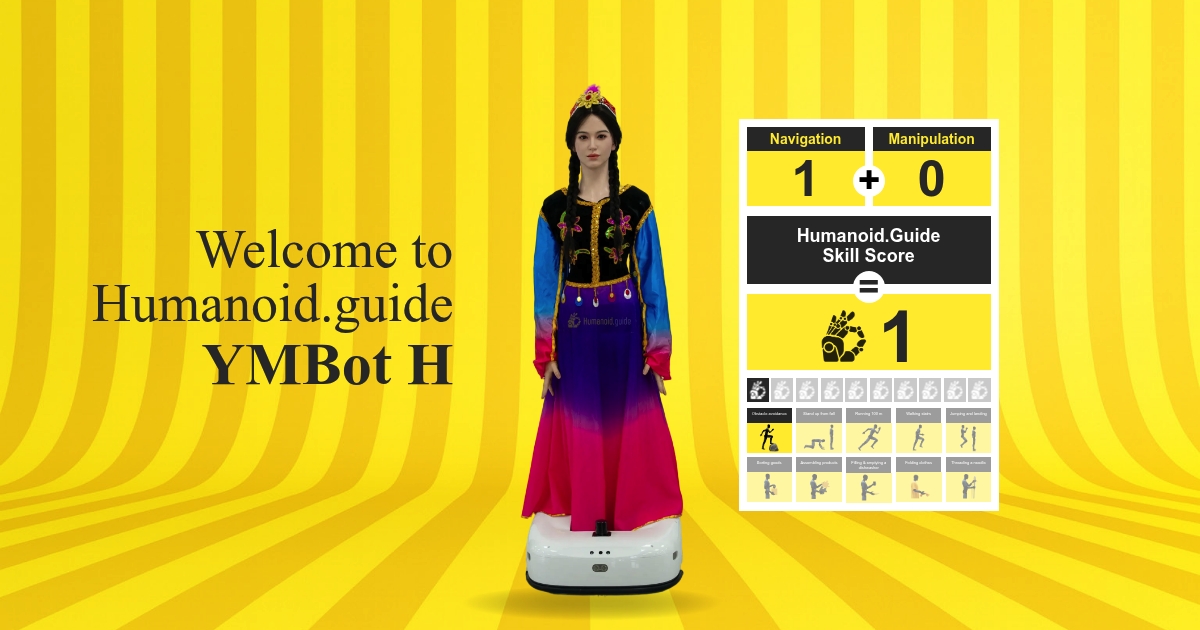
YMBot H is a wheeled humanoid service robot developed by Jiangsu Yunmu Intelligent Manufacturing Technology Co., Ltd. in China. Designed for visitor engagement in public spaces, it combines a humanlike appearance, dual robotic arms, and a mobile base rather than legs. The robot stands 170 centimeters tall and weighs 75 kilograms, giving it a substantial physical presence for reception areas and exhibition settings. Its listed maximum speed is 5.4 kilometers per hour, with a runtime of six hours per charge. Each hand has five fingers, for ten fingers overall. Obstacle avoidance is its confirmed physical capability. Its Humanoid.Guide Skill Score is 1 out of 10, placing it in the early stage of capability development. Navigation is rated 1 out of 5, while manipulation is rated 0 out of 5. These ratings distinguish its humanoid form from demonstrated task performance, positioning it as a preliminary service platform rather than a mature general purpose robot.
Obstacle avoidance is the central confirmed capability for YMBot H in shared indoor environments. For settings such as museums, science centers, shopping malls, and automotive showrooms, this function addresses a practical concern: obstacles within spaces occupied by visitors and staff. Its wheeled configuration distinguishes its mobility from the legged movement associated with many humanoid designs. The navigation rating remains at an early tier, so obstacle avoidance should not be equated with comprehensive autonomy or advanced performance in complex environments. Likewise, the presence of two arms and fingered hands does not establish practical manipulation proficiency. The clearest technical emphasis is therefore a mobile humanoid format with obstacle avoidance, rather than a broad repertoire of demonstrated physical tasks.
YMBot H is listed as a prototype, with an advertised price of USD 35,000 and an option to inquire about pricing. Its intended markets include visitor reception, museums, science centers, shopping malls, and automotive showrooms. These settings reflect a service oriented direction for humanoid development, where appearance and a mobile physical presence are central to the proposed application. The platform also lists CAN bus connectivity and an interface compatible with ROS 2, providing technical context for organizations evaluating integration requirements. Its broader significance lies in the distinction between humanoid appearance and demonstrated capability: YMBot H presents a recognizable humanlike format, while its current score places its physical skill development at a preliminary stage.