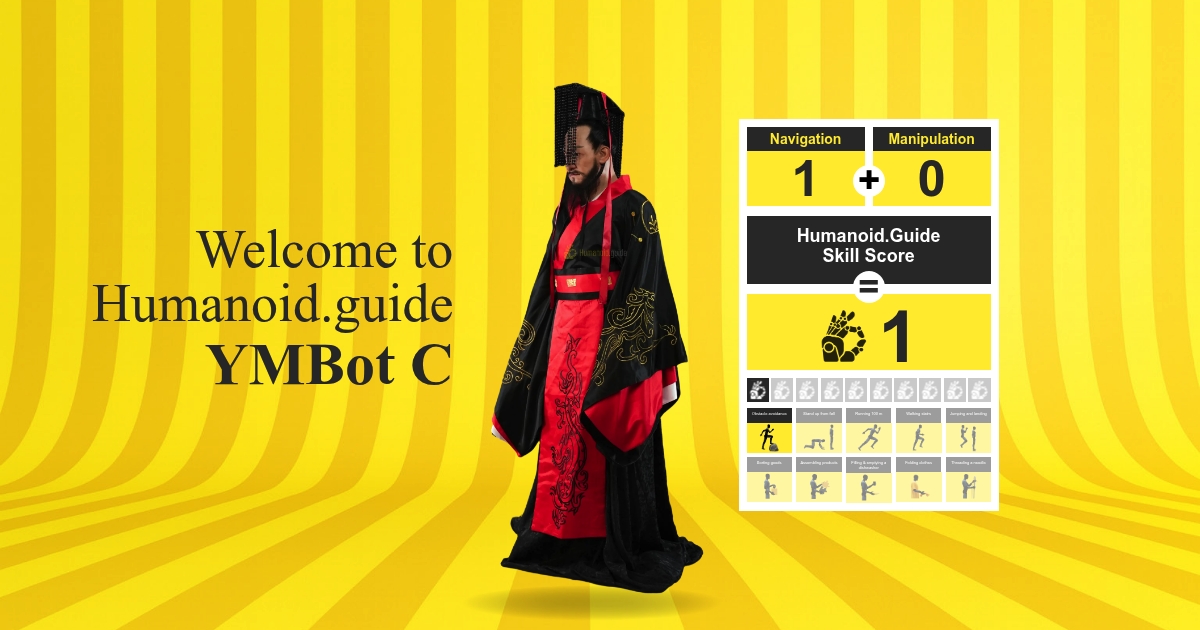
Welcome, YMBot C!
YMBot C is a full size bipedal humanoid developed by Jiangsu Yunmu Intelligent Manufacturing Technology Co., Ltd. for cultural tourism, exhibitions, museums, science centers, and visitor engagement. Standing 174 centimeters tall and weighing 75 kilograms, it combines a humanlike exterior with two arms and hands containing five fingers each. Its lifelike skin and human proportions give it a distinctive physical presence for public display. Listed specifications include a maximum speed of 3 kilometers per hour and a strength figure of 1 kilogram. Obstacle avoidance is its confirmed navigation capability. Its overall Humanoid.Guide Skill Score is 1 out of 10, placing it in the early stage category rather than among mature general purpose humanoids. Navigation receives a tier rating of 1 out of 5, while manipulation is rated 0 out of 5. These ratings distinguish its humanlike appearance and physical configuration from demonstrated functional maturity, making it important to evaluate the robot as a preliminary platform with a narrow confirmed capability set.
Obstacle avoidance is the central confirmed capability for YMBot C, and the most relevant technical feature when considering its movement through exhibition spaces. For museums, science centers, and cultural tourism venues, evaluation can focus on how consistently this function performs around display fixtures and changing visitor positions. Its navigation rating of 1 out of 5 signals an early level of development, not comprehensive autonomous mobility. Likewise, the presence of arms and ten fingers should not be confused with demonstrated practical manipulation, which carries a rating of 0 out of 5. A useful demonstration would therefore prioritize observable obstacle avoidance performance within a clearly defined route and operating environment, rather than treating its humanoid form as evidence of broader task competence.
YMBot C is listed as a prototype from China, with a displayed price of USD 60,000. Its manufacturer, Jiangsu Yunmu Intelligent Manufacturing Technology Co., Ltd., positions it for cultural tourism and exhibition settings where physical appearance is an important part of the visitor experience. Prototype status is a significant consideration for prospective buyers, who should establish delivery terms, support arrangements, and acceptance criteria before committing to a deployment. More broadly, YMBot C illustrates the distinction between creating a recognizable humanlike robot and achieving mature physical autonomy. Its significance lies in bringing a lifelike humanoid format into consideration for public venues, while its low overall skill score keeps expectations anchored to an early stage platform rather than a broadly capable robotic worker.