Welcome, XPENG VLA 2.0!
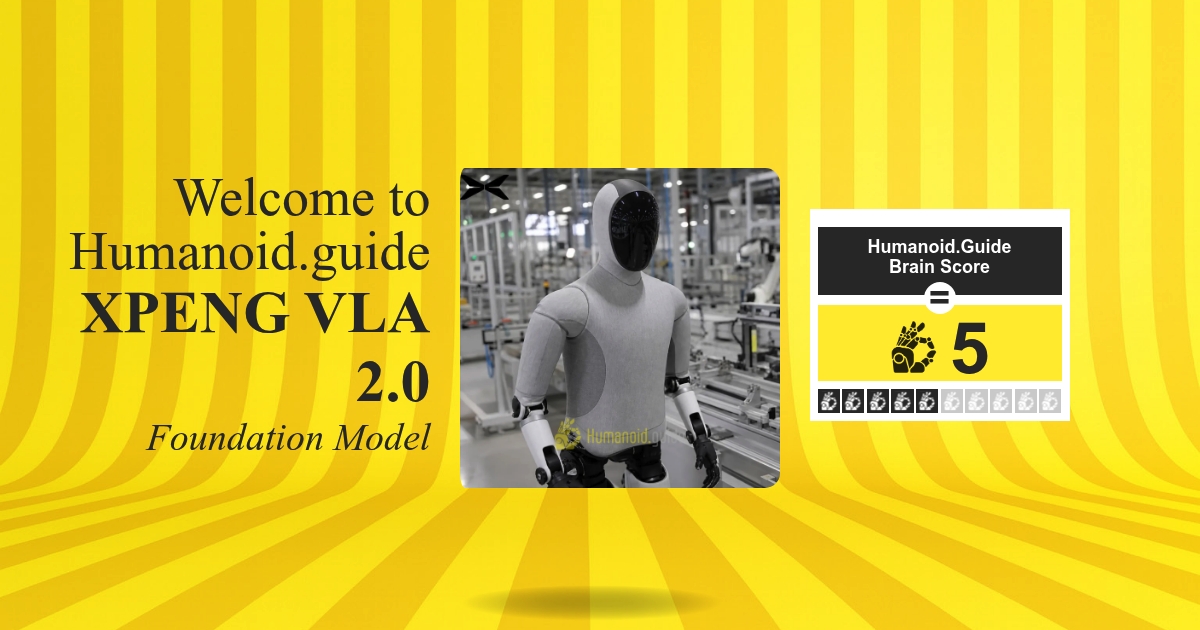
XPENG VLA 2.0 is a proprietary software foundation model developed by XPENG, the Chinese electric vehicle manufacturer. Introduced at the company’s AI Day in Guangzhou on November 5, 2025, it forms part of XPENG’s broader investment in artificial intelligence for physical systems. The model belongs to a software stack rather than being a standalone robot or a piece of mechanical hardware. XPENG positions it across its automotive and robotics programs, including smart cars, robotaxis and the IRON humanoid platform. Its development draws on nearly 100 million clips of real driving video, giving the project a substantial automotive training foundation. The company describes VLA 2.0 as its first large model built for mass production, placing industrial deployment at the center of its positioning. A Humanoid.Guide Brain Score of 5 out of 10 places it in the developing range. That rating supports a measured assessment: this is an evolving foundation model associated with an established vehicle manufacturer, not evidence of comprehensive robotic intelligence or universally proven performance.
The technical context centers on training data, computing hardware and integration within a larger software system. XPENG identifies its own Turing AI chips as the computing platform for deployment within IRON. In that setting, VLA 2.0 sits alongside separate AI systems assigned to other functions, making the overall architecture important when evaluating the model’s role. The nearly 100 million driving video clips also establish the origin of its reported training material, rather than demonstrating equivalent results across every robotics environment. For prospective integrators, relevant evaluation questions include hardware requirements, interfaces, validation procedures and the distinction between automotive training experience and performance in a particular robot deployment.
XPENG plans to share VLA 2.0 with business partners, starting with Volkswagen. This places the model within a broader commercial strategy that extends beyond XPENG’s own branded products. The listing marks it as available on backorder and displays a price of zero dollars, but those storefront details do not establish an unrestricted public release, an open source license or free commercial deployment rights. Its proprietary status remains an important distinction for organizations considering access and integration. More broadly, the project illustrates how an automotive manufacturer is bringing its computing hardware, training resources and robotics investments into a shared AI initiative. Its significance lies in that industrial convergence and partnership direction, while its developing score calls for measured expectations.