Welcome, Xiao Di!
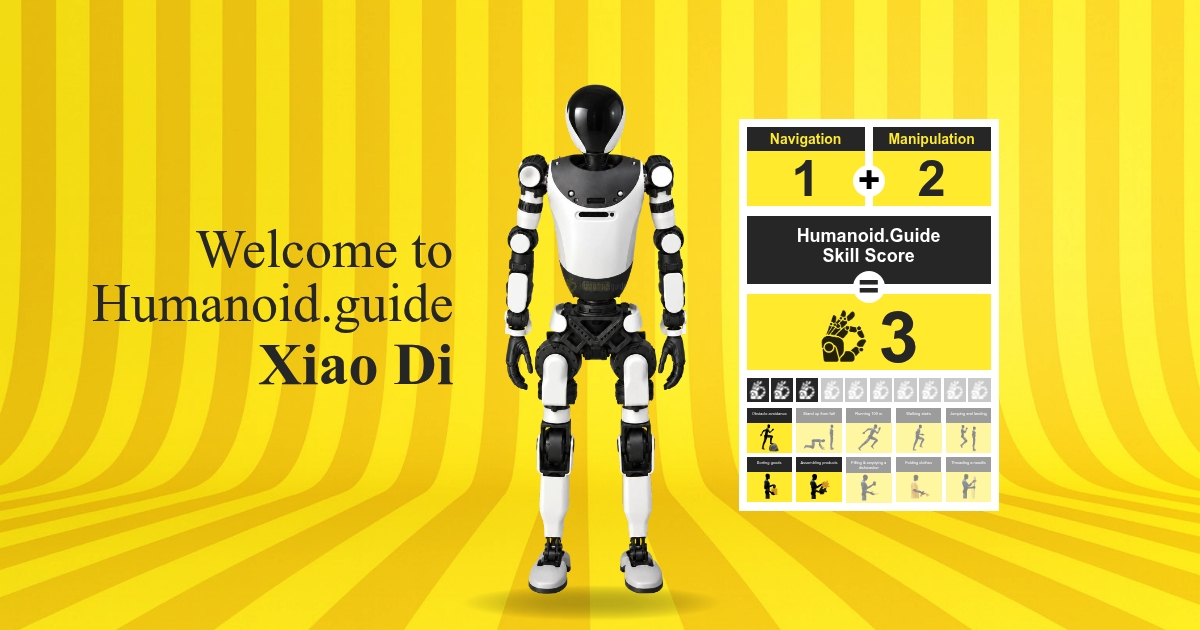
Xiao Di is BYD’s first self developed humanoid robot, designed for customer interaction in car dealerships and positioned for education, service, and industrial applications. Standing 161 cm tall and weighing 58.5 kg, it combines a humanlike body layout with a restrained black and white exterior. Rounded joints at the shoulders, elbows, hips, and knees give its structure a distinctive appearance, while its rounded head has no screen, eyes, or mouth. Its specifications list 31 degrees of freedom and ten fingers, with five on each hand. Maximum travel speed is listed as 4 km/h, runtime per charge as four hours, and strength as 2 kg. Xiao Di has an overall skill score of 3 out of 10, placing it in the developing category. Its Navigation rating of 1 out of 5 and Manipulation rating of 2 out of 5 indicate an emerging platform with a stronger relative emphasis on handling tasks than on navigating its surroundings.
Obstacle avoidance, sorting goods, and assembling products define Xiao Di’s listed practical capabilities. Obstacle avoidance supports movement around physical obstructions, an important consideration for a humanoid intended for spaces shared with people and equipment. Sorting goods connects its manipulation abilities to organizing objects, while assembling products extends its task scope to bringing components together. These capabilities align with potential applications in service environments, educational demonstrations, and industrial task development. Its ratings remain important context: Navigation sits in a lower tier, and Manipulation is also developing. The combination therefore supports a measured assessment of task coverage rather than a claim of advanced autonomy, precision assembly, or unrestricted operation across varied environments.
Xiao Di is listed as a prototype, with a displayed price of USD 25,000 and an inquiry option for prospective buyers. Its manufacturer is BYD Company Limited, the Chinese automaker expanding its work into embodied artificial intelligence. BYD established a dedicated embodied AI research team in 2022, placing this robot within a broader internal development effort. The dealership setting gives the project a concrete commercial context through customer greeting and vehicle explanation. Education, service, and industrial uses are also named target markets. Its broader significance lies in an automaker developing a humanoid platform for applications beyond vehicles, while its prototype status and developing skill score distinguish current maturity from wider commercial ambition.