Welcome, TRON 2!
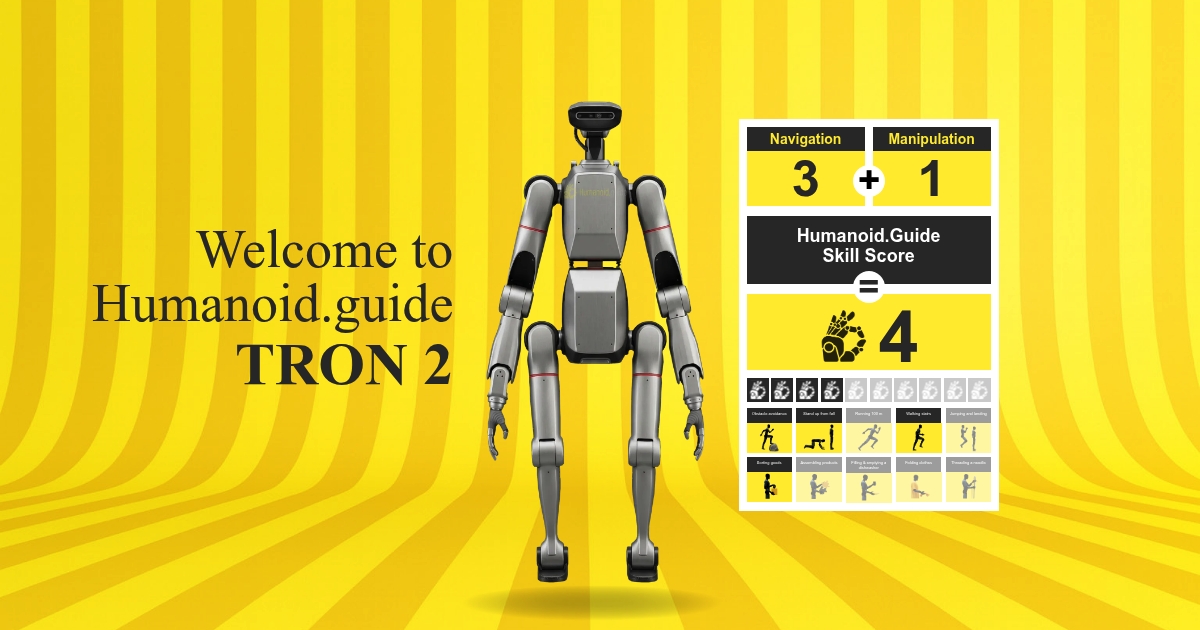
TRON 2 is a modular embodied robot from LimX Dynamics, designed for research, education and industrial prototyping. Its configurable architecture lets users switch between dual arm, bipedal and wheeled leg forms, giving laboratories several experimental configurations within one platform. The robot measures 132 cm in height, weighs 35 kg and lists a maximum speed of 18 km/h, a strength specification of 10 kg and a runtime of four hours per charge. Its aluminum alloy and plastic structure houses electric joint actuators developed by LimX. Each arm offers seven degrees of freedom, while standard grippers provide two fingers, with optional dexterous hands offering five. RGB depth cameras are positioned at the head, waist and wrists. TRON 2 has an overall skill score of 4 out of 10, placing it in the developing category. Its Navigation rating of 3 out of 5 exceeds its Manipulation rating of 1 out of 5, indicating a platform currently stronger in mobility than in object handling.
TRON 2 supports obstacle avoidance, standing up after a fall, walking stairs and sorting goods. Together, these capabilities provide a practical foundation for studying mobility and basic manipulation in research settings. Obstacle avoidance supports experiments involving movement around physical barriers, while stair walking enables investigation of transitions between different floor levels. Recovery after a fall adds another dimension to locomotion research, allowing teams to examine how a robot returns to an upright position after losing balance. Sorting goods provides a concrete manipulation task for evaluating object handling workflows. These functions suit structured experiments in which researchers assess navigation and manipulation separately, then explore how the two interact within a shared task environment.
TRON 2 is in production, with a listed price of USD 37,700. Developed by Shenzhen based LimX Dynamics and launched in December 2025, it follows the company’s TRON 1 platform. Its broader significance lies in combining configurable hardware with tools intended for embodied AI development. The Linux based system supports ROS 1 and ROS 2, while the EDU configuration includes an Intel Core Ultra development module and 2 TB of storage. Wireless VR teleoperation and a native VLA data pipeline support research workflows connecting operator demonstrations with model development. For universities and robotics teams, the modular design offers a way to investigate multiple robot configurations without treating every configuration as a separate hardware purchase.