Motion demonstrates Galbot S1 palletizing at Slush summit
Motion demonstrated the Galbot S1 palletizing robot at the Industrial Renaissance Summit in Helsinki on November 19, 2026, as speakers examined factory applications for physical AI. Hosted by Extantia and Google Cloud during Slush, the event covered robot deployment, workforce shortages and industrial automation, according to Robotics Norway’s account.
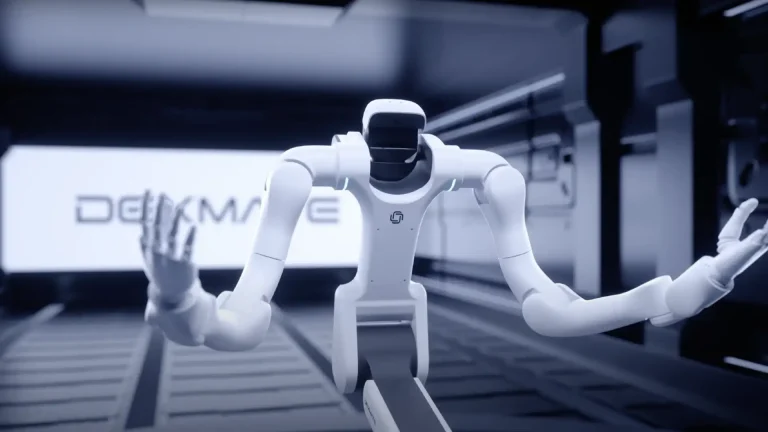
Alexander Stevens of Brussels based Motion presented the robot stacking grey crates on stage. He described the Galbot S1 as weighing 320 kilograms with a 50 kilogram payload, and said it uses lidar to slow down near people. Stevens called its payload the heaviest on the market.
The demonstration was accompanied by a more practical discussion of how robots reach customer sites: assessing tasks, training operators, managing safety and providing remote support. Those operational details were a substantial part of Motion’s presentation, alongside the hardware.
Leasing robots and managing deployment
Stevens presented MotionOS, built on Google Cloud and Gemini, as a software platform covering task qualification from customer video, digital twin planning, VR training, safety certification and fleet management. Motion trains operators using cameras and AR glasses and supports sites through remote teleoperation, he said.
The company leases its robots, which Stevens said cost €100,000 to €150,000 (about $110,000 to $165,000) today. He also said Motion had grown from six to 50 customers within two months of announcing its pre seed funding. Its customer mix is 40 percent food and beverage, 30 percent heavy industry and 30 percent warehouse logistics.
Motion begins deployment discussions with trade union presentations, according to Stevens. He argued that robots address labour shortages and can restock warehouses overnight without requiring people to work night shifts.
Tracking factory activity and training models
The summit also brought together Jan-Erik Solheim of Malmö based STAIR and Fabian Kurz of Copenhagen based Qualia. Solheim described STAIR’s spatial intelligence layer as tracking robots, trucks and goods flows in real time. Kurz said Qualia trains foundation models for robotics companies working in manufacturing, agriculture and hospitals.
Kurz argued that giving robots human names can be practical because people readily anthropomorphize them, but that a human appearance is unnecessary. The discussion put task execution and integration alongside the humanoid form factor, rather than treating appearance as the central requirement.
Stevens said the Galbot S1 demonstrated at the summit is scheduled to ship to a warehouse customer in Belgium the following week.
Source: roboticsnorway.org