Welcome, CYBORG W01!
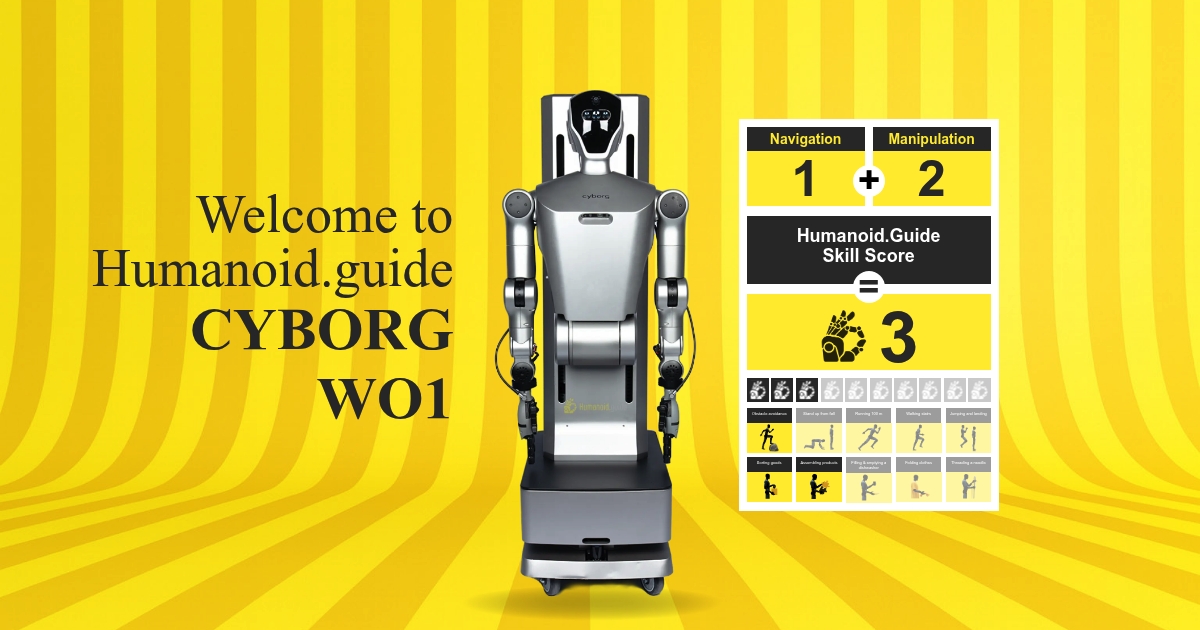
CYBORG W01 is a wheeled humanoid robot from Cyborg Robotics in Guangdong, China, designed for industrial environments where mobile manipulation supports sorting goods and assembling products. Standing 160 cm tall and weighing 170 kg, it combines a mobile base with articulated arms and hands featuring five fingers each. Its mechanical configuration includes 53 degrees of freedom overall and 16 degrees of freedom in its dexterous hands, with a stated payload of 15 kg across both arms. Maximum travel speed is 3.6 km/h, and listed runtime is five hours per charge. An aluminium and magnesium alloy structure uses topology optimization, while joint motor modules deliver a maximum joint torque of 562 newton metres. The onboard perception platform combines a processor with 12 cores and 275 TOPS of compute. Its overall skill score of 3 out of 10 places it in the developing category, with navigation rated 1 out of 5 and manipulation rated 2 out of 5.
Obstacle avoidance, sorting goods, and assembling products define CYBORG W01’s supported capability set. Its sensing equipment includes ultrasonic radar, infrared sensors, LiDAR, a monocular camera, an RGB depth camera, and a 3D camera. Together, these provide environmental and object information relevant to navigating around obstacles and positioning the arms for manipulation. Cyborg’s OMCI system coordinates the robot’s body, while its proprietary large model supports task generalization. For sorting and assembly applications, the combination of dexterous hands, paired arms, and onboard compute brings perception and physical interaction onto one platform. Connectivity includes 5G, Bluetooth 5.2, Gigabit Ethernet, USB 3.0, WiFi 5, and DisplayPort, providing several interfaces for integration with surrounding equipment.
CYBORG W01 is listed as in production, with an advertised price of USD 60,000 and an inquiry option for prospective buyers. Its broader significance lies in combining wheeled mobility and humanoid manipulation for industrial sorting and assembly rather than pursuing legged movement. The platform brings cameras, proximity sensing, articulated hands, and substantial onboard processing into a single machine. Its developing skill rating provides important context for evaluating that combination: a broad hardware specification does not itself establish advanced autonomy. For organizations considering deployment, the relevant assessment is how consistently obstacle avoidance, goods sorting, and product assembly perform within their own layouts, object ranges, workflow requirements, and human safety procedures.