Welcome, CALVIN-40!
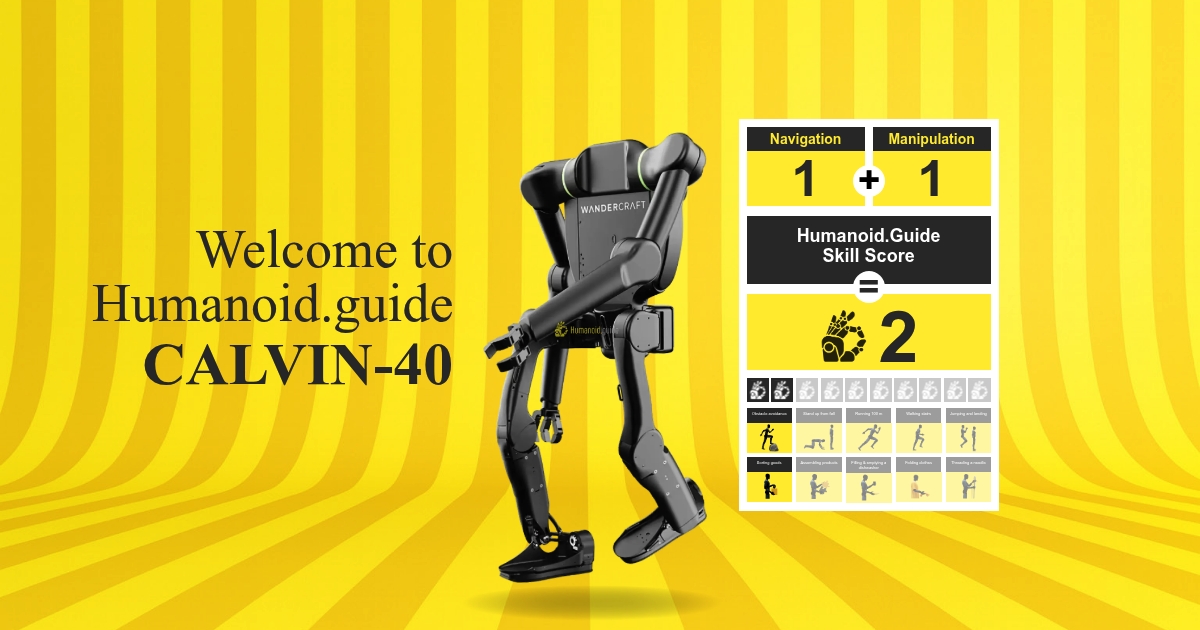
CALVIN-40 is an industrial humanoid robot from Wandercraft, built for heavy factory work rather than showroom demos. It is a headless, voice operated biped that uses the company’s self balancing locomotion platform, originally developed for medical exoskeletons, to move through production environments while carrying loads up to 40 kg. The robot stands 170 cm tall, weighs 80 kg, runs for up to 4 hours per charge, and reaches 3 km/h. Its hardware includes 28 total degrees of freedom, brushless servo actuators, harmonic and cycloidal reduction systems, aluminum alloy structure, and force sensing in the feet for balance on uneven ground. Cameras mounted at the waist support day and night perception, and LED status lighting helps nearby workers understand its operating state. CALVIN-40 is rated at 2 on Humanoid.Guide, with entry tier scores in Navigation and Manipulation, which places it in an early stage capability band overall, even as it is already being used in real industrial settings for physically demanding repetitive tasks.
Its practical strengths center on focused factory workflows. CALVIN-40 supports obstacle avoidance, allowing it to move through active industrial spaces while maintaining stable motion and awareness around people and equipment. It is also suited to sorting goods, especially in logistics and manufacturing contexts where repetitive handling, transfer, and organization of items create ergonomic strain for human workers. The robot’s modular end effector approach lets Wandercraft tailor the system to the task, whether the job calls for grippers, suction tools, or other specialized interfaces. Voice commands, onboard vision, and visual language model reasoning help translate operator instructions into concrete actions, making it useful for structured environments where the job is clearly defined and repeated at scale. This makes CALVIN-40 a strong fit for internal material flow and task specific automation inside factories.
Availability is limited to pilot deployments and industrial programs rather than open commercial retail. Renault has already put CALVIN-40 into operation at its Douai electric vehicle plant, where the robot hauls tires on the production line, and the carmaker later took a minority stake in Wandercraft. Renault plans to expand deployment to 350 units across its electric vehicle factories by 2027, showing meaningful confidence in the platform’s industrial value. Sapa Group has also committed to introducing the robot into plastics manufacturing environments. This matters because CALVIN-40 represents a different path for humanoids, one grounded in proven mobility technology from clinical exoskeletons and aimed directly at painful, repetitive factory jobs. Instead of chasing broad consumer appeal, Wandercraft is positioning the robot as a practical labor tool for specific workflows where physical strain, consistency, and uptime matter most.