Agility Robotics panel examines robot deployment bottlenecks
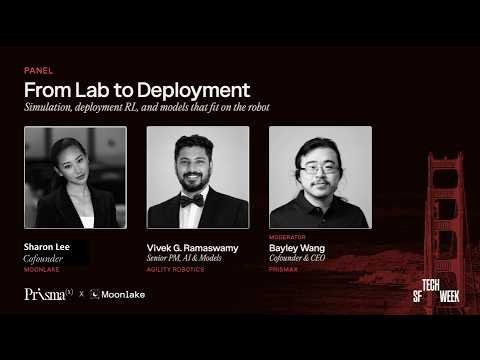
Agility Robotics and Moonlake representatives identified simulation accuracy, onboard computing limits and customer data rights as practical constraints on robot deployment during a panel published on PrismaX’s YouTube channel. The discussion took place at the RoboCon Physical AI Salon on October 9, 2026, during SF Tech Week by a16z.
PrismaX cofounder and CEO Bayley Wang moderated the session with Sharon Lee, cofounder of simulation company Moonlake, and Vivek G. Ramaswamy, senior product manager for AI and models at Agility Robotics. Their central argument was operational rather than architectural: a capable robot model still has to work within the hardware, workflows and economics of a customer site.
Simulation needs useful physics, not just convincing images
Ramaswamy described simulation as a way to narrow the combinations that need testing on physical hardware, rather than a substitute for those tests. Engineers can screen policies in simulation, then reserve hardware time for cases where simulated behavior is less trustworthy. He also highlighted regression testing: each policy release can be checked against scenarios that caused earlier failures.
Lee said Moonlake uses multiple simulation engines and, for some tasks, custom solvers. She named MuJoCo and Drake among its tools and said the company has been testing Genesis modules for deformable objects. In her account, visual realism helps policy training, but inaccurate physics can break a policy even when the simulated scene looks convincing.
Contact remains a particular difficulty. Ramaswamy pointed to modeling object contact forces and the interaction between robot feet and warehouse floors, including wet surfaces. Lee cited deformable objects and processes involving changes of state as other difficult cases. She argued that simulation spending should follow the task: dangerous or physically large environments can justify extensive modeling, while some simpler experiments may be cheaper to run directly.
The model must fit the site
Ramaswamy questioned whether large foundation models are always necessary for customer tasks. Computing capacity, power consumption and latency constrain what can run economically on a robot. His preferred architecture separates higher level planning, which could use cloud resources, from low latency control running at the edge.
Lee similarly described a practical role for smaller models trained around particular tasks and environments, alongside traditional robotics methods. Digital twins and varied simulated environments, which the panel called digital cousins, could help cover the conditions those models will encounter without requiring a single model to handle every task.
Customer permission creates another constraint. Ramaswamy recounted a warehouse customer asking whether recorded operational data would be used to train models, raising concerns about proprietary workflows and equipment. Even reconstructing a site for simulation can require agreement on how that information will be used.
The panel also challenged the usefulness of benchmark success rates in isolation. Ramaswamy said customers care whether their own task gets done, and whether performance holds across many repetitions. Lee noted that acceptable failure rates depend on the task and the cost of an error.
Asked where outside suppliers could help, Ramaswamy pointed to the operational work surrounding autonomous robots, including maintenance and calibration. He closed by calling for better collection and reuse of deployment failure data, so subsequent model updates address mistakes encountered at customer sites.
Source: youtube.com – PrismaX