Agibot leads H1 2026 humanoid shipments with 8,600 units
Agibot shipped more than 8,600 humanoid robots in the first half of 2026, giving it approximately 35 percent of a global market approaching 25,000 units, according to IDC figures reported by Robotics & Automation News.
IDC put worldwide humanoid shipments up 432.1 percent year on year during the period. The figures make Agibot the largest supplier by shipment volume in the dataset, although the published report does not provide IDC’s full vendor ranking, methodology or definition of a qualifying humanoid shipment. The accompanying IDC graphic was supplied to the outlet by Agibot.
Key facts
- Agibot shipments: More than 8,600 units
- Estimated market share: Approximately 35 percent
- Global H1 shipments: Nearly 25,000 units
- Annual market growth: 432.1 percent
Production scale and commercial deployments
Agibot said it reached 20,000 cumulative robots produced in September 2026. That production total should not be treated as equivalent to the IDC humanoid shipment figure, which covers a specific six month period and measures shipments rather than factory output.
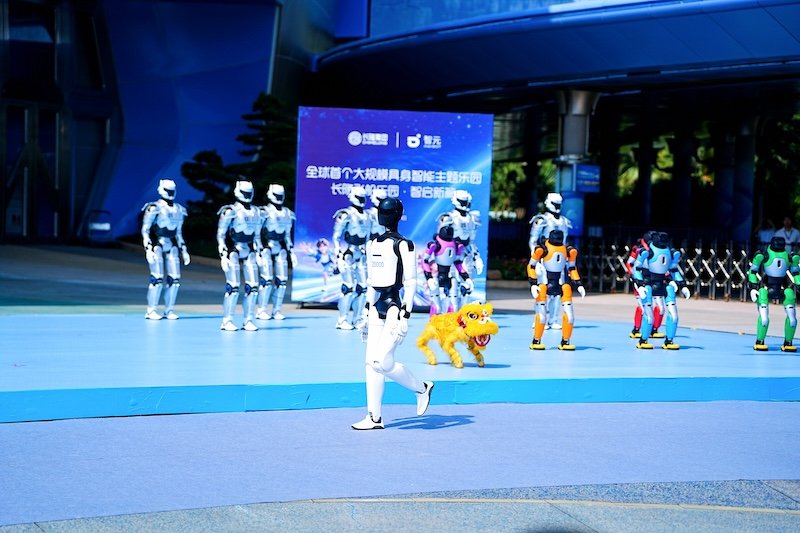
The company has also disclosed two sizeable commercial deployments. More than 300 robots were deployed with Chimelong at Chimelong Spaceship Park in Hengqin, where they are used for entertainment, visitor guidance, retail services, education, hospitality and sports interactions. The source describes that fleet as including humanoid and other embodied robots, so it is not clear how many of the 300 units are humanoids.
A separate retail rollout placed 100 Agibot X2 humanoid robots across ASD stores. Their assigned functions include greeting customers, providing product information and offering in store guidance.
These deployments provide operating environments with sustained public interaction, but the report gives no measures for autonomy, intervention rates, uptime or task completion. Shipment leadership therefore establishes manufacturing and sales scale more clearly than it establishes technical performance in customer workflows.
IDC expects environmental understanding, task planning, manipulation and continuous learning to become increasingly important as humanoids take on more complex work. It forecasts global humanoid robot shipments exceeding 750,000 units by 2030, with industrial, commercial service and consumer applications contributing to demand.
Source: Robotics & Automation News