Welcome, GO 3!
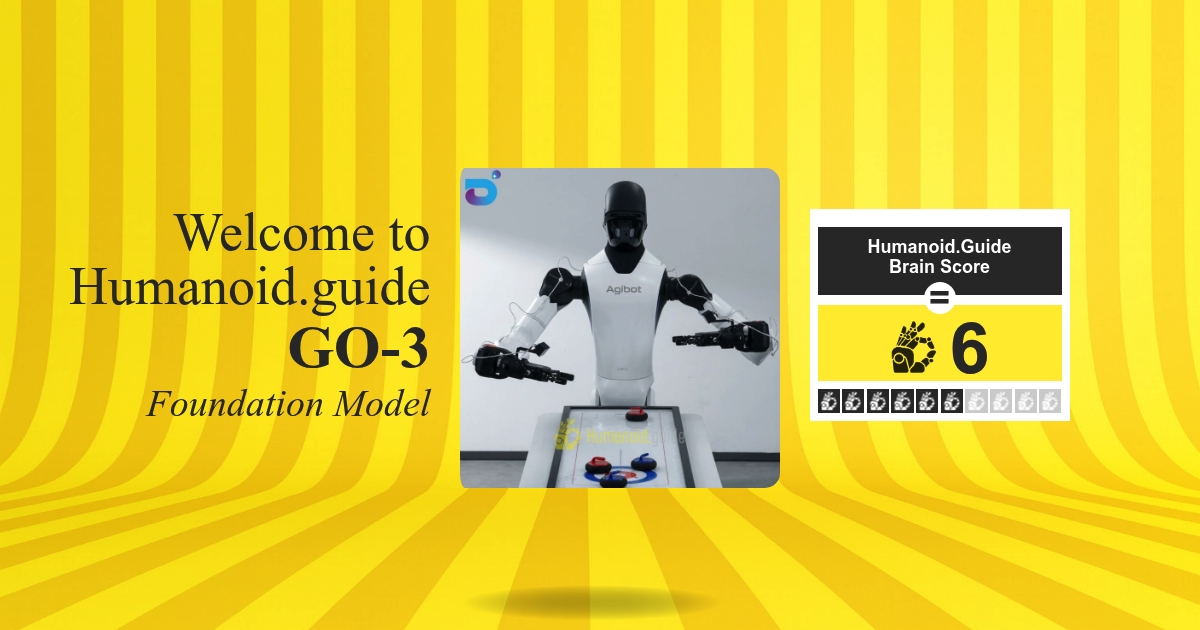
GO 3, short for Genie Operator 3, is AgiBot’s newest embodied AI foundation model and the latest entry in its Genie Operator series. It follows GO 1 and GO 2, extending the company’s software portfolio for robotics. Developed by the Chinese humanoid robot manufacturer, the model was introduced in preview form at AgiBot Innovation Day in Shanghai on October 29, 2026. Its underlying framework is called WRAM, an abbreviation for World Reasoning Action Model. GO 3 earns a Humanoid Guide Brain Score of 6 out of 10, placing it in the capable range of the rating scale. It is software rather than a physical humanoid, so its identity should remain distinct from the machines that use it. That distinction matters when comparing foundation models with complete robotic systems: a model is one component within a larger deployment. GO 3 represents the newest generation of AgiBot’s embodied software offering, with a preview release preceding its planned broader distribution.
For technical teams evaluating a robotics foundation model, the central question is how it fits a particular system and operating environment. Evaluation should separate the software model from the robot’s mechanical design, sensors, control stack and safety systems. A useful assessment also distinguishes repeatable test results from demonstrations, and laboratory conditions from production requirements. For GO 3, its position within the Genie Operator family provides a clear starting point for comparison with earlier releases. Teams considering an integration should define acceptance criteria around their own workflows, document testing conditions and assess the complete system rather than treating a model score as a deployment guarantee. This approach keeps technical comparisons practical and ties procurement decisions to measurable operational requirements.
GO 3 is listed as available on backorder, with a displayed price of zero dollars. That listing should not be treated as a complete statement of licensing terms, support arrangements or deployment costs. AgiBot plans to release the model as open source by the end of 2026, making the release schedule an important consideration for prospective adopters. The preview announcement and planned public release represent separate milestones: one introduces the model, while the other concerns access and distribution. Its broader significance lies in a humanoid manufacturer developing its own foundation model alongside its robotics business. For developers and researchers, the eventual release terms will help determine how GO 3 can be evaluated, integrated and used within their projects.