Welcome, Star!
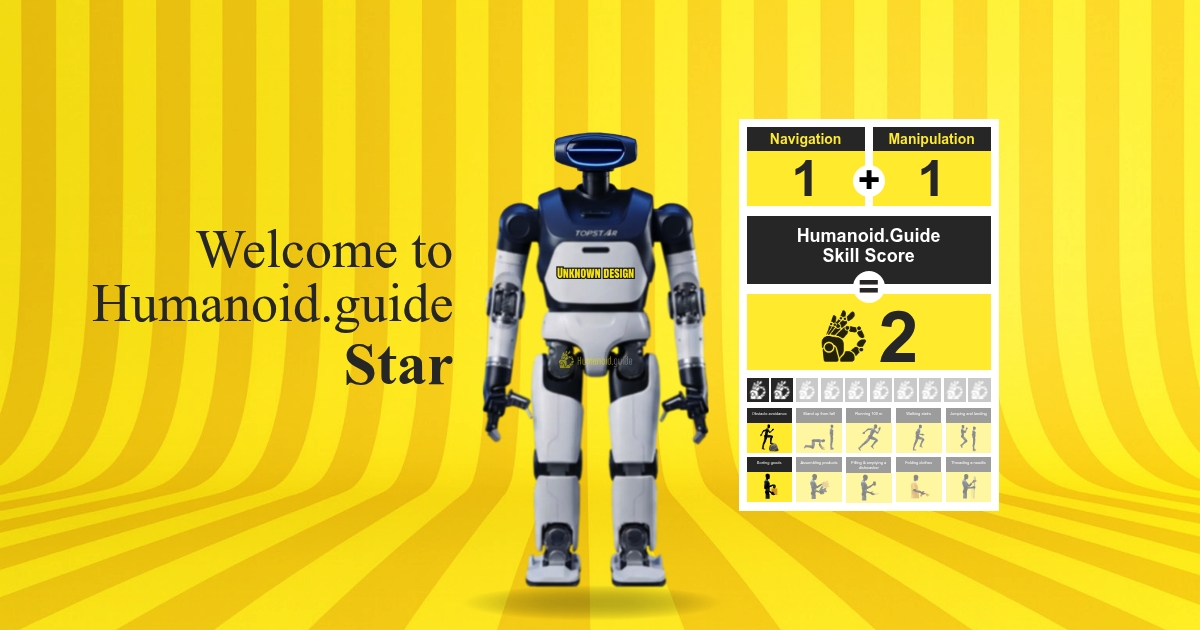
Star is a full size bipedal humanoid robot developed by TOPSTAR Group for industrial manufacturing. Standing 172 cm tall and weighing 72 kg, it combines a human scale body with seven axis arms and a stated dual arm payload of 10 kg. Its overall architecture has 32 degrees of freedom, with 12 degrees of freedom listed for the hands and two finger gripping claws as its end effectors. The robot has a listed walking speed of 3 km/h, a maximum speed of 5 km/h, and a runtime of two hours per charge. Its demonstrated capability profile includes obstacle avoidance and sorting goods. Star earns an overall skill score of 2 out of 10, placing it firmly in the early stage category. Navigation and manipulation are each rated 1 out of 5, reflecting preliminary capability in both areas. Its design emphasizes industrial handling and bipedal movement, bringing Topstar’s factory automation background into a humanoid platform that remains at the prototype stage.
Obstacle avoidance and sorting goods define Star’s current capability profile. For industrial settings, these address two practical concerns: navigating around obstructions and organizing items through physical manipulation. Its gripping claws and articulated arms provide the hardware for goods handling, while its bipedal body provides a mobile platform. The 10 kg dual arm payload is a useful specification for evaluating potential sorting tasks, but it does not establish sorting speed, precision, or sustained productivity. Likewise, obstacle avoidance should be considered alongside its navigation rating of 1 out of 5 rather than interpreted as advanced autonomy. Star is best understood as an early platform for evaluating these specific functions, with both navigation and manipulation still at preliminary rating levels.
Star is listed as a prototype, with a displayed price of USD 70,000 and an option to inquire about pricing. Its manufacturer, TOPSTAR Group, is based in Dongguan, China, and brings nearly two decades of experience in industrial robots, injection molding machines, and automation lines. That background gives Star a clear industrial context without making the prototype equivalent to a proven production system. The project represents Topstar’s move into bipedal humanoids after its earlier wheeled humanoid, Xiao Tuo. Its broader significance lies in an established automation supplier exploring a human scale robot format for manufacturing. For prospective buyers, prototype availability and preliminary skill ratings remain central considerations when assessing its suitability for evaluation.