Welcome, Y4!
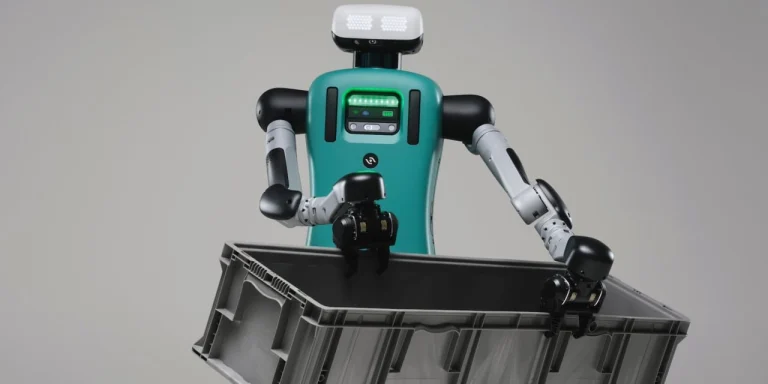
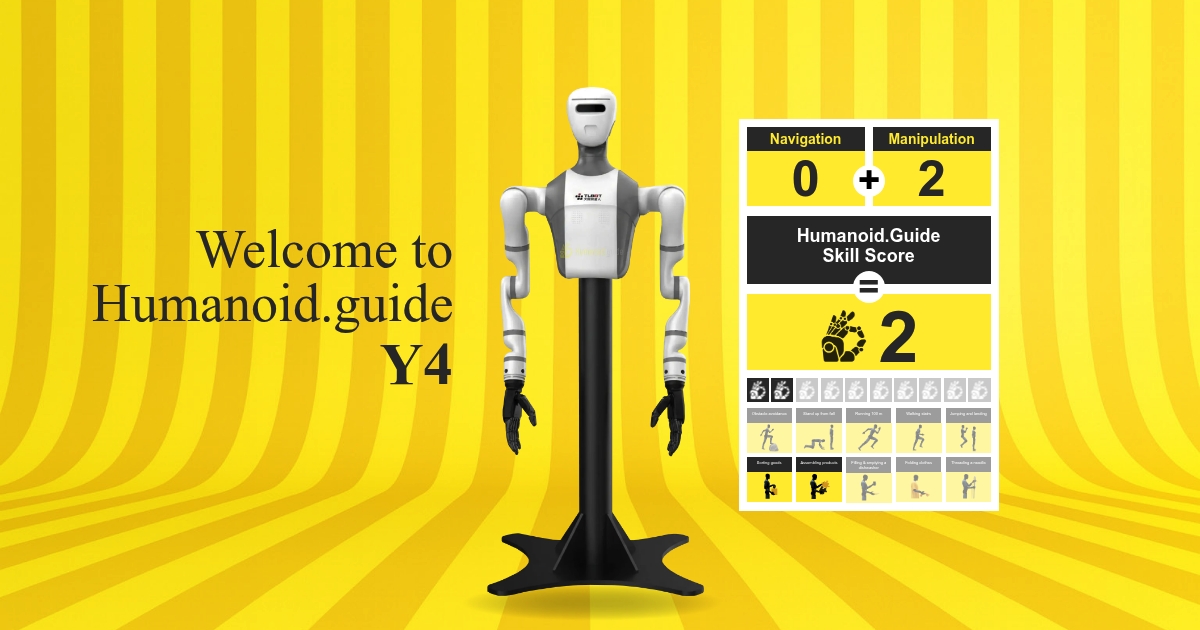
Y4 is a stationary humanoid robot from Tlibot, designed around a humanlike torso and two arms for embodied AI data collection. Its supported physical capabilities include sorting goods and assembling products, placing its emphasis on manipulation rather than locomotion. Each arm has a stated payload of 5 kg, providing a dual arm configuration for work with objects at a fixed station. The robot uses mains power and relies on a customer supplied computer, with ROS 2 and API support providing interfaces for integration into research environments. Tlibot supplies its own joint modules, while two finger gripping claws provide the contact interface for handling objects. Ethernet and USB 3.0 connections support connection to external computing equipment. With an overall skill score of 2 out of 10, Y4 sits in the preliminary capability tier. Its navigation rating is 0 out of 5 and its manipulation rating is 2 out of 5, reflecting a platform centered on stationary arm tasks rather than mobile operation.
Sorting goods and assembling products are the central supported applications for Y4. Its two arms give researchers a physical platform for studying these tasks within a fixed workspace, while the stated payload offers a practical constraint for selecting suitable objects and components. For sorting experiments, the focus can remain on organizing goods through repeated manipulation trials. For assembly research, the platform provides two arms and gripping claws for investigating product assembly workflows. ROS 2 and API support allow laboratory software to interface with the robot through a customer supplied computer. This arrangement makes Y4 relevant to teams collecting embodied AI training data around its supported tasks, without treating its preliminary manipulation rating as evidence of advanced dexterity.
Y4 is listed as in production, with an advertised price of USD 12,000 and an option to inquire about pricing. Its manufacturer, Sichuan Tianlian Robot Co., Ltd., operates under the Tlibot name and is based in Mianyang, China. The company develops robot joints and arms, placing Y4 within a broader hardware development effort rather than presenting it solely as a software platform. For research buyers, its significance lies in providing a stationary dual arm format for embodied AI dataset work. Procurement planning should account for the required external computer and the integration work associated with ROS 2 or API use. Its preliminary score sets an appropriately modest expectation for current capability.