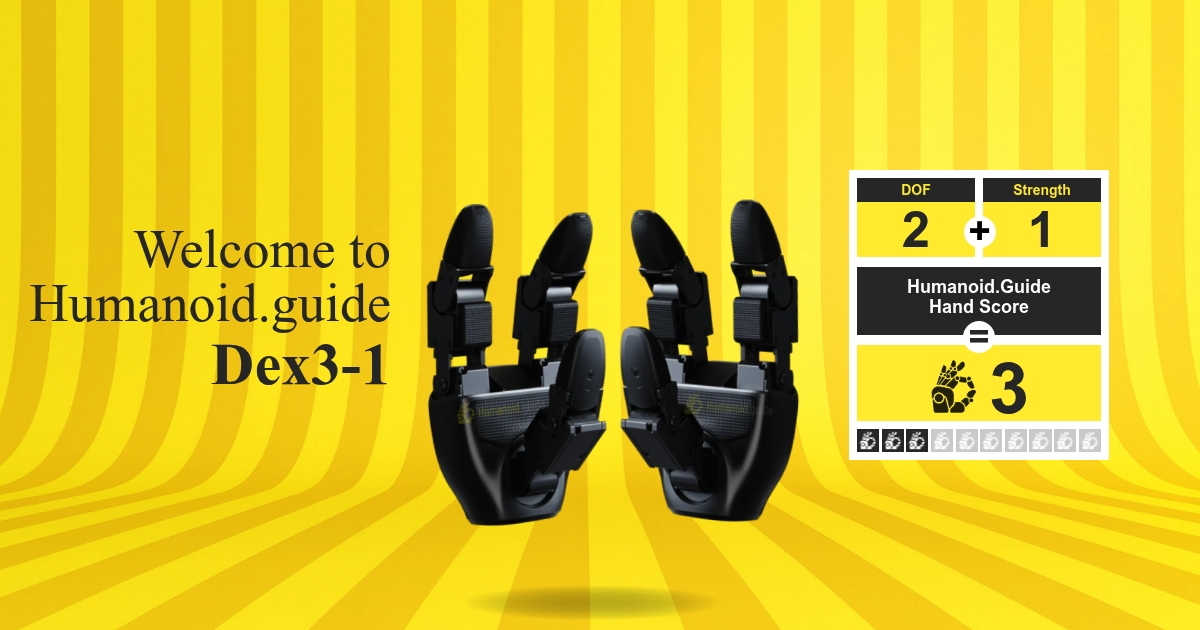
Welcome, Dex3-1!
Unitree Robotics’ three finger robotic hand is designed primarily for the company’s G1 humanoid platform. Its compact arrangement uses a thumb and two fingers rather than a conventional five finger layout, giving the product a distinctive configuration within the humanoid hand market. The assembly measures 175 × 88 × 77 millimeters and weighs 0.71 kilograms. Its hardware incorporates miniature brushless motors, with most joints driven directly and one driven through gears. The overall Hand Score is 3 out of 10, placing it in the developing category rather than among mature or leading systems. Within that assessment, Degrees of Freedom receives 2 out of 5, while Strength receives 1 out of 5. These ratings describe comparative tiers, not joint counts or measured lifting performance. Together, they position the hand as a developing option whose dexterity rating exceeds its strength rating, with a relatively simple physical layout and a clear connection to Unitree’s broader humanoid hardware ecosystem.
For research and development, the distinction between dexterity and strength is central to evaluating a robotic hand. Here, the higher Degrees of Freedom rating and lower Strength rating establish a useful starting point for setting realistic expectations. Neither rating alone establishes suitability for a particular object, task, or experimental workflow. A practical evaluation should examine the intended object sizes, required contact forces, mounting arrangement, and integration requirements before committing to a deployment. Researchers comparing hands should also distinguish a compact finger arrangement from demonstrated manipulation performance. The relevant question is how well the complete system meets a defined task, rather than whether its appearance resembles a human hand. This keeps comparisons focused on measurable requirements instead of promotional assumptions.
The hand is listed as in production, with an advertised price of 1,600 USD and an inquiry option for prospective buyers. Unitree Robotics, based in Hangzhou, China, is the manufacturer, and the product belongs to its wider portfolio of humanoid and quadruped robotics hardware. Its intended association with the G1 gives it a specific platform context rather than positioning it solely as an independent accessory. For buyers, the listed price provides an initial budgeting reference, while purchasing decisions should account for the required configuration and integration arrangements. More broadly, the product illustrates the range of hand architectures entering humanoid development: not every design follows a five finger template, and a developing score remains distinct from demonstrated maturity across demanding applications.