Welcome, Y1!
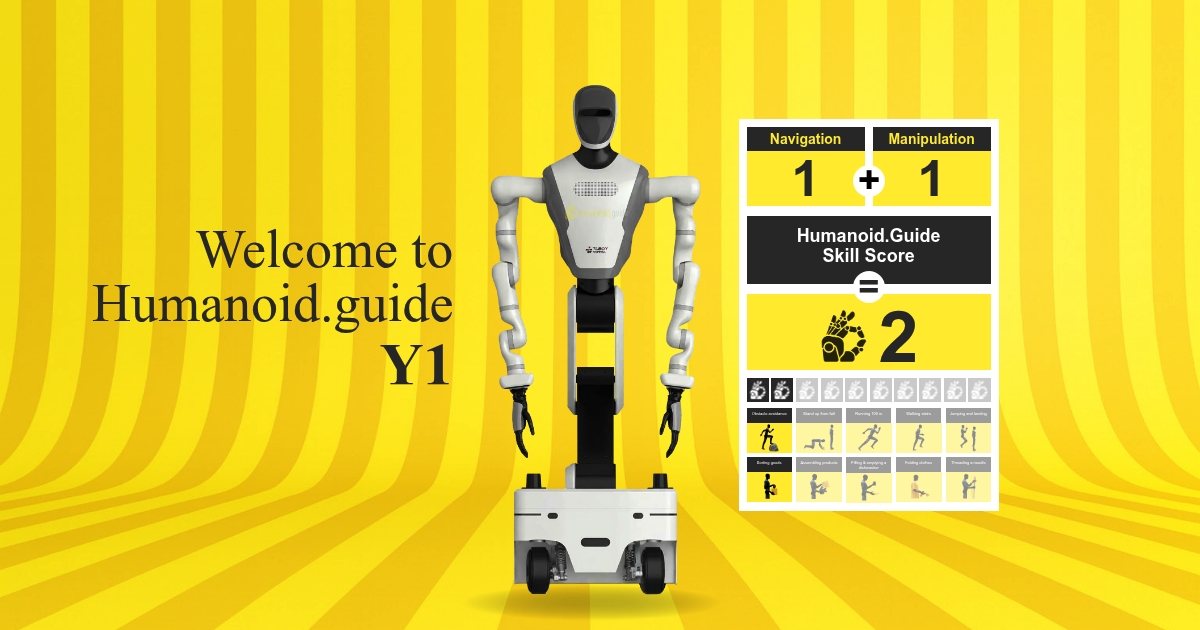
Y1 is a wheeled humanoid robot from Tlibot, also known as Sichuan Tianlian Robot Co., Ltd., based in Mianyang, China. It combines a humanlike upper body and two arms with a mobile chassis, using a folding and lifting body to adjust its working height. A 500 mm lift and a working range of 2.47 m give it a broad physical workspace, while each arm supports a payload of 5 kg. The robot stands 195 cm tall, weighs 150 kg, and reaches a maximum travel speed of 5.4 km/h. Its computing platform includes an NVIDIA Jetson AGX Orin with 64 GB of memory and a 1 TB SSD. Tlibot supplies its own joint modules, bringing its component development into the complete robot platform. Y1 has five fingers on each hand and a white exterior. Its overall skill score of 2 out of 10 places it in the early stage category, with Navigation and Manipulation each rated 1 out of 5.
Obstacle avoidance and sorting goods are Y1’s supported capabilities. LiDAR scanning provides obstacle detection for its wheeled navigation, making this sensing system relevant to movement around objects in a workspace. For sorting goods, its two arms provide a physical platform with a combined rated payload of 10 kg. The lifting body allows adjustment of the arms’ working height, while the folding structure changes the robot’s posture. ROS 2 and API support provide interfaces for developing navigation and sorting workflows. Connectivity includes Ethernet, HDMI, two USB 3.0 ports, and WiFi. Runtime is listed as approximately five hours per charge, with a stated range of four to six hours, an important planning consideration for repeated sorting sessions.
Y1 is in production, with a listed price of USD 35,000. It represents Tlibot’s approach to combining its own joints and arms with a wheeled humanoid platform rather than a legged design. Its broader significance lies in bringing adjustable body geometry, onboard computing, and dual arm hardware into one system for further application development. The early stage skill rating provides an important counterweight to its substantial dimensions and payload specifications: physical hardware capacity and demonstrated task maturity are different measures. For organizations evaluating the platform, its current obstacle avoidance and goods sorting capabilities offer a concrete starting point. LiDAR obstacle avoidance is a safety feature, not a guarantee of unrestricted operation around people.