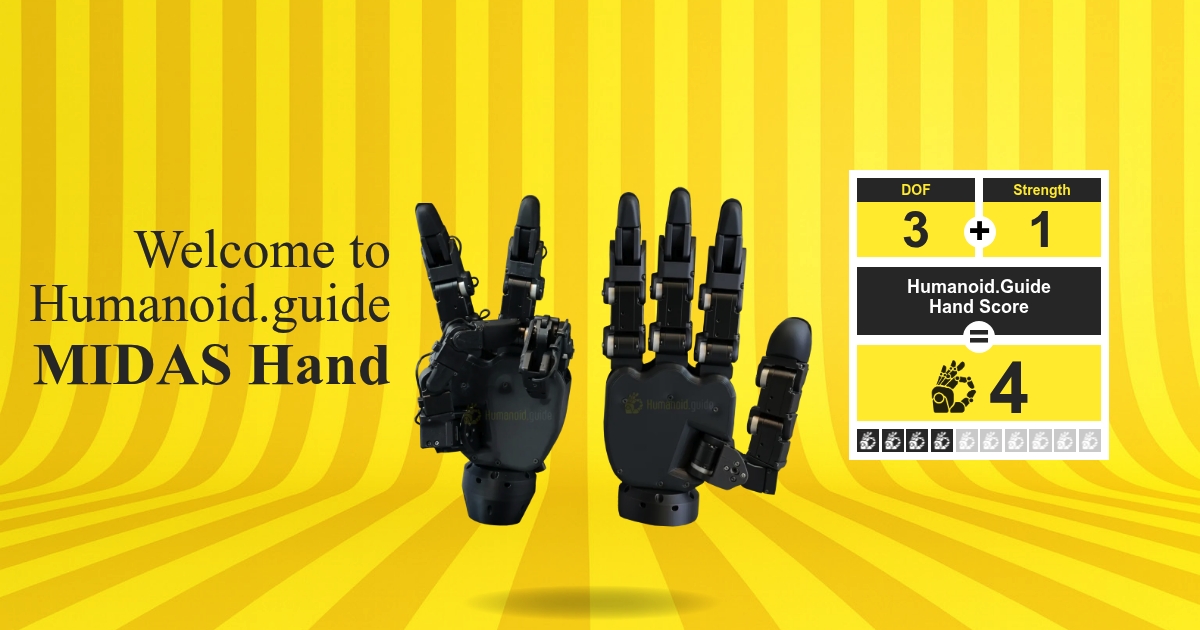
Welcome, MIDAS Hand!
MIDAS Hand is an open source robotic hand developed for robot learning and manipulation research by researchers led by Professor Dennis Hong at UCLA’s RoMeLa laboratory. Its name stands for Modular low Impedance Direct drive Anthropomorphic Sensing Hand. The project offers a publicly shared design rather than a conventional finished commercial product, with prototype availability and a listed price of approximately $2,980. Its overall Humanoid.Guide Hand Score is 4 out of 10, placing it in the developing category rather than among mature or leading systems. The category ratings are 3 out of 5 for Degrees of Freedom and 1 out of 5 for Strength. These ratings distinguish its relative emphasis on dexterity from its lower strength tier; they are not measurements of joint count or lifting capacity. Its construction combines printed plastic components with a soft TPU palm. The design emphasizes an accessible research platform, giving laboratories a concrete starting point for studying robotic hands without presenting the prototype as an industrially proven solution.
The most useful technical distinction in MIDAS Hand’s assessment is the separation between degrees of freedom and strength. A middle tier rating for Degrees of Freedom and a lower tier rating for Strength describe different evaluation dimensions, not interchangeable measures of overall performance. For researchers considering a hand platform, that distinction helps frame questions about experimental priorities, evaluation methods, and the balance between dexterity and force requirements. The overall score of 4 out of 10 signals a developing system and should be read alongside those category ratings. Potential research planning should therefore distinguish interest in dexterity from requirements for substantial grip strength, with suitability established through testing for each intended experiment.
MIDAS Hand is listed as a prototype, making its availability distinct from that of an established production hand. The project’s open source approach is central to its broader significance: researchers can work from a shared design instead of relying exclusively on a proprietary finished product. The published build estimate is about $3,000, broadly consistent with the listed price, and assembly is described as taking under three hours. Those figures provide an initial budgeting and planning reference rather than a guarantee of total deployment cost. Its connection to UCLA’s RoMeLa laboratory places it within an academic robotics context. More broadly, the project represents an effort to make robotic hand research more accessible through published designs and a comparatively modest hardware budget.