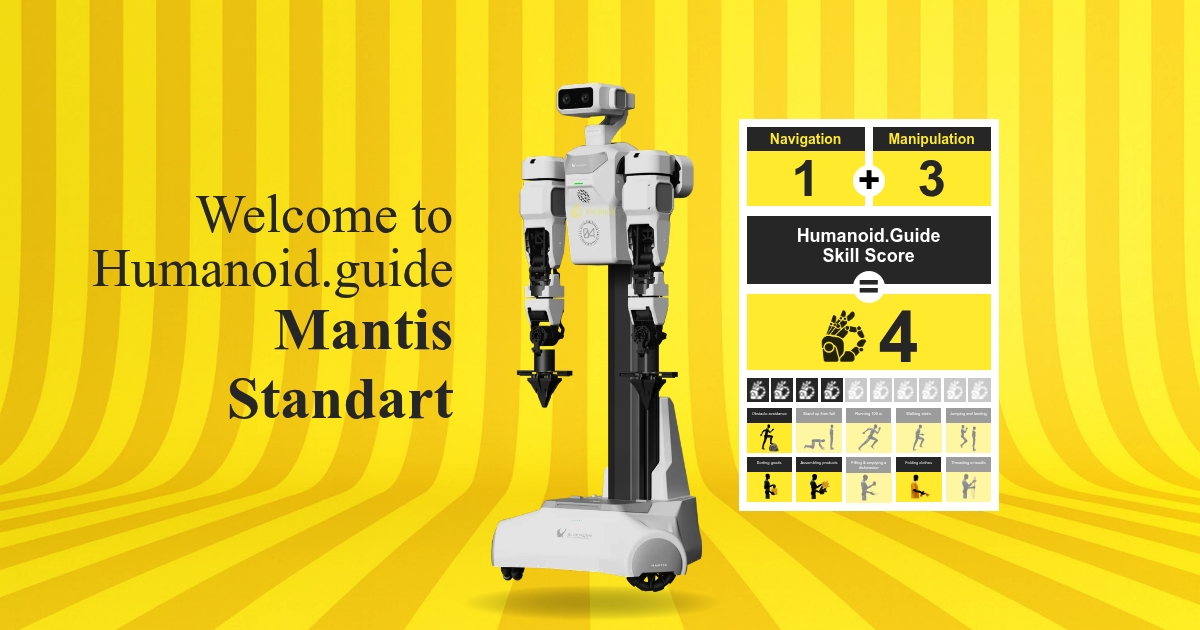
Welcome, Mantis Standart!
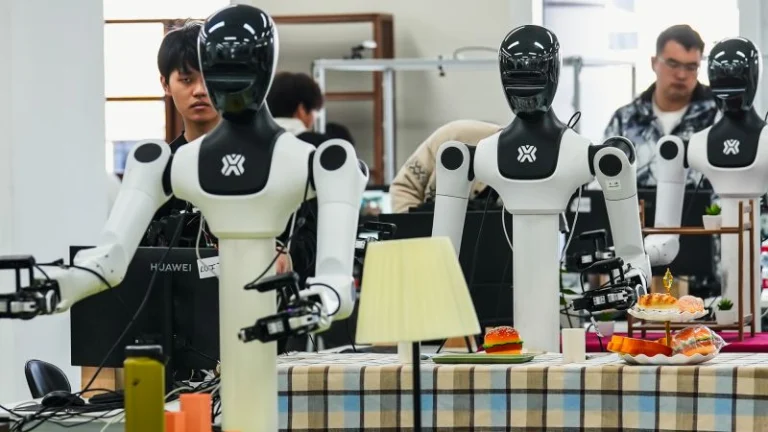
Mantis Standart, nicknamed Xiaobai, is a modular wheeled humanoid developed by Blue Worm in Xi’an, China. Designed for research, data collection, commercial services and light industrial work, it combines a mobile base with two articulated arms and an adjustable lifting waist. The robot stands 140 cm tall, weighs 50 kg and has a listed maximum speed of 10.8 km/h. Its configuration supports up to 22 degrees of freedom, including seven in each arm, with a stated lifting capacity of 7 kg per arm. A waist lifting range of 550 mm provides vertical adjustment for manipulation tasks. Runtime is listed at three hours per charge. Its overall skill score of 4 out of 10 places it in the developing category, with manipulation rated 3 out of 5 and navigation rated 1 out of 5. Supported capabilities include obstacle avoidance, sorting goods, assembling products and folding clothes. These capabilities give the platform a practical focus on mobile manipulation rather than advanced legged mobility.
The technical platform combines a stereo head camera with two wrist cameras, providing viewpoints around the robot and its manipulation workspace. Obstacle avoidance supports wheeled navigation, while sorting goods, assembling products and folding clothes define its listed manipulation capabilities. Electric joint motors deliver a stated maximum torque of 120 N·m. Support for ROS 2, MoveIt 2 and an SDK gives developers integration options for these tasks. VR teleoperation provides an operator control interface, with listed control latency below 10 milliseconds. Connectivity includes Bluetooth, CAN 2.0, USB 3.1 and WiFi 6. Blue Worm’s BW Brain and Wormhole embodied models, alongside VLA examples including ACT and SmolVLA, form part of the software offering for development and experimentation.
Mantis Standart is listed as in production, with a starting price of US$1,400. Its manufacturer, Blue Worm, is a robotics startup that spun out of Xi’an Jiaotong University in 2025. That academic origin connects the platform to robotics research, while its listed markets extend into commercial services, flexible manufacturing, home services, warehousing and logistics. The combination of a modular structure, developer software support and teleoperation makes it relevant to teams building manipulation datasets and testing robot workflows. Its broader significance lies in offering a comparatively accessible entry point into wheeled humanoid development. The developing overall skill rating remains important context: this is a platform for continued integration and evaluation, not a claim of comprehensive autonomous performance.