Welcome, Bumi!
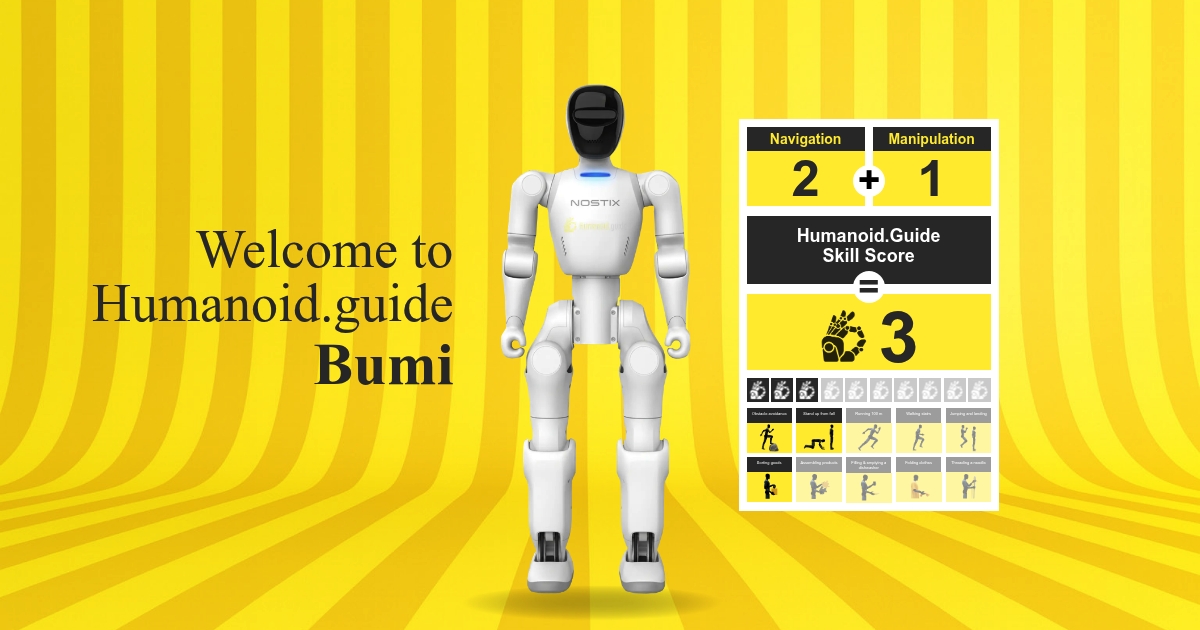
Bumi is a compact consumer humanoid from Noetix Robotics, designed for home companionship, education, and experimentation. Priced at $1,400, it stands 98 cm tall and weighs 17 kg, placing it close to the size of a young child. Its composite body, rounded edges, and low operating speed reflect a design intended for use around families. The robot has 21 degrees of freedom and uses joint modules developed by Noetix, with a stated maximum torque of 70 newton meters. Its supported physical capabilities include obstacle avoidance, standing up after a fall, and sorting goods. A Humanoid Guide Skill Score of 3 out of 10 places Bumi in the developing category rather than among mature general purpose humanoids. Navigation is rated 2 out of 5, while manipulation is rated 1 out of 5, indicating a stronger emphasis on basic mobility than sophisticated object handling. Listed specifications include a maximum speed of 1.8 kilometers per hour, a strength rating of 1 kg, and three hours of runtime per charge.
Bumi’s combination of obstacle avoidance, recovery after a fall, and goods sorting provides a focused set of capabilities for exploring embodied robotics. Obstacle avoidance is relevant to movement through rooms where furniture and everyday objects interrupt clear paths. Standing up after a fall adds a whole body recovery function, an important distinction from demonstrations that depend entirely on remaining upright. Sorting goods introduces object handling as a practical educational topic, while the manipulation rating of 1 out of 5 keeps expectations grounded. Together, these functions offer concrete subjects for studying navigation, balance recovery, and basic manipulation. They support an introduction to humanoid behavior without implying advanced household automation or industrial dexterity.
Bumi is in production and comes from Noetix Robotics, a Beijing company founded by researchers from Tsinghua and Zhejiang universities. Launched in October 2025, it recorded more than 200 units sold during its first three hours of presale. Its $1,400 price positions it as an accessible entry into consumer humanoid ownership relative to the substantial investment often associated with robotics development. The intended audience includes families, educators, makers, and technology enthusiasts. Its broader significance lies in bringing a physical humanoid platform into a consumer price bracket while retaining clearly limited capability ratings. For prospective owners, the central proposition is affordable access to an evolving robotics platform, not a replacement for comprehensive household labor.