Welcome, W-Bot!
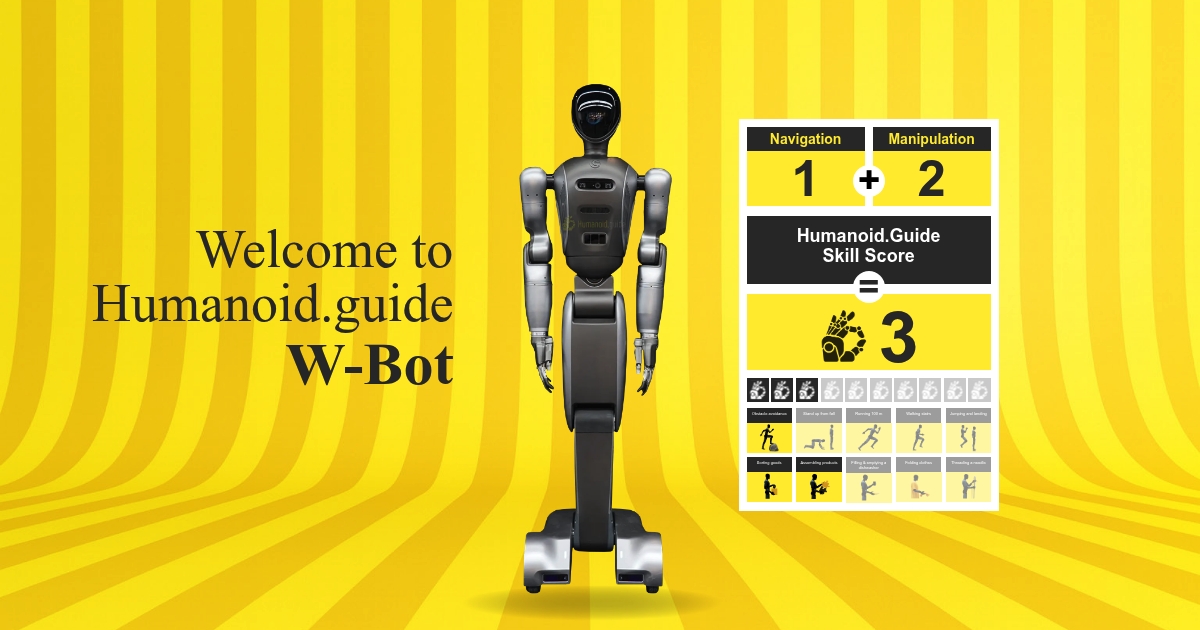
Yue Quan Bionics’ wheeled humanoid combines a compact mobile base with an articulated upper body designed for manipulation in tight spaces. Standing 178 cm tall and weighing 60 kg, it uses folding hips, knees and ankles to position its arms across a working height ranging from floor level to 2.2 meters. This configuration brings humanlike reach to a platform that travels on wheels rather than walking. Its 43 degrees of freedom include arms with seven degrees of freedom each, and each arm can lift 10 kg. Optional dexterous hands extend its manipulation hardware. Two NVIDIA Jetson Orin NX computers, each with 16 GB of memory, provide onboard computing. Intel RealSense D435i and D455 depth cameras supply visual depth information, while 360 degree LiDAR and force sensors support environmental awareness and interaction. Its overall skill score of 3 out of 10 places it in the developing category, with navigation rated 1 out of 5 and manipulation rated 2 out of 5.
Obstacle avoidance, sorting goods and assembling products define the robot’s listed task capabilities. For sorting goods, its adjustable body height and articulated arms provide access to materials at different elevations, including low bins and higher storage locations. For assembling products, the arm configuration and force sensing provide relevant hardware for positioning and interacting with components. The compact wheeled base supports movement through constrained work areas, with obstacle avoidance addressing navigation around surrounding objects. A maximum travel speed of 10.8 km/h and a stated runtime of five hours per charge describe its mobility and operating duration. These specifications support evaluating the platform for workflows that combine movement between stations with sorting or assembly tasks.
The robot is in production and comes from Yue Quan Bionics, a company based in Beijing, China. Its listed price is USD 50,000, with an inquiry option for prospective buyers to discuss pricing and intended applications. Its broader significance lies in a practical design choice: combining wheeled mobility with an articulated body rather than requiring a walking platform for every manipulation task. This approach targets environments where access, reach and compact positioning matter. The developing skill rating remains an important counterweight to its substantial hardware specifications. For organizations considering adoption, sorting and assembly provide concrete starting points for evaluating whether its physical configuration matches their operational requirements.