Welcome, ARI!
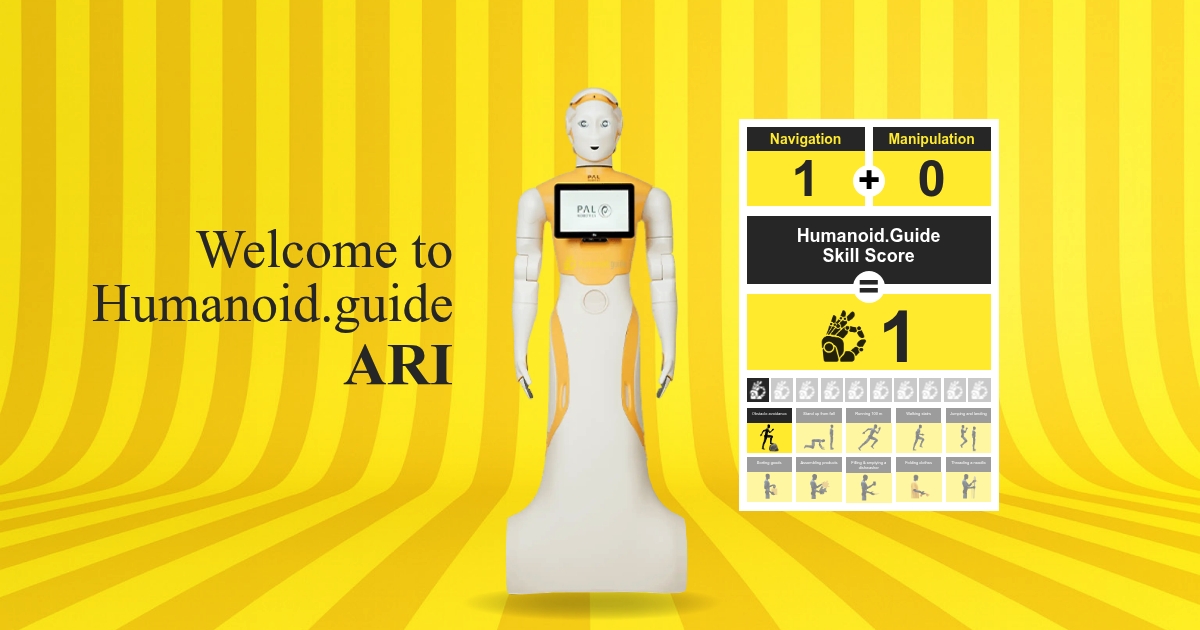
ARI is a wheeled humanoid designed for social interaction, customer service, and research into human robot communication. It stands 165 cm tall, weighs 60 kg, and travels at up to 5.4 km/h on its mobile base. Its skill score of 1 places it in an early stage capability tier, with navigation rated 1 out of 5 and manipulation rated 0 out of 5. This profile prioritizes simple mobile engagement and controlled service workflows rather than advanced whole body work. ARI combines animated eyes, colored lighting, head movement, gesturing arms, and a chest touchscreen to communicate information in approachable ways. It recognizes faces, supports speech interaction, and speaks more than 30 languages, making it suitable for visitor reception, public information, education, and studies of social robotics. Its 14 overall degrees of freedom and five fingers on each hand provide an expressive humanoid form, while its reported one kilogram strength supports light physical interaction. With up to eight hours of runtime per charge, ARI can support extended indoor deployments where people need guidance, dialogue, and digital content.
ARI’s documented physical task capability is sorting goods. This use fits controlled environments where items can be organized through clearly defined workflows and where the robot’s wheeled mobility supports movement between work points. The platform uses electric DC motors, planetary and harmonic reducers, and an aluminium frame with plastic covers. Its computing options include Intel i5, i7, or i9 processors, with optional NVIDIA Xavier NX or Orin hardware. An 8 MP RGB head camera and a RealSense D435i RGBD torso camera support perception, while Ethernet and wireless connectivity link the robot to local systems. Ubuntu LTS 64 bit with an RT Preempt kernel and ROS Noetic provide a familiar robotics software environment.
ARI is in production from PAL Robotics, a Spanish robotics manufacturer based in Barcelona. It is listed at 75,000 USD and is offered for inquiries that match the robot to an application. The platform has particular significance for organizations building practical experience with public facing robotics before pursuing more demanding physical automation. Its approachable design brings speech, visual communication, mobile presence, and touchscreen content into one research and service platform. Support for Rasa dialogue management, optional Google Dialogflow, and application programming interfaces through ROS allows teams to connect ARI with existing conversational and operational software. For museums, hospitals, offices, retail locations, and research labs, it provides a visible humanoid interface for studying how people engage with robots.