Welcome, Feather!
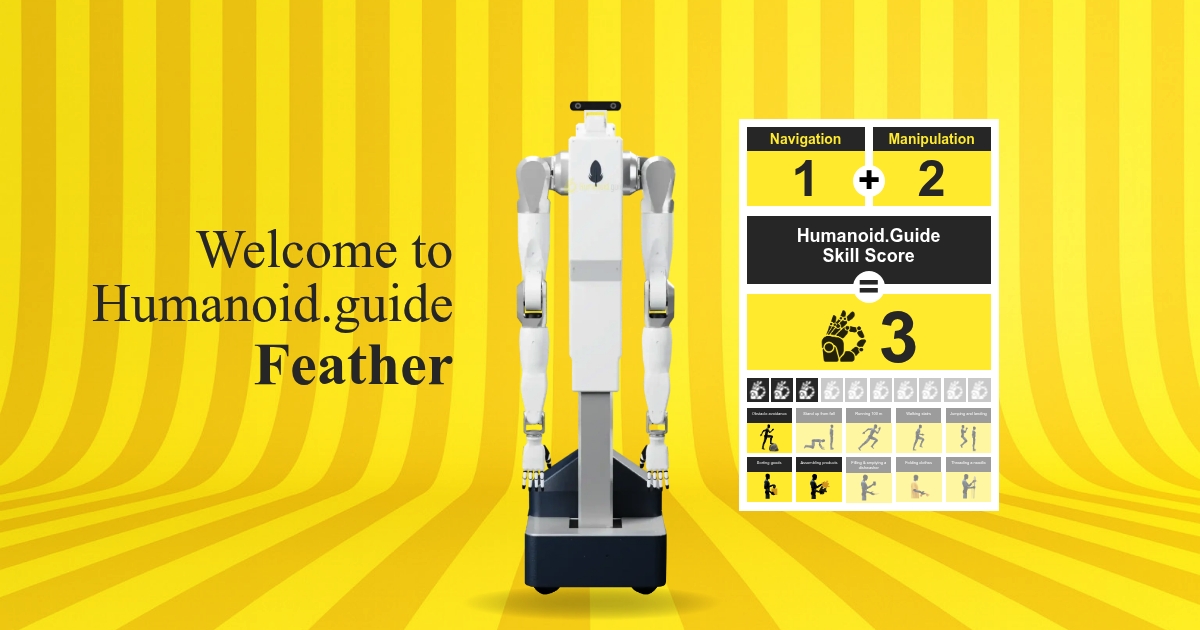
Feather is a 105 kilogram wheeled humanoid robot designed for practical work in warehouses, factories, restaurants, laboratories, and physical AI development environments. Rather than relying on bipedal walking, it uses an omnidirectional mobile base that moves sideways and turns in place, supporting work around aisles, kitchens, and stations made for people. A height adjustable torso extends its reach, while swappable hands support task specific end effectors. Feather stands 180 centimeters tall, weighs 105 kilograms, and has a listed strength of 13.6 kilograms. Its maximum speed is 4.7 kilometers per hour, and its stated runtime reaches 10 hours per charge. The platform is rated as safe for humans and carries a Humanoid.Guide score of 3 out of 10, placing it in a developing stage. Its navigation rating is 1 out of 5, while manipulation is rated 2 out of 5. This positioning emphasizes reliable mobile work within structured indoor operations.
Feather’s technical stack is built for adaptable indoor deployment. It has 23 overall degrees of freedom, including six in the hands, and supports interchangeable hand configurations for varied workflows. Compute options include NVIDIA Jetson Nano, Jetson Orin AGX, and Jetson Thor. The open SDK uses Python 3.9 or later and aligns with a ROS2 based software stack, enabling developers to integrate their own AI models. Configurable stereo vision is provided through head mounted Stereolabs ZED cameras, with optional wrist cameras for close work. In operation, Feather is suited to sorting goods and assembling products, where wheeled movement, controlled arm placement, and repeatable handling support organized production and logistics tasks.
Feather is in production and shipping to paying customers, making it a commercially available platform rather than a research concept. Feather Robotics Inc. is a United States manufacturer, and the listed price is 29,990 USD, with purchase inquiries tailored to each application. The system represents an important route to practical humanoid automation, pairing a human scale upper body with a stable rolling base. This design can fit established indoor sites without requiring a full walking robot, while retaining arms and hands for embodied work around existing facilities. For operators, it represents a developing platform for deploying embodied AI in real workplaces. Its open software approach also gives researchers and physical AI teams a foundation for building and testing specialized automation workflows.