Welcome, Axol!
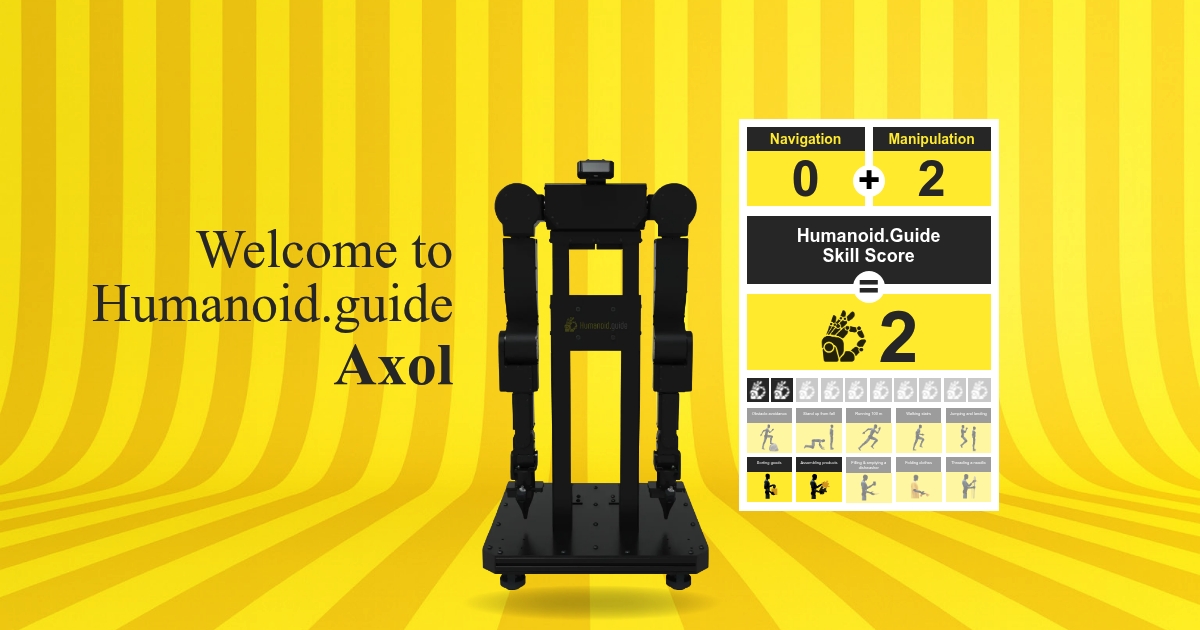
Axol is a compact humanoid research platform centered on dual arm physical manipulation. Its overall Humanoid Guide score of 2 places it at an early stage, with navigation rated 0 out of 5 and manipulation rated 2 out of 5. The machine prioritizes upper body work through two seven degree of freedom arms, each providing 860 millimetres of reach and payload capacity up to 6.5 kilograms. At 61 centimetres tall and 19.5 kilograms, Axol is designed to mount on a table or mobile cart for laboratory and workplace experiments. Electric servo and brushless actuators, CAN joint control at 500 times per second, and reduction gearing support repeatable arm motions. Two finger grippers provide a practical interface for object handling. Steel, aluminium, and TPU form the structure, while wrist cameras and a central global shutter camera support visual perception. Built by Almond AI in the United States, Axol targets physical AI teams seeking accessible hardware for manipulation development.
Axol supports practical manipulation research through sorting goods and assembling products. Its two arm configuration enables researchers to develop coordinated grasping, placement, and object transfer workflows across structured workspaces. Each arm has independent motion capability, allowing tasks to be divided between grippers during assembly sequences or item sorting routines. Built in VR teleoperation support gives operators a direct way to demonstrate task motions, collect examples, and evaluate learned behaviours. The open source SDK enables teams to adapt control software, perception pipelines, and task policies to their own projects. Compute options include ZED Box Orin NX, Jetson AGX Orin, and Jetson Thor T5000 hardware, offering a range of onboard processing configurations for vision guided manipulation development.
Axol is in production and ships in stock from San Francisco, with pricing starting at 9,499 USD. Almond AI positions the platform for research and education, robotics startups, and physical AI teams that need a lower cost entry point for dual arm experimentation. Its focus on arms rather than a full body architecture concentrates development effort on manipulation, visual feedback, teleoperation, and repeatable task execution. The platform also offers an accessible route for teams building data collection systems for sorting goods and assembling products. By pairing commercially available compute hardware with an open source software approach, Axol contributes to a growing ecosystem of research tools intended to move physical AI from controlled demonstrations toward useful object handling workflows.