Welcome, Nova!
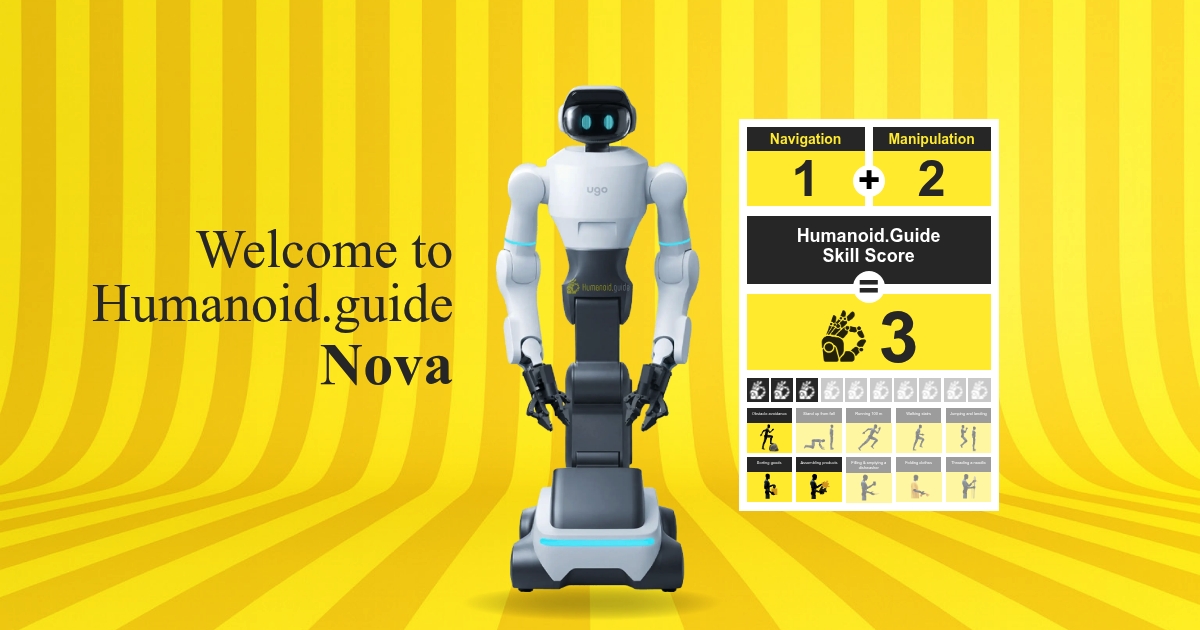
Nova is a Japanese wheeled humanoid robot created by ugo, Inc. for industrial work in factories, warehouses, and logistics environments. It combines a mobile base with dual seven degree of freedom arms, a four degree of freedom waist, and 22 degrees of freedom across the system. At 162 centimetres tall and 90 kilograms, Nova is designed for stable, human compatible operation rather than athletic locomotion. Its score of 3 out of 10 places it in a developing stage, with Navigation rated 1 out of 5 and Manipulation rated 2 out of 5. The robot uses electric servo actuators, two finger gripping claws, and an NVIDIA Jetson Thor computer. Vision comes from a head mounted stereo camera and RGB cameras positioned at each hand. Six hours of runtime per charge, a top speed of 3.6 kilometres per hour, WiFi 6, wired networking, and USB connections support extended deployment and integration with workplace systems.
Nova is equipped for obstacle avoidance while moving through structured work areas, supporting safer navigation around people, equipment, and changing floor layouts. Its manipulation system is directed toward sorting goods, allowing the robot to handle, position, and organise items within an operational workflow. Nova also supports assembling products, pairing its mobile platform with coordinated arm and waist movement for light industrial tasks. The two arm arrangement enables work across stations where objects are handled, placed, or aligned in sequence. These capabilities suit repetitive material flow and production activities that benefit from consistent operation. The current skill profile emphasizes practical industrial assistance, with navigation and manipulation still developing as the platform progresses toward wider deployment.
Nova is currently a prototype, and ugo plans mass production in 2027. The programme carries broader significance within Japan’s effort to establish domestically produced general purpose robotics. Development is backed by the New Energy and Industrial Technology Development Organization, known as NEDO, and by the AI Robot Association. Ugo’s Physical AI Fabric links data collection, model development, and future skill improvement into a common development approach. This framework is intended to capture work data from real tasks and use it to improve the robot over time. By combining institutional support, industrial design, and a pathway to volume production, Nova represents a practical Japanese effort to bring adaptable humanoid robotics into manufacturing and logistics operations.