Unitree G1 teardown reveals actuator and cooling tradeoffs
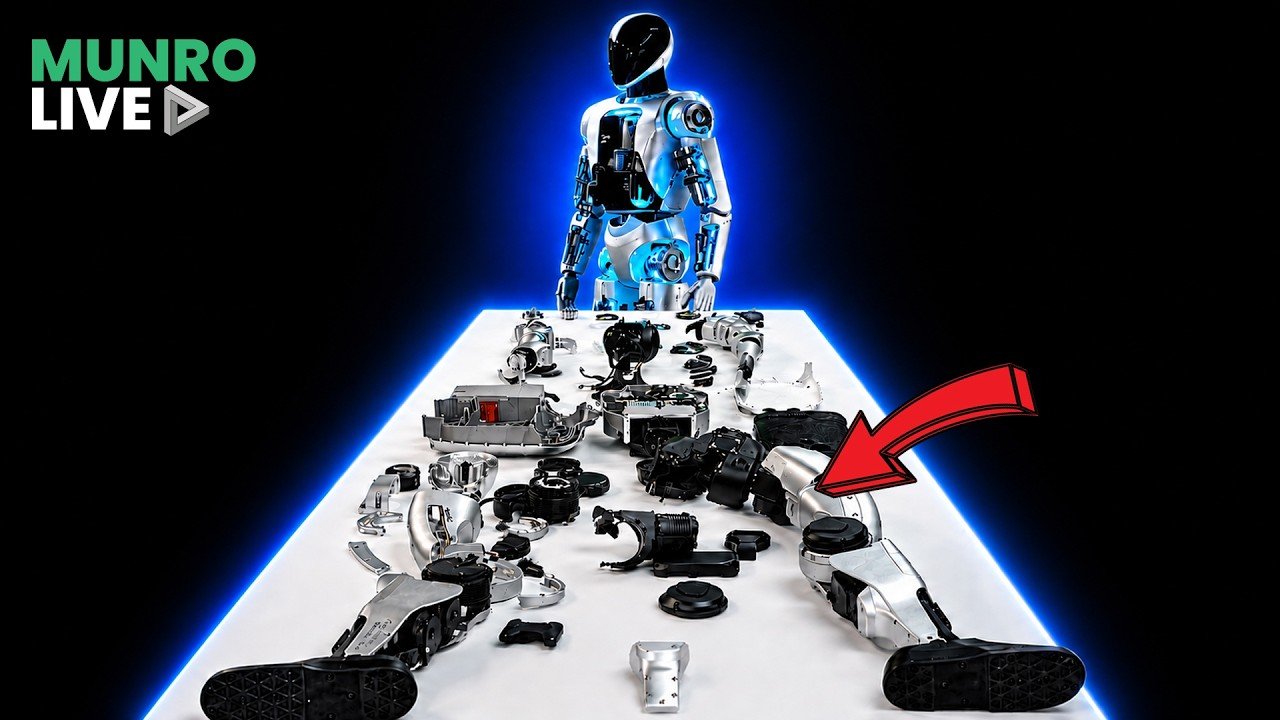
A complete teardown of the Unitree G1 has exposed the actuator, thermal management and structural choices inside the humanoid. The 38 minute examination by Munro Live, the media division of engineering consultancy Munro & Associates, found a design optimized for rapid iteration, with extensive CNC machining and several packaging decisions that may need refinement for sustained production use.
The teardown brought together Munro engineers, Robo Strategy robotics research director Scott Walter and Schaeffler representatives. Their analysis focused less on the G1’s headline capabilities and more on how its joints transmit torque, reject heat and handle mechanical loads.
Planetary gears prioritize back driveability
The Unitree G1 uses scaled versions of the same general rotary actuator architecture across its hips, knees, shoulders and elbows. Each combines a motor with a two stage planetary gearbox at an approximately 15 to 1 ratio, according to the teardown.
That differs from the strain wave gearing commonly found in industrial robot joints. A strain wave drive can deliver ratios of 100 to 1 or higher in a light, compact package with almost no backlash. Its high ratio, however, makes it difficult to back drive and generally requires a torque sensor for output feedback.
Unitree’s lower ratio planetary arrangement is easily back drivable. The motor current can provide an indication of output torque, improving torque transparency for control. The tradeoff is backlash across the two gear stages, although the G1 measures output position to help manage that behavior.
The panel described the G1 motor as relatively inexpensive but less torque dense than some permanent magnet synchronous motors used in industry. It also identified unused winding space where a different copper winding method could potentially lower resistance and reduce heat generation.
Multiple small fasteners connect the rotor and other actuator components. This can ease repair and shorten development time, but adds parts and assembly steps. Munro viewed those choices as evidence that getting functional hardware into developers’ hands took priority over optimizing every component for volume production.
Heat pipes supplement forced air cooling
Thermal management varies by joint. The aluminum actuator housings clamp around the motors to conduct heat into the surrounding structure, while the anodized exterior provides another route for heat rejection.
In high duty cycle joints such as the knees, Unitree installed a copper heat pipe against the motor stator. Fluid inside the pipe vaporizes at the hot end and condenses against a cooler aluminum section, transferring heat away from the motor. The panel compared the principle with heat pipes used to cool processors, but said it had not previously encountered the technique applied directly to a motor stator.
The hip area uses two centrifugal fans. Air is directed through machined channels around the actuators, with some flow diverted toward nearby electronics. This forced air system accounts for part of the audible fan noise when the robot operates.
Capacitor boards distributed through the body smooth fluctuations on the shared DC bus. Each motor can consume electricity or generate it when a joint is moved, causing voltage variation that complicates precise torque control. The capacitors store some of that energy and filter voltage ripples, though their placement requires additional cables and connectors.
Ankle linkage keeps motor mass higher on the leg
The G1 uses only rotary actuators, but its ankle motors are mounted remotely above the joint rather than inside it. Two tie rods connect the motors to a universal joint at the ankle. Coordinated movement of both rods produces pitch, while differential movement produces roll.
This arrangement lets both motors share torque during ankle pitch and keeps their mass higher on the leg. It also introduces control and mechanical complications. Spherical joints are required because the tie rods move out of plane, and the linkage geometry can make it difficult to separate pitch resistance from roll resistance using motor torque data alone.
The exposed, greased Cardan joint also drew criticism from the panel. Dust or grit could contaminate it during long term operation in a home or production environment. A protective boot similar to those used over automotive constant velocity joints was suggested as one possible remedy.
CNC construction preserves design flexibility
Many of the G1’s silver structural parts are machined from aluminum billet rather than cast. CNC machining avoids the lead time and capital needed for casting tools, while allowing Unitree to modify components as the robot develops. The panel said machining capacity in China helps make this approach more economical, although casting would generally become less expensive at higher volumes.
The same development logic appears throughout the robot: reusable actuator designs, replaceable fastened components and capacitor modules fitted wherever space was available. These are practical choices for an early platform intended to support continuing hardware and software work. They are not evidence of a final manufacturing architecture, and the teardown leaves Unitree’s next packaging and production changes as the more revealing test.
Source: youtube.com