Pepper robot trust study finds social gestures can backfire
A Drexel University study using the semi humanoid Pepper robot found that errors reduced participants’ trust and reliance, regardless of whether the robot used social gestures. Exploratory results suggest the expressive version carried an additional penalty: people appeared to process its mistakes more like interpersonal violations than technical faults.
The peer reviewed research, published in Science Robotics and reported by Tech Xplore, examined trust through behavioral choices, questionnaires, brain activity and salivary oxytocin. Its central finding is less about making robots personable than getting the fundamentals right. Expressiveness did not compensate for unreliable behavior.
Errors cut Pepper’s influence on decisions
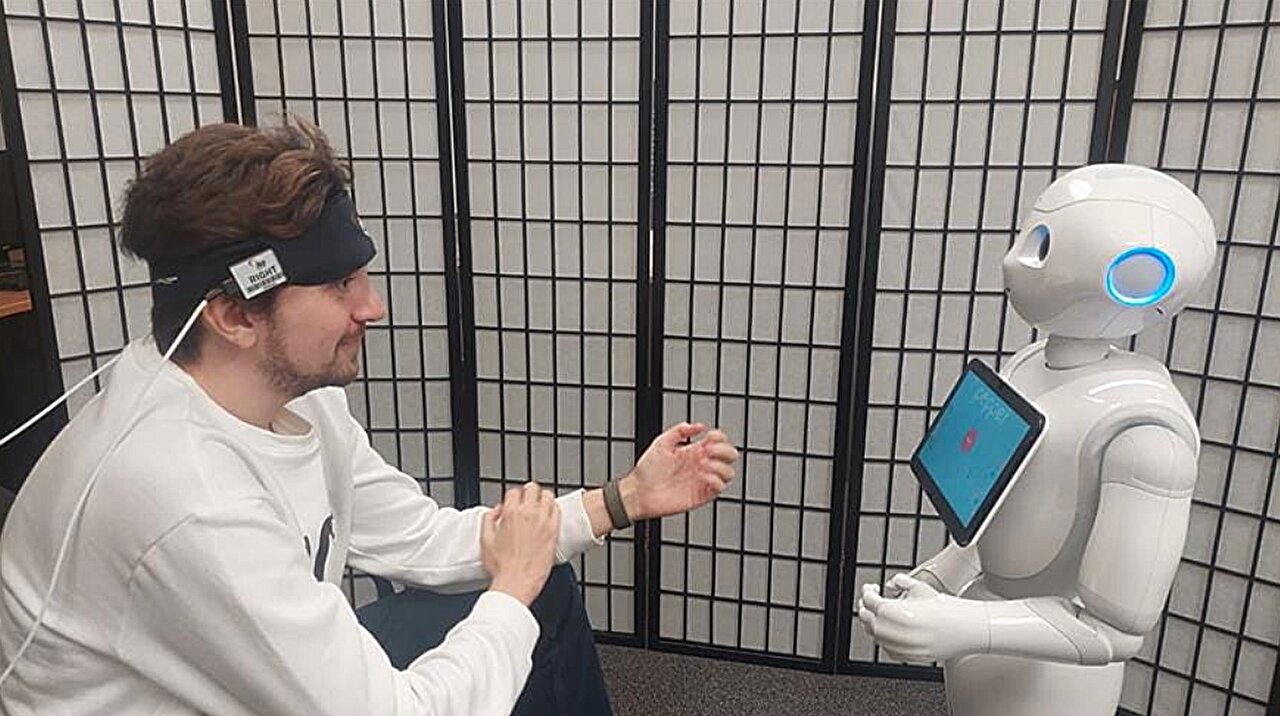
The researchers recruited 50 adult male participants, each of whom spent roughly two and a half hours interacting face to face with Pepper. Sessions included conversations and two collaborative decision making exercises: an island survival task and an art ranking task.
Participants made initial choices, discussed them with Pepper and then submitted final answers. This let the team measure whether the robot persuaded them to change a decision. Pepper’s influence score fell from 0.25 during reliable interactions to 0.10 after errors, and questionnaire responses showed a corresponding decline in trust.
The errors were deliberate social and cooperative failures, including interruptions, irrelevant comments and opinions supported by illogical explanations. They were not mechanical malfunctions. A researcher controlled Pepper in real time through the Wizard of Oz method, a standard experimental approach in which participants believe a robot is acting autonomously.
Half the participants encountered an expressive Pepper that made eye contact, gestured, nodded and used conversational responses such as “uh-huh” and “hmm.” The other half interacted with a stationary robot. Both conditions used verbal material from the same predefined response pools.
Expressive mistakes prompted different processing
Wearable fNIRS measurements showed that errors by the expressive Pepper were associated in exploratory analyses with increased activity in the left dorsolateral prefrontal cortex, which is linked to monitoring uncertainty and norm violations. Greater activity also appeared in medial prefrontal regions involved in social inference. The stationary robot’s errors were not followed by the same patterns.
Trust in the expressive robot also predicted participants’ subsequent behavior, while trust in the stationary version did not. Salivary oxytocin rose during robot errors even as reported trust fell, with a reliable negative association specifically when the expressive robot erred. The researchers interpret this cautiously, arguing that oxytocin may increase attention to socially relevant cues rather than uniformly promote bonding.
The Pepper robot trust study has clear limits. The sample consisted of young adult men from a Western population, only one robot platform was tested, and the failures were conversational rather than physical or task execution errors. Researcher control also means the experiment did not evaluate how participants respond to mistakes generated by an autonomous system.
For humanoid developers, the practical implication is narrow but useful: adding gaze, gestures and conversational feedback can raise expectations that the robot will behave like a competent social partner. When it violates those expectations, a generic technical error response may be insufficient. Drexel’s researchers plan to test whether acknowledgment, apology and other rapport repair strategies can restore trust after a robot fails.
Source: Tech Xplore