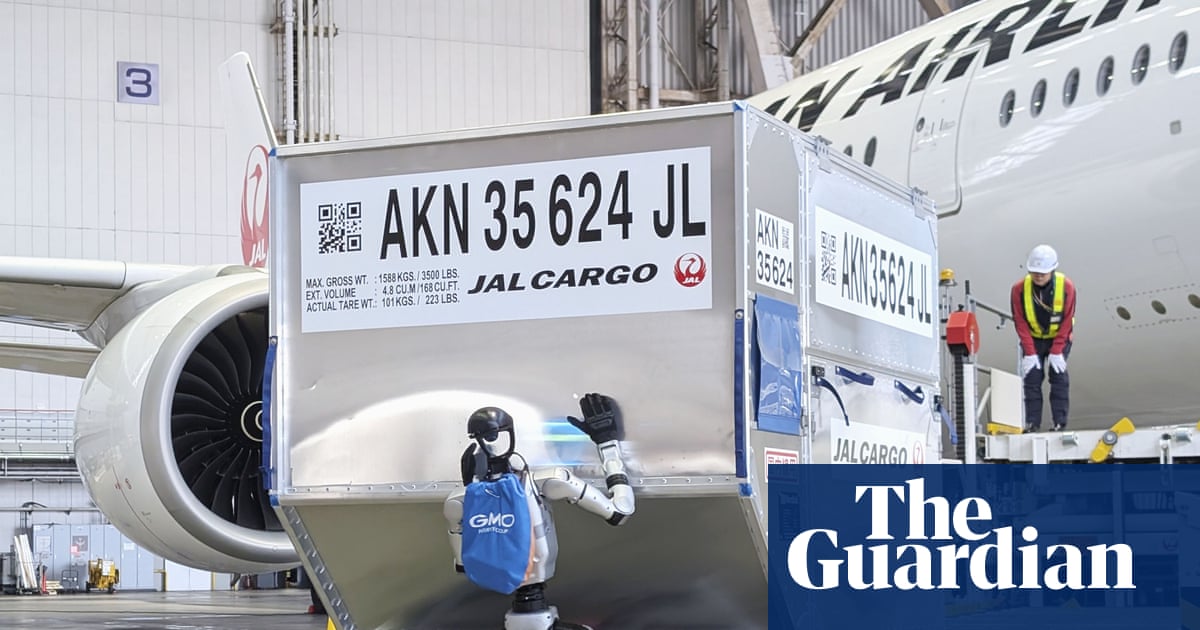
Japan Airlines starts airport baggage humanoid robots at Haneda
Japan Airlines will begin testing airport baggage humanoid robots at Tokyo’s Haneda airport from the beginning of May, adding Chinese-made machines to ramp operations on a trial basis. The program is notable because it places humanoids into a live airport workflow, where labor shortages, safety requirements, and heavy passenger volumes make ground handling difficult to staff.
Airport baggage humanoid robots move onto the tarmac
According to the Guardian, JAL and Japan Airlines GMO Internet Group plan to use the robots to move travellers’ luggage and cargo on the tarmac at Haneda, which handles more than 60 million passengers a year. The trial is scheduled to run until 2028, giving the companies a multi-year period to assess whether the machines can support daily ground operations.
At a media demonstration in Tokyo, a 130cm robot made by Hangzhou-based Unitree was shown pushing cargo onto a conveyor belt beside a JAL passenger aircraft. The robot also waved to an unseen colleague, indicating that the demonstration was meant to show both material handling and operation around human staff.
The report does not describe a fully autonomous baggage workflow, and JAL has been clear that people will remain responsible for core oversight. Yoshiteru Suzuki, president of JAL Ground Service, said the use of robots for physically demanding work would “inevitably reduce the burden on workers and provide significant benefits to employees,” while safety management would continue to be handled by humans.
What the Haneda trial is testing
The operational case is less about replacing staff outright than about supporting difficult tasks and covering recurring shortages. Tomohiro Uchida, president of GMO AI and Robotics, said, “While airports appear highly automated and standardised, their back-end operations still rely heavily on human labour and face serious labor shortages.”
That distinction matters for humanoid deployments. Loading and moving baggage involve repetitive force, irregular schedules, outdoor conditions, and coordination near aircraft, conveyors, and service vehicles, so a successful pilot would need to show reliability inside those constraints rather than only in a staged demo.
The choice of a humanoid platform is also notable because both ramp work and cabin cleaning take place in environments built around human access and movement. JAL’s trial does not disclose detailed performance targets, but it will effectively test whether a humanlike form can cover more than one airport task without dedicated infrastructure.
The robots can operate continuously for two to three hours, according to the report. JAL and its partners are also considering other uses, including cleaning aircraft cabins, suggesting that baggage and cargo handling are only the first applications under evaluation.
Labor pressure is driving airport automation
Japan’s labor market is the main backdrop to the program. The country is dealing with an ageing and shrinking population at the same time that inbound tourism has risen sharply, increasing pressure on service and transport operators that already struggle to recruit for physically demanding jobs.
More than 7 million people visited Japan in the first two months of 2026, after a record 42.7 million last year, as the Guardian reports. One estimate cited in the report says Japan will need more than 6.5 million foreign workers in 2040 to meet growth targets, even as the government faces political pressure to rein in immigration.
Within that context, airport baggage humanoid robots are being tested as a labor tool rather than a public-facing novelty. The Haneda program will be watched closely because airports combine standardized processes with strict operational discipline, making them a demanding early commercial setting for humanoids. What remains unclear is how reliably the robots can sustain work cycles, coordinate with crews, and expand beyond trial tasks before the experiment concludes in 2028.
Source: theguardian.com