Welcome, AI Sapiens K1!
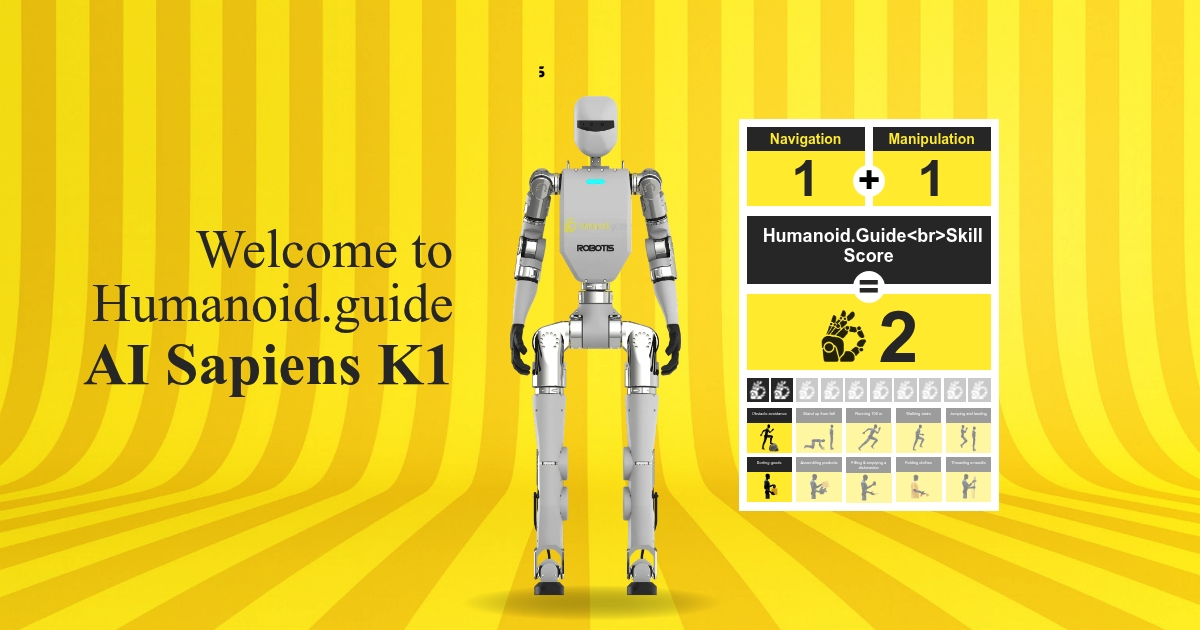
AI Sapiens K1 is a fully open source humanoid platform from Robotis, created for physical AI research rather than consumer deployment. Standing 135.5 centimetres tall and weighing 35 kilograms, it combines a compact body with 23 total joints and hands with five fingers each, giving researchers a practical testbed for whole body behavior. The robot uses DYNAMIXEL Q quasi direct drive actuators, an aluminium alloy frame, polymer covers, and a computing stack built around NVIDIA Jetson Orin NX 16GB, with ROS 2 Jazzy running on Cyclo OS. Connectivity includes Wi Fi, Bluetooth, USB, and 2.5 GbE, supporting integration with lab tools and custom pipelines. With a top speed of 4.3 kilometres per hour, a runtime of about two hours per charge, and design choices aimed at low inertia and controllability, K1 is tuned for repeatable experimentation. Its overall skill score of 2, with early tier ratings in navigation and manipulation, places it as a research platform focused on development, iteration, and transparent access to the full robotics stack.
In practical tasks, K1 supports obstacle avoidance and sorting goods, which align with its balanced but early navigation and manipulation profile. Obstacle avoidance lets teams study perception, motion planning, and safe body movement in cluttered indoor spaces, especially for research in mobile interaction. Sorting goods highlights how the platform can connect arm motion, hand use, and scene understanding for structured handling workflows. Because Robotis positions K1 as a modifiable system, these behaviors are valuable as baseline tasks for sim to real transfer, policy refinement, and imitation learning. Researchers can start with repeatable sorting routines, then improve reliability, timing, and coordination while testing new controllers, perception stacks, and data collection methods on real hardware.
K1 is already in production and represents an important contribution from South Korea to the global humanoid field. Its significance comes less from polished end user deployment and more from how much of the platform Robotis intends to open, including mechanical design, electrical resources, software, simulation assets, and training workflows. That level of access lowers barriers for universities, labs, and robotics developers who want a shared humanoid baseline instead of a sealed product. The combination of NVIDIA computing, ROS 2 support, and simulation driven development also makes K1 relevant to teams building physical AI pipelines that connect digital training with real world execution. In that sense, K1 helps broaden humanoid research infrastructure, not just the robot catalog.