Welcome, Asimov 2!
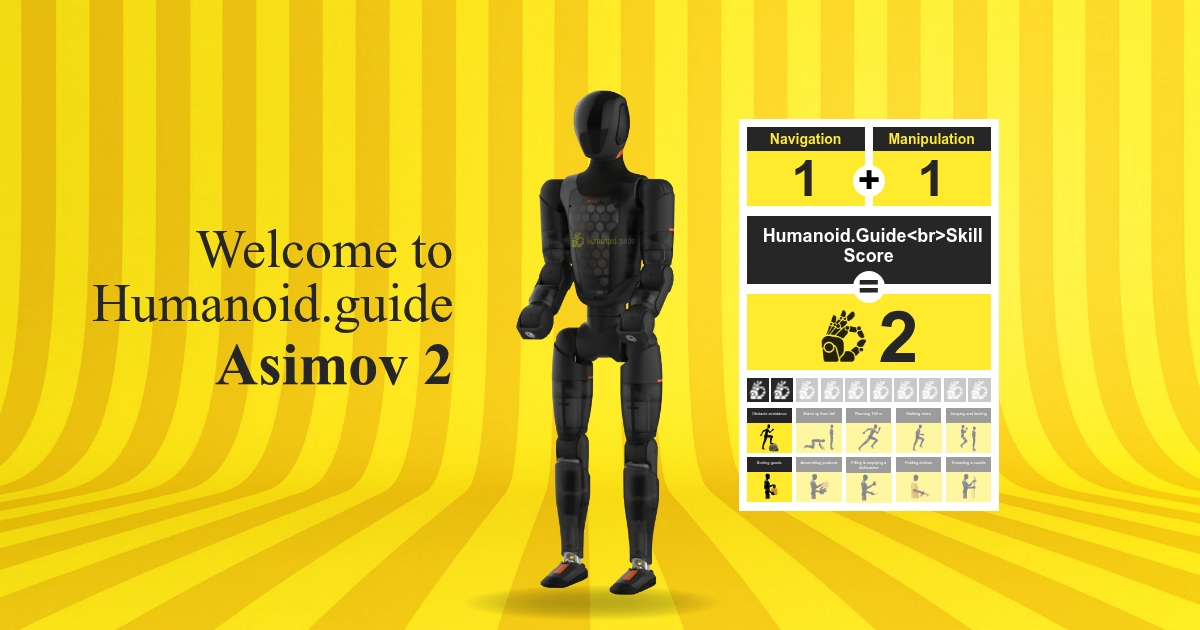
Asimov 2 is a compact humanoid robot from MenloAI built for developers, researchers, and robotics education teams that want a practical physical platform rather than a concept machine. It stands 120 centimeters tall, weighs 38 kilograms, and reaches a top speed of 4 kilometers per hour, with a stated strength of 5 kilograms and runtime per charge of 2.5 hours. The robot is marked safe with humans and combines a Raspberry Pi 5 for media and networking with a Radxa CM5 for motion control, giving it a split computing architecture suited to experimentation and real world operation. Connectivity includes internal CAN bus branches, Bluetooth, Ethernet, and wireless networking, while its software stack runs on Asimov OS with LLM integration. Its overall skill score is 2, with navigation rated 1 and manipulation rated 1, placing it firmly in an early stage category focused on foundational mobility and task execution rather than advanced whole body performance.
In use, Asimov 2 centers on two concrete capabilities, obstacle avoidance and sorting goods. Obstacle avoidance gives the platform a basic level of spatial awareness that supports movement through cluttered indoor environments, helping it navigate around people, furniture, and work area objects with more control than a scripted demo robot. Sorting goods points to practical handling workflows in labs, classrooms, and light logistics settings where repeated object selection and placement matter more than speed. These use cases fit its early navigation and manipulation tiers, which emphasize learning, integration, and iteration. For teams developing perception, control, and task planning pipelines, Asimov 2 offers a manageable way to connect sensing, motion control, and simple work routines into one embodied system that can be tested, refined, and benchmarked over time.
Asimov 2 is available as a prototype and represents MenloAI’s broader push to make humanoid robotics more accessible from Singapore into the global developer and education market. With a listed price of 35 000 USD, it sits in a range where universities, robotics programs, and ambitious labs can treat it as a serious platform for sustained experimentation rather than a one off showcase. Its significance comes from pairing open platform thinking with a complete humanoid form, allowing teams to study locomotion, manipulation, onboard compute, and human safe operation in a single system. That combination gives Asimov 2 value beyond its current score, because it supports the day to day work of building software, testing behaviors, and training the next wave of roboticists on hardware they can actually use.