Humanoid wheeled robots draw $152M for factory rollout
London based Humanoid has raised $152 million in a Series A at a $1.35 billion post money valuation, with Bosch and Schaeffler joining a round led by Prime Movers Lab. The company announced the round on 21 July 2026. The company says total funding is now $270 million.
The investor list is the real industrial signal. Schaeffler is not just a backer, but an anchor customer and actuator supplier. Bosch is not just a backer either. Under an agreement announced on 21 May 2026, it will act as Humanoid’s contract manufacturing partner for the HMND 01 in Europe. In Humanoid’s funding announcement, Bosch CTO Mathias Pillin said the partnership runs “through our subsidiary Robert Bosch Robotics GmbH”. Neither company’s announcement states a production volume.
Humanoid is calling itself Europe’s first pure play humanoid robotics unicorn. The qualifier does work here. Germany’s NEURA Robotics closed a much larger Series C of up to $1.4 billion at a $7 billion valuation in June 2026, but NEURA also sells light robot arms and mobile platforms. Humanoid’s claim rests on its narrower humanoid only positioning.
Correction — 29 July 2026
An earlier version of this article said Bosch had “production capacity earmarked for up to 100,000 units over the next five years” for the HMND 01.
That figure is not Bosch’s, and no company has stated it. It originates with Forbes on 13 May, which derived it from Humanoid’s contract to buy a seven-digit number of actuators from Schaeffler – an estimate of Humanoid’s own output, in an article that does not mention Bosch. Forbes attached the figure to Bosch on 21 July. We took it from a secondary report without checking it against the announcements. Neither Humanoid’s nor Bosch’s own announcement states any production volume.
Unchanged: Bosch is Humanoid’s contract manufacturing partner for the HMND 01. In Humanoid’s announcement, Bosch CTO Mathias Pillin describes the partnership as running “through our subsidiary Robert Bosch Robotics GmbH”.
Unit volumes, named entities and dates now go back to the company’s own release before we publish them.
A wheeled humanoid aimed at factory floors
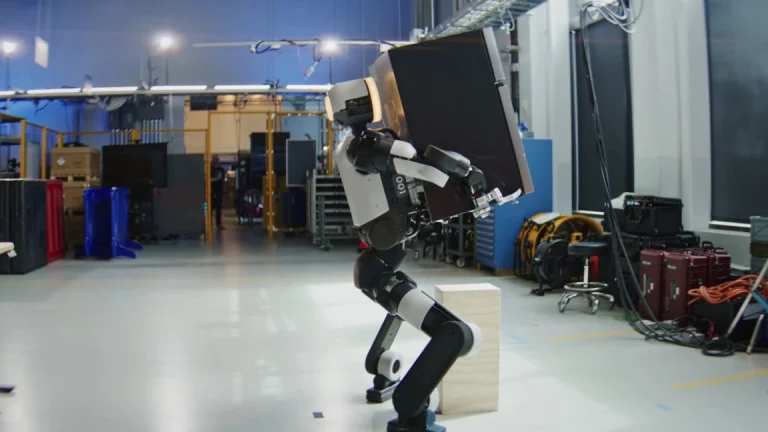
The HMND 01 Alpha is not a biped. It is a dual arm mobile manipulator on an omnidirectional wheeled base, standing 220 centimeters tall and moving at up to 7.2 km/h. The current Alpha configuration carries up to 15 kilograms total, has close to 29 degrees of freedom, and can use either a 12 DOF five finger hand or a parallel gripper. Compute comes from NVIDIA Jetson Thor, listed at about 800 TOPS of AI inference capacity.
Humanoid’s technical bet is that factory floors do not need legs if the target work is box handling, tote logistics and container transfer. Tech Times argues that bipedal systems still spend too much of their control budget on balance for commercial uptime in structured plants. A wheeled base also gives Humanoid a simpler path toward CE certification, which the company is targeting by 2027.
Schaeffler appears to agree with that operating premise. Its deployment agreement with Humanoid, signed May 13, 2026, targets a four digit number of wheeled robots across Schaeffler’s global facilities by 2032. The first phase is scheduled for December 2026 through June 2027 at two German sites: Herzogenaurach for box handling in live production operations, and Schweinfurt for capability demonstration and integration testing.
KinetIQ ties fleet planning to low level control
Humanoid’s KinetIQ software is described as a four layer control architecture operating across different timescales. At the top, System 3 assigns work across a facility within seconds. System 2 breaks instructions into subtasks for an individual robot. System 1 handles vision language action control at 5 to 10 Hz, while System 0 runs whole body control at 50 Hz.
The locomotion layer uses reinforcement learning trained entirely in simulation, with Tech Times citing about 15,000 hours of simulated experience for a capable model. Humanoid says the approach applies to wheeled and bipedal platforms, allowing data from one embodiment to improve the other. For now, the commercial emphasis is clearly on wheeled systems, where stability and certification are more tractable.
Tech Times cites IDC projections that wheeled humanoid robots will grow at about 120 percent compound annually, ahead of roughly 95 percent for full bipedal humanoids. Forecasts in this category should be treated cautiously, but the direction matches what many industrial buyers are asking for: mobility where it is useful, without paying for legged locomotion where it adds little operational value.
The contracts reduce some risk, not the uptime problem
The Schaeffler relationship also covers supply. The company is set to provide more than 50 percent of Humanoid’s joint actuator demand for wheeled platforms through 2031, involving a seven digit number of actuators. Since actuators are estimated by Tech Times at 40 to 60 percent of a humanoid robot’s bill of materials cost, locking down that supply is a substantial manufacturing advantage.
Bosch ran a proof of concept in March 2026 at an intralogistics facility in Bühl, Germany, where HMND 01 robots autonomously moved boxes from a conveyor to a trolley across five box sizes and footprints. The manufacturing agreement followed in May. At Siemens’ electronics factory in Erlangen, HMND 01 Alpha ran a tote-to-conveyor destacking task at 60 tote moves per hour, with pick and place success above 90 percent and uptime beyond eight hours. The figures are Humanoid’s own, from its account of the January 2026 trial.
Several headline figures remain company claims. Humanoid says it has 34,000 preorders worth about $2.4 billion and nine completed proof of concept projects with Fortune 500 partners, but Tech Times says those figures have not been independently verified.
The next hard test is scheduled for Q4 2026, when Beta robots are expected to enter sustained factory operation. A robot that can move boxes in a controlled trial is one thing. A fleet that can keep doing it across shifts, with dented packaging, imperfect trolley placement and ordinary plant variability, is the standard Schaeffler’s factories will apply.
Sources: Humanoid, “Humanoid Raises $152 Million at $1.35 Billion Post-Money Valuation”, 21 July 2026 · Humanoid, “Humanoid Secures Partnership with Bosch Following a Successful POC”, 21 May 2026 · Humanoid, “Humanoid Secures Landmark Deal with Schaeffler”, 13 May 2026 · Humanoid and Siemens, proof of concept, 15 January 2026 · Forbes, 13 May 2026 · Forbes, 21 May 2026 · Forbes, 21 July 2026 · Engadget, 21 May 2026 · Interesting Engineering, 22 May 2026 · NEURA Robotics, Series C, 10 June 2026 · Tech Times, 24 July 2026