Welcome, HELIOS!
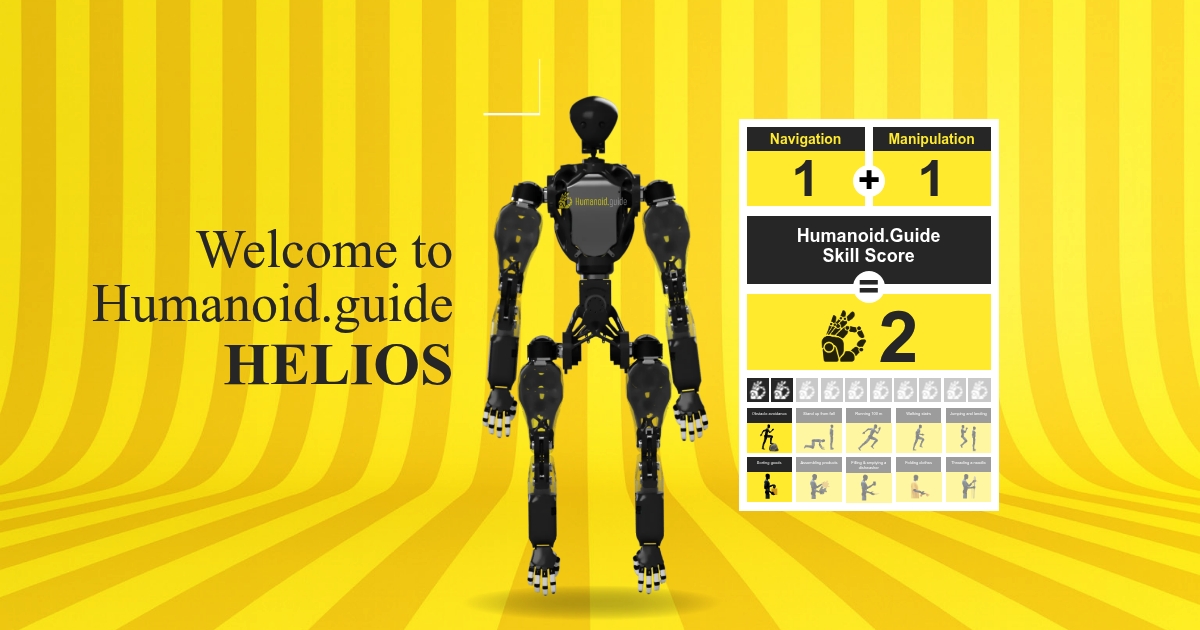
HELIOS is a humanoid robot prototype from ORBIT Robotics in Switzerland, created for space research and operations in microgravity. Rather than pursuing human style walking, the platform uses four coordinated arms to move through station interiors, stabilize its body, and position itself for work in tight orbital spaces. This makes it a distinctly task focused humanoid whose form follows the realities of motion in orbit. Humanoid.guide gives HELIOS a total skill score of 2, with Navigation rated 1 out of 5, and Manipulation rated 1 out of 5, which places it firmly in an early stage category rather than a mature deployment system. Even so, the prototype highlights several ambitious ideas, including autonomous experimentation, teleoperation, and parallel arm use for mobility and handling. Page details describe 28 overall degrees of freedom, 14 in the hands, a height of 160 centimeters, a top speed of 2 kilometers per hour, and a runtime of about 3 hours per charge. Its structure uses aluminum alloys and carbon fiber, with electric actuators, a tendon driven system, and rolling contact joints intended to reduce moving mass and improve agility.
Within the limited public skill profile, HELIOS is currently credited with obstacle avoidance and sorting goods. In a space habitat, obstacle avoidance matters because narrow passages, floating equipment, and changing layouts can turn simple motion into a planning problem. Even with a low navigation tier rating, the presence of this capability suggests the platform can support basic collision aware movement under supervision or structured autonomy. Sorting goods is also notable for orbital logistics, where researchers may need a robot to identify, organize, and place supplies into designated areas. That use case fits HELIOS well because its four arm layout can help with body stabilization while one or more limbs perform the sorting task. These abilities should be read as early demonstrations, not proof of broad warehouse style autonomy.
Availability is listed as Prototype, and the page states that HELIOS is not currently available for purchase. That status fits the product description, which emphasizes rapid iteration and hands on testing over polished commercialization. ORBIT Robotics says the first platform was completed in only two months, underscoring a development style centered on learning quickly from real hardware in realistic constraints. For the broader humanoid field, HELIOS matters because it shows that humanoid design in space may diverge from Earth focused expectations. Instead of optimizing for walking, it prioritizes anchoring, reaching, and controlled movement in orbit. If the concept matures, it could inform future station assistants for research support, internal logistics, and teleoperated intervention, while also serving as a testbed for autonomy in environments where balance and locomotion follow very different rules.