Welcome, Pantheon Hand!
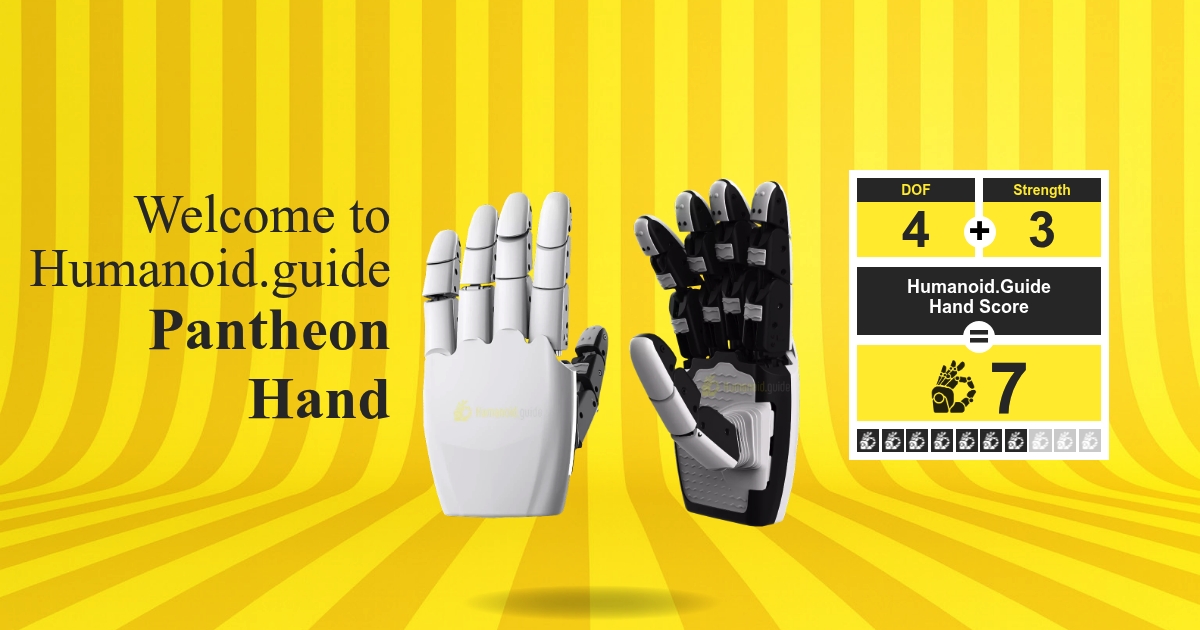
Pantheon Hand is Stella Robot’s flagship tendon driven robotic hand, combining a lightweight hand assembly with a design that places its electric motors outside the hand itself. The manufacturer’s drive and hand separation approach locates those motors in the forearm or robot body, reducing the mass carried at the hand. The listed hand weight is 0.29 kg, with dimensions of 230 × 190 × 50 mm and a five finger configuration. Its transmission uses single side pull cables, supported by automatic tension adjustment intended to maintain cable tension over time. The design addresses a practical issue for tendon mechanisms: cable behavior can change through stretching and temperature variation. Pantheon Hand earns an overall score of 7 out of 10, placing it in the capable or mature category. Its category ratings are 4 out of 5 for Degrees of Freedom and 3 out of 5 for Strength, giving it a stronger relative rating for joint freedom than for force.
The scoring profile emphasizes dexterity while retaining a solid strength assessment. A Degrees of Freedom rating of 4 out of 5 places Pantheon Hand toward the upper end of that category, while its Strength rating of 3 out of 5 sits in the middle tier. These ratings describe different aspects of hand performance and should be read separately rather than treated as interchangeable measures. Joint freedom concerns the range of independent movement available within a hand design, whereas strength concerns its force related performance. Together, the two scores provide a concise comparison framework: Pantheon Hand receives greater recognition for degrees of freedom, with strength contributing to an overall assessment of a capable, mature robotic hand.
Pantheon Hand is listed as in production, with an advertised price of USD 3,500 and an inquiry option for prospective buyers. Its manufacturer, Stella Robot, is a robotics startup based in Shenzhen, China, and positions the hand as part of its high end product line. The broader significance lies in its architectural choice: separating the motors from the hand changes where weight and mechanical complexity sit within a robotic system. That makes the distinction between hand assembly specifications and the surrounding drive installation important when evaluating integration. For purchasing comparisons, the listed price, production status, physical dimensions, and category ratings offer useful starting points alongside the requirements of the intended robot platform.