Welcome, LinkerArm A7!
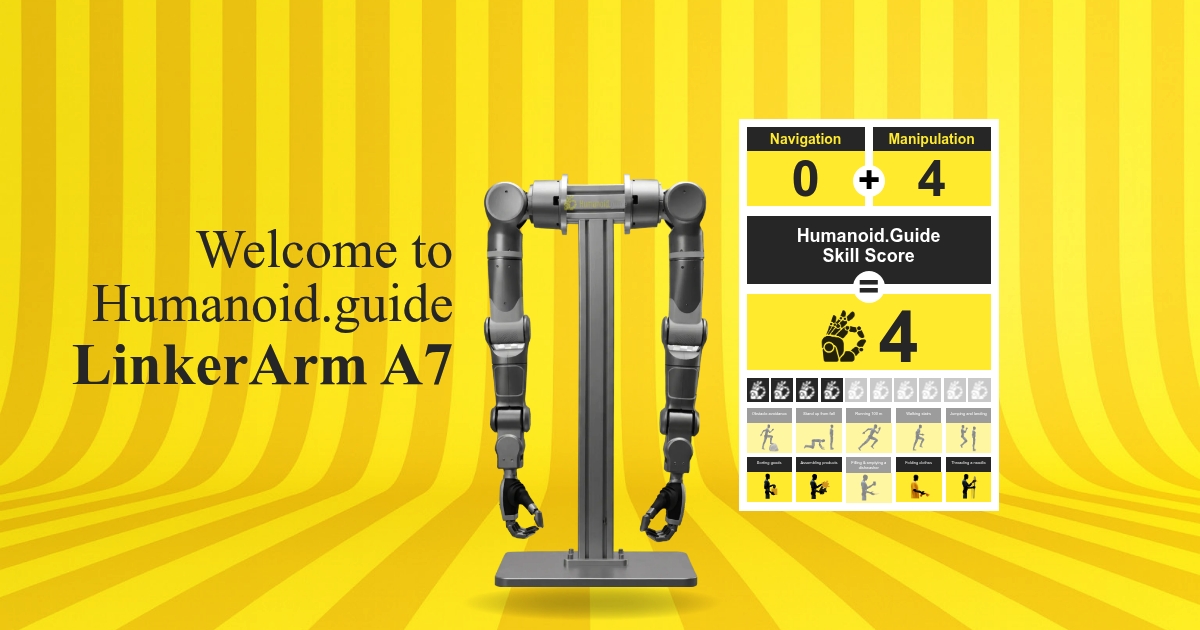
LinkerArm A7 is a LinkerBot humanoid manipulation platform designed around a seven axis arm and the Linker Hand series. It brings together human like reach, redundant positioning, and hand based control for embodied AI research, data collection, and light industrial manipulation. Its Humanoid Guide Skill Score is 4 out of 10, placing it at a developing stage, with navigation rated 0 out of 5 and manipulation rated 4 out of 5. This profile centers the system on arm and hand tasks rather than autonomous mobility. The platform has 14 overall degrees of freedom, including 14 hand degrees of freedom, a 140 centimeter height, a 40 kilogram weight, and a stated 6 kilogram strength figure. Aluminium alloy structure, planetary reducers, and integrated joint modules that combine motor, driver, and reducer support a compact mechanical design. Five fingers per hand provide the physical basis for detailed object interaction, while the grey system targets teams building repeatable manipulation workflows.
Manipulation is the central technical emphasis of LinkerArm A7. Its strong manipulation rating supports tasks that demand controlled reaching, hand placement, and precise finger coordination. The platform is suited to sorting goods, assembling products, folding clothes, and threading a needle. These activities span both practical industrial handling and fine dexterity research, making the system relevant for teams collecting demonstrations, testing embodied AI policies, and developing robotic work cells. The arm’s redundant motion allows the hand to approach an object from different positions, which is valuable when objects, tools, or work surfaces constrain access. Combined with the Linker Hand series, the platform provides an integrated route from arm movement to detailed grasping and object handling.
LinkerArm A7 is in production and is manufactured by LINKERBOT, a China based robotics company focused on dexterous robot hands and manipulation systems. It uses CAN and CAN FD connectivity, operates through an external PC or controller, and supports a Python SDK and ROS 2 compatibility. AI compute is handled externally, while LinkerBot’s skill library and external AI models can support higher level control. This architecture makes the platform relevant to research laboratories, developers, and industrial teams that need flexibility in their software stack. Its significance lies in combining a dedicated dexterous hand system with an arm designed for it, supporting a more unified approach to embodied AI data collection and practical manipulation development.