Welcome, E1!
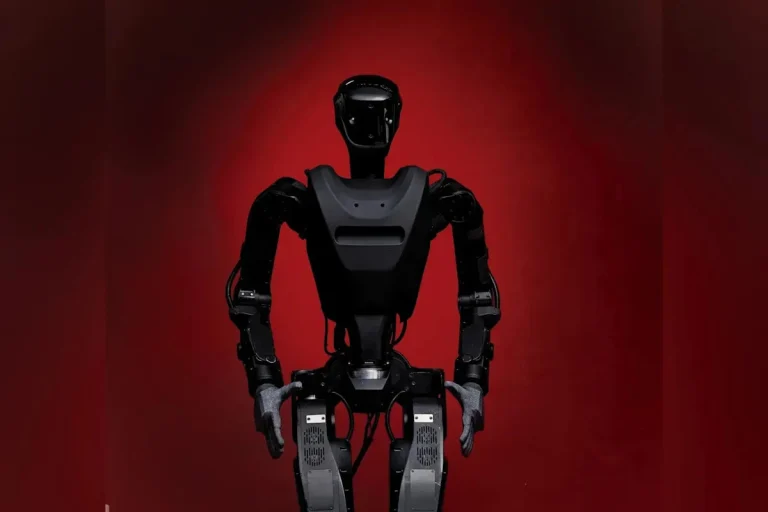
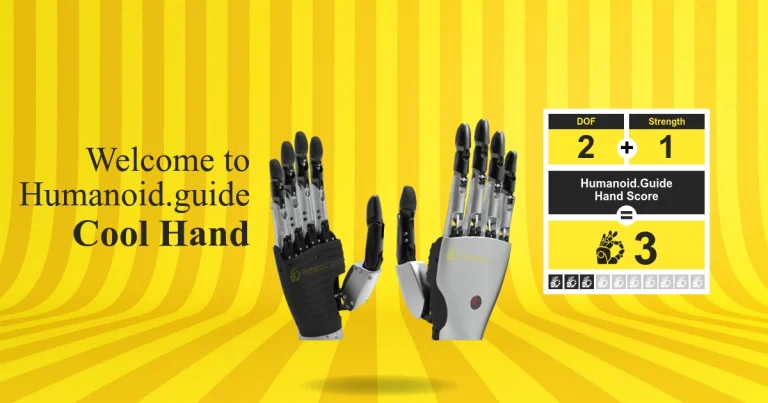
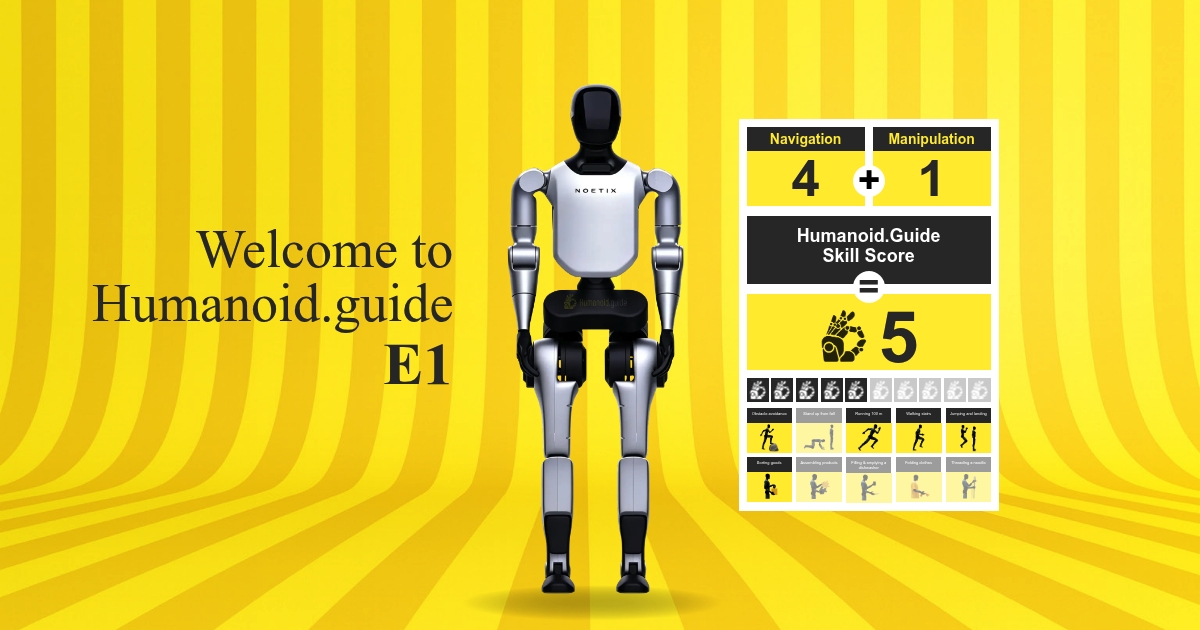
E1 is a compact humanoid from Noetix Robotics, designed for research, education and entertainment. Standing 136 cm tall and weighing 40 kg, it combines a relatively small frame with an emphasis on physical mobility. Its demonstrated capabilities include obstacle avoidance, running 100 m, walking stairs, jumping and landing, and sorting goods. A Humanoid.Guide Skill Score of 5 out of 10 places E1 in the developing category, with a stronger navigation rating of 4 out of 5 and a more limited manipulation rating of 1 out of 5. This balance makes locomotion its clearest strength while keeping expectations for handling tasks grounded. The listed maximum speed is 12.6 km/h, and peak knee torque reaches 150 N·m. Runtime is listed at two hours per charge. E1 has five fingers on each hand, while its specified strength is 5 kg. Together, these characteristics position it as a platform for studying how a compact humanoid moves through physical environments and performs basic object sorting.
E1’s navigation capabilities provide several concrete directions for experiments and demonstrations. Obstacle avoidance supports research into movement around obstructions, while walking stairs introduces changes in elevation and foot placement. Running 100 m offers a setting for examining sustained locomotion, and jumping and landing add a distinct challenge involving balance and impact management. E1 won the standing long jump at the 2025 World Humanoid Robot Games, giving its jumping capability a competitive milestone. Sorting goods provides a practical manipulation task for education and research, although its lower manipulation tier calls for measured expectations. Technical development is supported by a 6 TOPS motion controller and an NVIDIA Jetson Orin Nano Super development configuration with 67 TOPS, 8 GB RAM and 128 GB storage.
E1 is in production, with a listed price of USD 21,000. Its manufacturer, Noetix Robotics, is a Beijing company founded by researchers from Tsinghua and Zhejiang universities. The robot targets education, research and entertainment, placing it within the growing market for humanoid platforms used beyond industrial deployment. Linux and an open SDK support secondary development, while WiFi 6, Bluetooth 5.2 and built in 4G connectivity offer several integration options. For prospective users, E1’s broader significance lies in the combination of compact dimensions, demonstrated locomotion and development hardware. Its developing overall score also provides useful context: this is a platform for structured experimentation and capability development, rather than a mature general purpose worker.