Welcome, Dex!
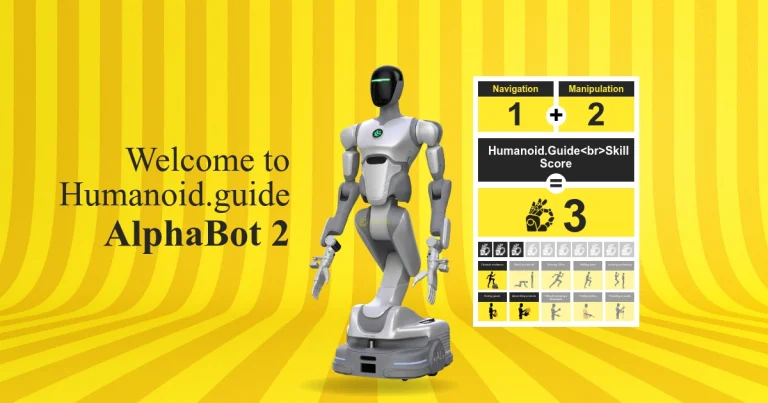
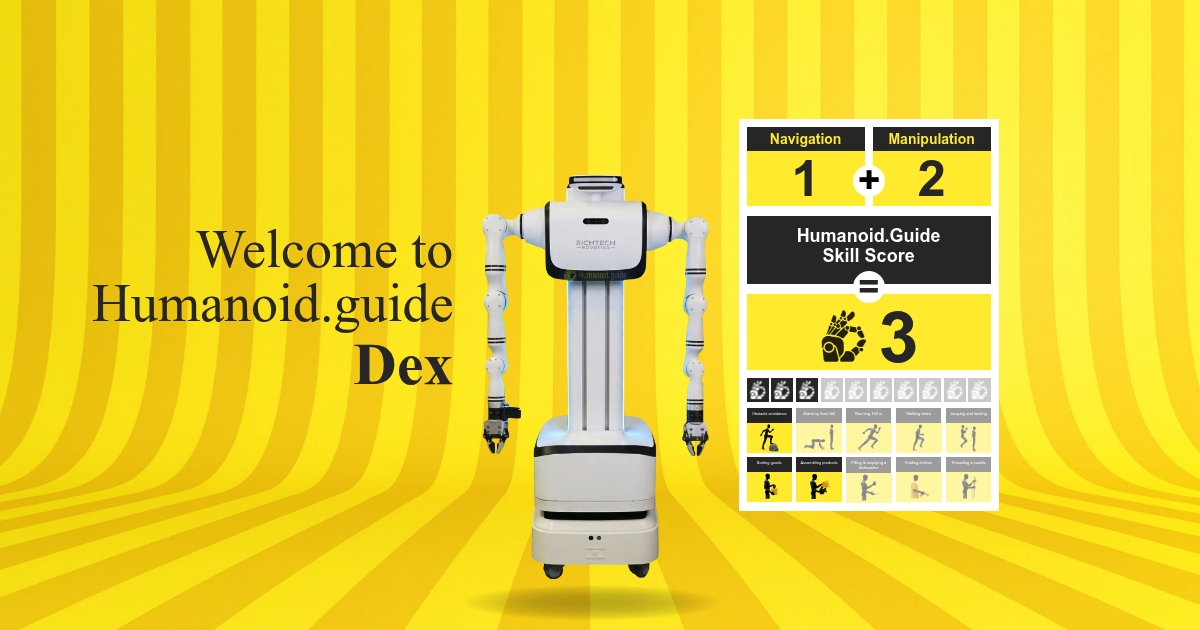
Dex is an industrial humanoid from Richtech Robotics designed for manufacturing, logistics and warehouse environments. It combines two arms with either a mobile wheeled base or a stationary configuration, giving facilities a choice between movement across work areas and operation at a fixed workstation. The robot stands 137 cm tall, weighs 60 kg and has a listed strength specification of 10 kg. Its maximum travel speed is 3.6 km/h, while the mobile configuration offers a stated runtime of four hours per charge. NVIDIA Jetson Thor provides its computing platform, and electric motors power its movements. Modular end effectors let operators select hardware suited to different objects and workstation requirements, including gripping claws, clamps and suction cups. Dex has an overall skill score of 3 out of 10, placing it in the developing category. Its Navigation rating is 1 out of 5 and its Manipulation rating is 2 out of 5, reflecting a platform whose industrial capabilities remain in development rather than a mature general purpose worker.
Dex supports obstacle avoidance, sorting goods and assembling products. In a warehouse or factory, obstacle avoidance is relevant when the mobile configuration travels through shared work areas, while sorting goods gives its arms a practical role in organizing items. Product assembly provides another application for the stationary configuration, where a consistent workstation layout can support repeatable tasks. The combination of two arms and interchangeable end effectors allows different physical interfaces to be selected for these activities. Its lower Navigation tier and developing Manipulation rating are important considerations when defining deployment scope. Suitable evaluations should concentrate on specific sorting or assembly workflows, with clear requirements for object characteristics, workspace layout and interaction with nearby personnel.
Dex is listed as a prototype with a price of USD 60,000. Richtech Robotics introduced it in October 2025 as its first mobile humanoid, extending a robotics business based in Las Vegas. The company is listed on Nasdaq and reports more than 450 robot deployments across the United States, although that figure describes its broader deployment experience rather than Dex installations. The use of NVIDIA Jetson Thor connects Dex to an established robotics computing platform without establishing a separate commercial partnership. Its broader significance lies in combining industrial arms, configurable tooling and a choice of mobile or stationary layouts. For prospective users, its prototype status makes focused trials and clearly defined acceptance criteria especially important before committing to production use.