Welcome, Apollo 2!
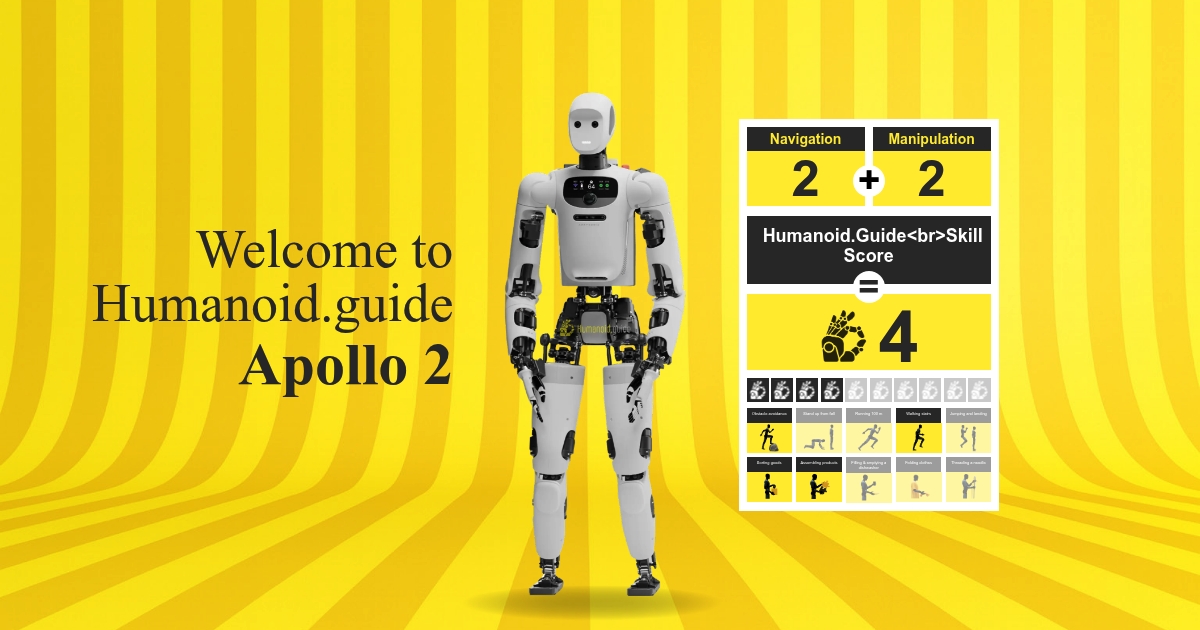
Apollo 2 is a modular humanoid robot from Apptronik designed for practical work in human environments. Its core idea is adaptability: the same system can operate as a walking biped or switch to a wheeled base when stability and steady throughput matter more. The robot stands 173 centimeters tall, weighs 75 kilograms, reaches speeds up to 5 kilometers per hour, and is rated to handle 25 kilograms. With 35 total degrees of freedom and 12 in the hands, Apollo 2 is shaped for mobile manipulation rather than static demonstration. It is designed to work safely with people and to communicate clearly through speech, coordinated lighting, an expressive LED mouth, and a chest display that shows status, battery level, and task progress. Swappable batteries support long shifts, with runtime listed at 4 hours per charge. Apollo 2 currently sits in a developing stage, reflected in a total score of 4, with navigation rated 2 and manipulation rated 2, positioning it as an emerging platform focused on dependable workplace deployment rather than headline chasing athletic feats.
Apollo 2’s current capability profile centers on useful day to day tasks that matter in service and industrial settings. It is listed with obstacle avoidance, which is essential for moving through shared spaces where people, carts, and equipment constantly change the scene. On the manipulation side, it is associated with sorting goods, a strong fit for logistics and retail workflows that depend on repeatable handling, placement, and organization. It is also connected with putting dishes, showing that its hands and arm control are being developed for structured service tasks in environments such as hospitality or back of house operations. These examples point to a robot intended for routine material flow and workspace assistance, where steady execution, readable behavior, and compatibility with human teams are more important than spectacle.
Apollo 2 is listed as a prototype, which places it in an important phase between concept and scaled deployment. That status matters because Apptronik is pairing the hardware with its proprietary Artemis control and AI stack, plus Fleet Connect for robot management across operations. Connectivity includes Ethernet and Wi Fi, supporting integration into enterprise environments. A notable strategic element is Apptronik’s partnership with Google DeepMind and Gemini Robotics foundation models, signaling an effort to connect embodied action with more advanced language and reasoning systems. In the broader humanoid market, Apollo 2 represents a pragmatic direction: not a fixed machine for one narrow role, but a configurable platform that can be tuned for manufacturing, logistics, and retail. That combination of modular mobility, human friendly communication, and software ambition makes it a closely watched entrant in the developing commercial humanoid landscape.