
R1-D
13 390 USD

Unitree Robotics
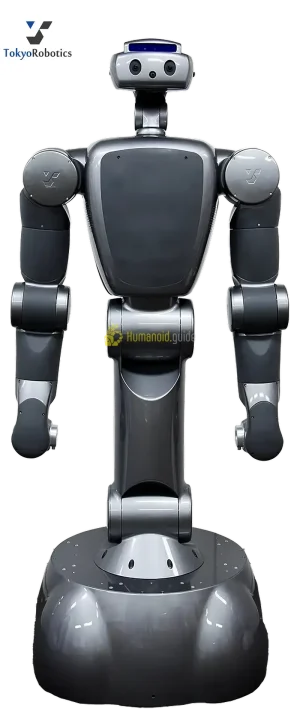
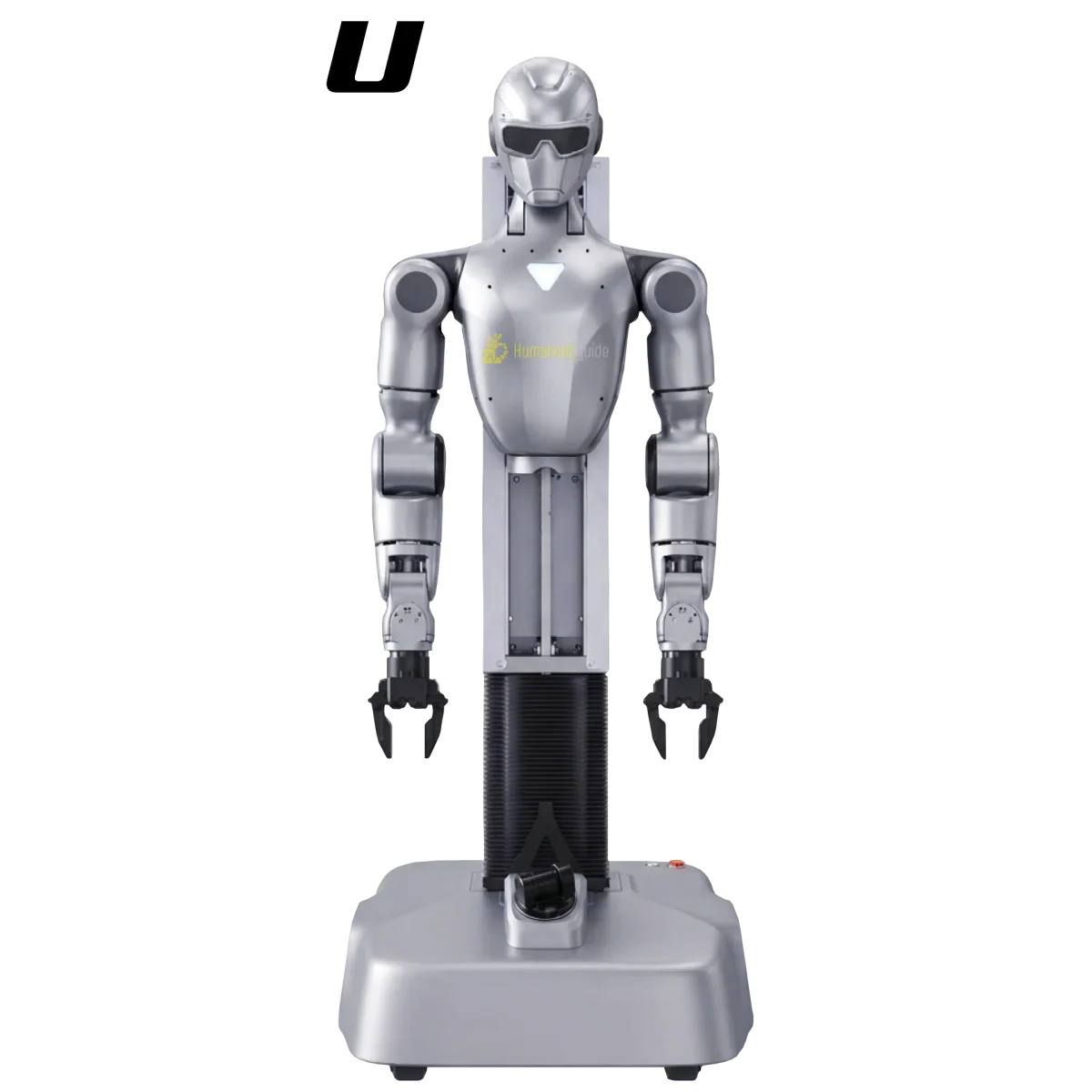
Unitree R1-D is a wheeled dual-arm humanoid launched in April 2026. It pairs 7-DoF arms with a lifting column, LiDAR navigation and swappable hands for research, education and AI data collection.
Skill Score
 4
4

Specifications and details:
| Availability | In production |
|---|---|
| Nationality | China |
| Website | https://www.unitree.com/ |
| Degrees of freedom, overall | 36 |
| Degrees of freedom, hands | 14 |
| Height [cm] | 160 |
| Max speed (km/h) | 3.6 |
| Strength [kg] | 8 |
| Weight [kg] | 52 |
| Runtime pr charge (hours) | 1.5 |
| Safe with humans | Largely yes. It is light, uses low-payload arms, and has LiDAR on the base. It has no formal safety certification. |
| CPU/GPU | 8-core CPU in the body / 8-core CPU with 10 TOPS in the head / optional NVIDIA Jetson Orin (40–100 TOPS) |
| Ingress protection | N/A |
| Camera resolution | Binocular RGB camera at 1280×720 at 30 Hz, with depth at 544×448 at 10 Hz; optional wrist cameras |
| Connectivity | Bluetooth 5.2, Wi-Fi 6 |
| Operating system | Linux-based Unitree system with over-the-air updates and secondary development through the Unitree SDK and ROS 2 |
| LLM integration | Yes. It has voice interaction through dual microphone arrays, and it supports Unitree's UnifoLM AI models. |
| Latency glass to action | N/A |
| Motor tech | Unitree's own permanent magnet joint motors (60 N·m shoulder torque) |
| Gear tech | N/A |
| Main structural material | N/A |
| Number of fingers | 5 per hand |
| Main market | AI training data collection, Developers, education, Research |
| Color | Silver-grey |
| Manufacturer | Unitree Robotics |
Description
R1-D is a dual-arm humanoid from Unitree Robotics, the Chinese robot maker from Hangzhou. Unitree launched the series at the end of April 2026 as part of its R1 family. The R1-A7-D version combines two seven-joint arms with a wheeled base. Unlike Unitree’s walking robots, it rolls around on wheels and stretches upward on a lifting column. In short, it turns the idea of an affordable humanoid into a practical tabletop and mobile work platform.
The robot has a friendly shape and weighs about as much as a large suitcase. When it rests, it folds down to a low, compact size. However, it can raise itself to roughly the height of an adult when it needs to reach. Its arms move much like human arms, so it can handle objects with smooth, natural motions. Users can also fit a simple gripper, a three-finger hand or a five-finger hand.
New! 2026 Humanoid
Robot Market Report
198 pages of exclusive insight from global robotics experts — uncover funding trends, technology challenges, leading manufacturers, supply chain shifts, and surveys and forecasts on future humanoid applications.

now Google DeepMind
R1-D sees its surroundings with a stereo camera in its head, and it can use cameras on its wrists too. Additionally, a LiDAR sensor in the base helps it map rooms and move around obstacles. It can listen and respond to voice commands through its microphones and speakers. Meanwhile, developers can add a more powerful NVIDIA computer for heavier AI workloads. Unitree also lets its own embodied AI models run on the robot.
I’m Olivia, Humanoid Analyst at Humanoid.Guide
My mission, together with the team, is to help your organization understand the landscape, compare solutions, and move toward successful robot deployments.
Unitree aims R1-D mainly at researchers, universities and developers. Teams can use it to collect training data, test new AI models and practice fine manipulation tasks. Moreover, its low price opens the door for smaller labs and schools. The robot fits well in labs, classrooms and light assembly setups. Overall, R1-D gives more people an easy way to experiment with capable robot arms on a mobile body.
Download the Humanoid Robot Market Report here
Website: www.unitree.com