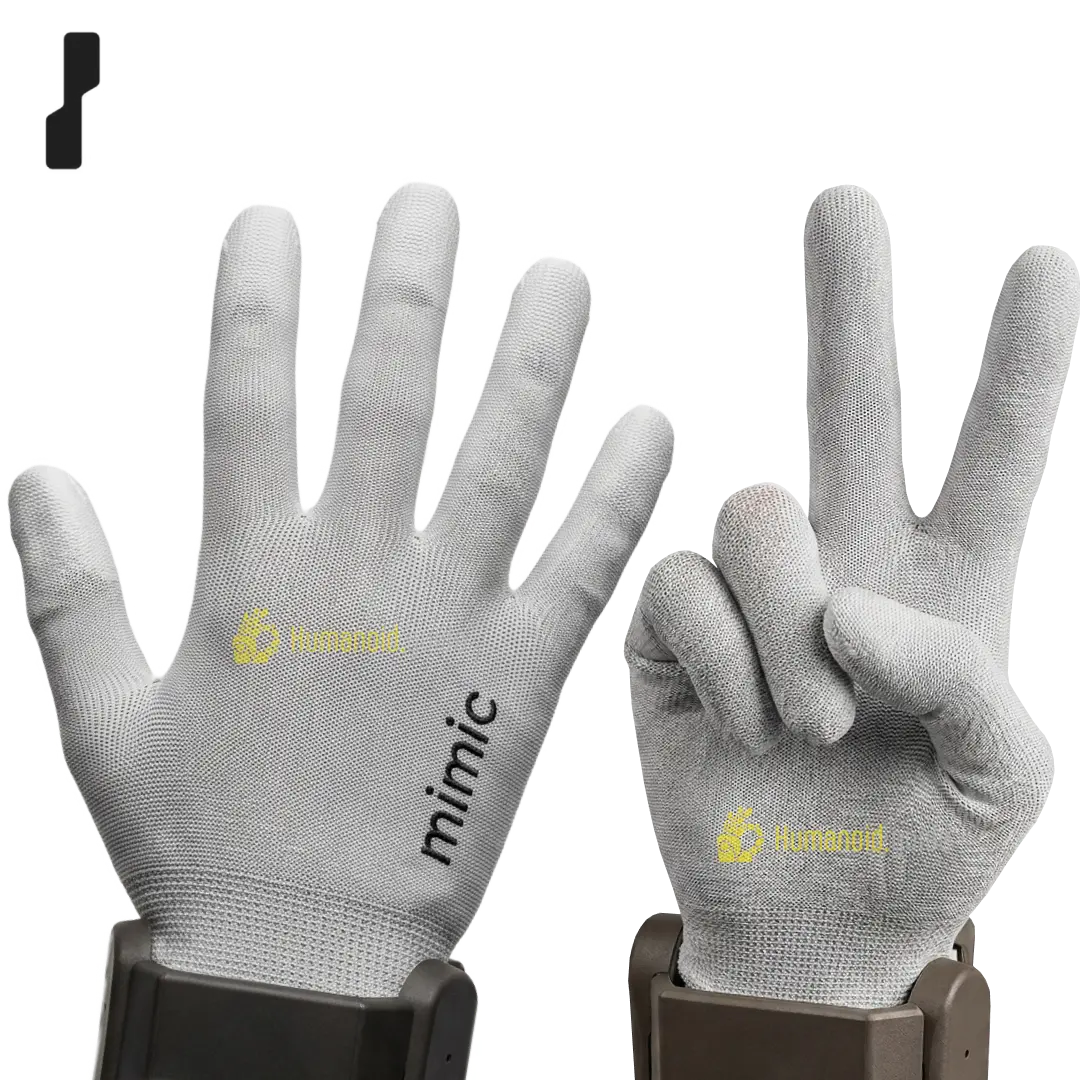
Mimic Hand M1

Mimic Robotics
The mimic hand M1 is a Swiss-made, tendon-driven robotic hand purpose-built for industrial automation. It pairs human-like dexterity with serious strength, lifting payloads over 25 kg while sensing forces as light as 50 g. Built-in force sensing, fingertip touch, and a wrist camera make it a smart, durable end-effector for AI-driven manipulation.
Hand Score
 6
6

Specifications and details:
| Strength [kg] | 25 |
|---|---|
| Weight [kg] | 1.8 |
| Number of fingers | 5 |
| Degrees of freedom, hands | 15 |
| Tactile/Force Sensors | Yes |
| Motor tech | Bi-directional, pulley-guided tendon drive with forearm-mounted actuators; highly backdrivable (< 0.05 Nm), force estimation via motor current (< 0.1 N) |
| Main structural material | Strong metal alloy structures (with high-performance tendons) |
| Manufacturer | Mimic Robotics |
| Nationality | Switzerland |
| Website | https://www.mimicrobotics.com/ |
| Availability | Not sold separately |
Description
The mimic hand M1 is a tendon-driven robotic hand that Mimic Robotics designed and built entirely in-house for real industrial work. Rather than chase raw complexity, the company matched the hand’s motion to the human hand’s most useful movements, so it grips, pinches, and manipulates the way a person naturally would. This human-matched form factor also serves a deeper purpose: it lets the robot learn directly from video and hands-on demonstrations of people doing tasks. As a result, the M1 handles delicate, precise jobs and heavy, forceful ones with the same system, and it absorbs the occasional knock or collision instead of breaking.
2026 Humanoid Robot Market Report
Interested in the Mimic Hand M1? Download 198 pages of exclusive insight from global robotics experts — uncover funding trends, technology challenges, leading manufacturers, supply chain shifts, and surveys and forecasts on future humanoid applications.
humanoid expert
What sets the M1 apart is how much it can feel. Its joints move freely and sense force through the motors themselves, so the hand notices contact as light as a small weight and adjusts its grip on the fly. Meanwhile, fingertip sensors and a wrist camera feed rich touch and visual information back to the AI that controls it. Because Mimic places the motors in the forearm and routes the tendons over smooth pulleys, the hand stays strong, reliable, and consistent across years of repeated use. Consequently, factories can trust it on the floor for demanding, shift-length operations, and developers can integrate it without wrestling with fragile, over-miniaturized parts.
Download the Humanoid Robot Market Report here
Website: www.mimicrobotics.com