Avatar
300 000 USD

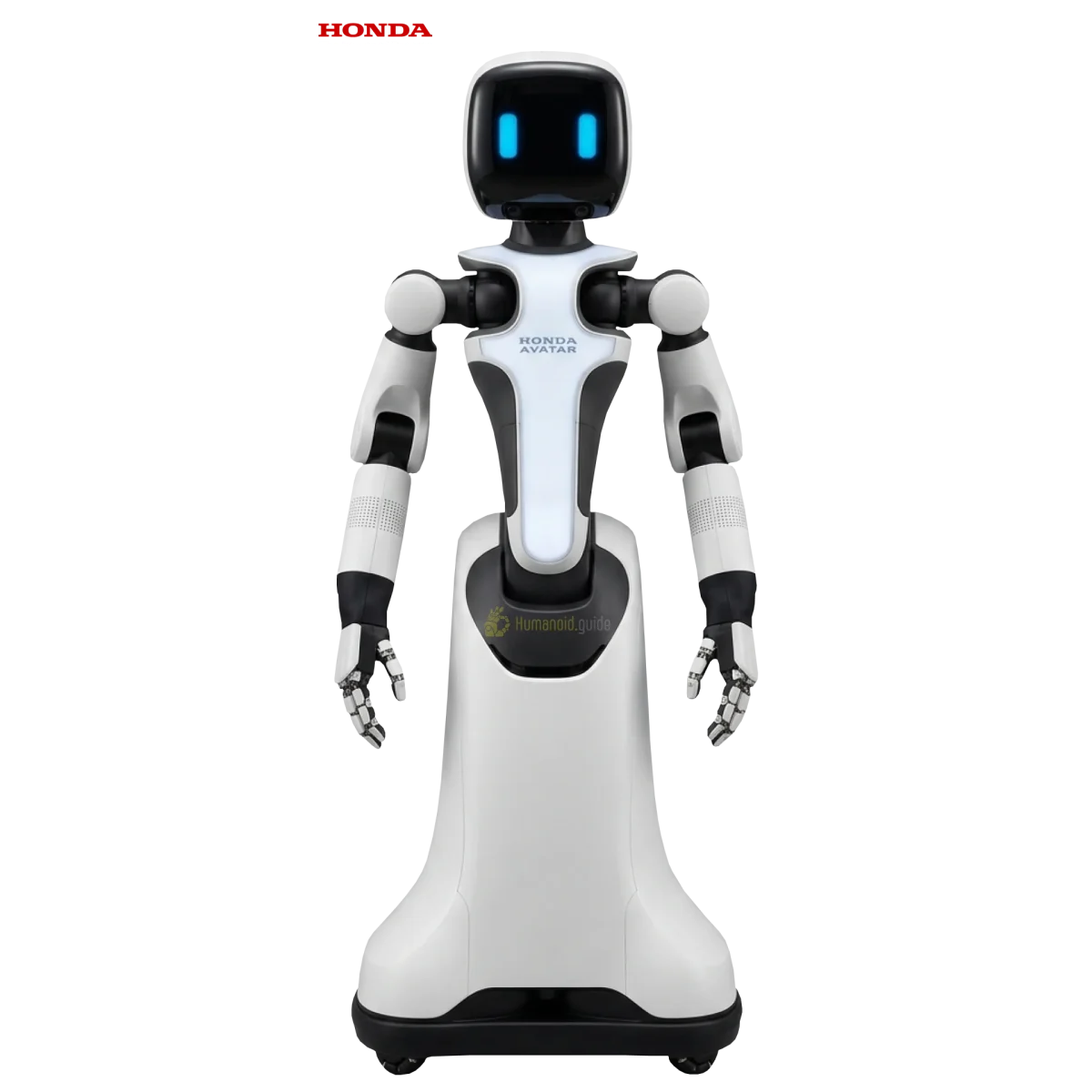
The Honda Avatar Robot is a wheeled humanoid for remote physical work, demonstrated at CEATEC 2026. It pairs human-strength multi-fingered hands with 288 tactile channels and fingertip force sensing, plus an AI support system that shares control with the operator, for medicine, maintenance, disaster response and space.
Honda R&D Co., Ltd.
Skill Score
 3
3

Specifications and details:
| Availability | Prototype |
|---|---|
| Nationality | Japan |
| Website | https://global.honda/en/ |
| Height [cm] | 155 |
| Max speed (km/h) | 3 |
| Strength [kg] | 5 |
| Weight [kg] | 101 |
| Runtime pr charge (hours) | N/A |
| Safe with humans | Partly: whole-body torque control; tactile and force sensing |
| CPU/GPU | N/A |
| Ingress protection | N/A |
| Camera resolution | Head: wide-view fisheye and 4 RGB-D cameras / Intel RealSense cameras at the hands |
| Connectivity | Network teleoperation (VR headset and gloves) |
| Operating system | N/A |
| LLM integration | AI support system for shared autonomy (operator makes decisions, robot executes fine motions) |
| Latency glass to action | AI shared control designed to tolerate communication delays |
| Motor tech | Forearm-mounted electric motors with cable-and-pulley (tendon-like) finger drive / Torque-controlled body joints |
| Gear tech | Cable/pulley transmission (>90% efficiency targeted) |
| Main structural material | N/A |
| Number of fingers | 10 (5 per hand) |
| Main market | Remote work: medical support, equipment maintenance, disaster response, space exploration |
| Color | White |
| Manufacturer | Honda R&D Co., Ltd. |
Description
The Honda Avatar Robot is a remote-work robot from Honda, the Japanese automaker with robotics research dating back to 1986. Honda calls it a “second self” for its operator. The idea is simple: a person anywhere in the world can perform physical work through the robot. It has a humanlike upper body with two arms on a wheeled base. Honda demonstrated it most recently at CEATEC 2026 in Japan in October.
The robot’s highlight is its multi-fingered hand. Unlike many robot hands, Honda places the motors in the forearm and moves the fingers with cables, much like human muscles and tendons. As a result, the hand reaches strength close to a human’s while staying compact. Hundreds of tactile sensors and fingertip force sensors let it feel what it touches. In fact, Honda says it can handle jobs from threading a needle to tightening screws and lifting heavier tools.
New! 2026 Humanoid
Robot Market Report
198 pages of exclusive insight from global robotics experts — uncover funding trends, technology challenges, leading manufacturers, supply chain shifts, and surveys and forecasts on future humanoid applications.

now Google DeepMind
Honda also rethought how people control the robot. Typical remote robots simply copy every move the operator makes. Instead, Honda’s AI support system lets the operator make high-level decisions while the robot handles fine details on its own. Therefore, it copes better with communication delays and differences between human and robot bodies. Honda describes it as more than a puppet controlled from afar.
I’m Olivia, Humanoid Analyst at Humanoid.Guide
My mission, together with the team, is to help your organization understand the landscape, compare solutions, and move toward successful robot deployments.
Honda sees many uses for the technology. For example, medical staff could provide first aid remotely, or engineers could maintain equipment in hard-to-reach places. It could also help in disaster zones and even on the surface of the Moon. Moreover, it could let people work regardless of where they live or their physical abilities. Honda expects robots like this to enter everyday life in the 2030s.
Download the Humanoid Robot Market Report here
Website: https://global.honda/en/topics/2026/c_2026-10-05ceng.html