Taku
60 000 USD

DYNA Robotics
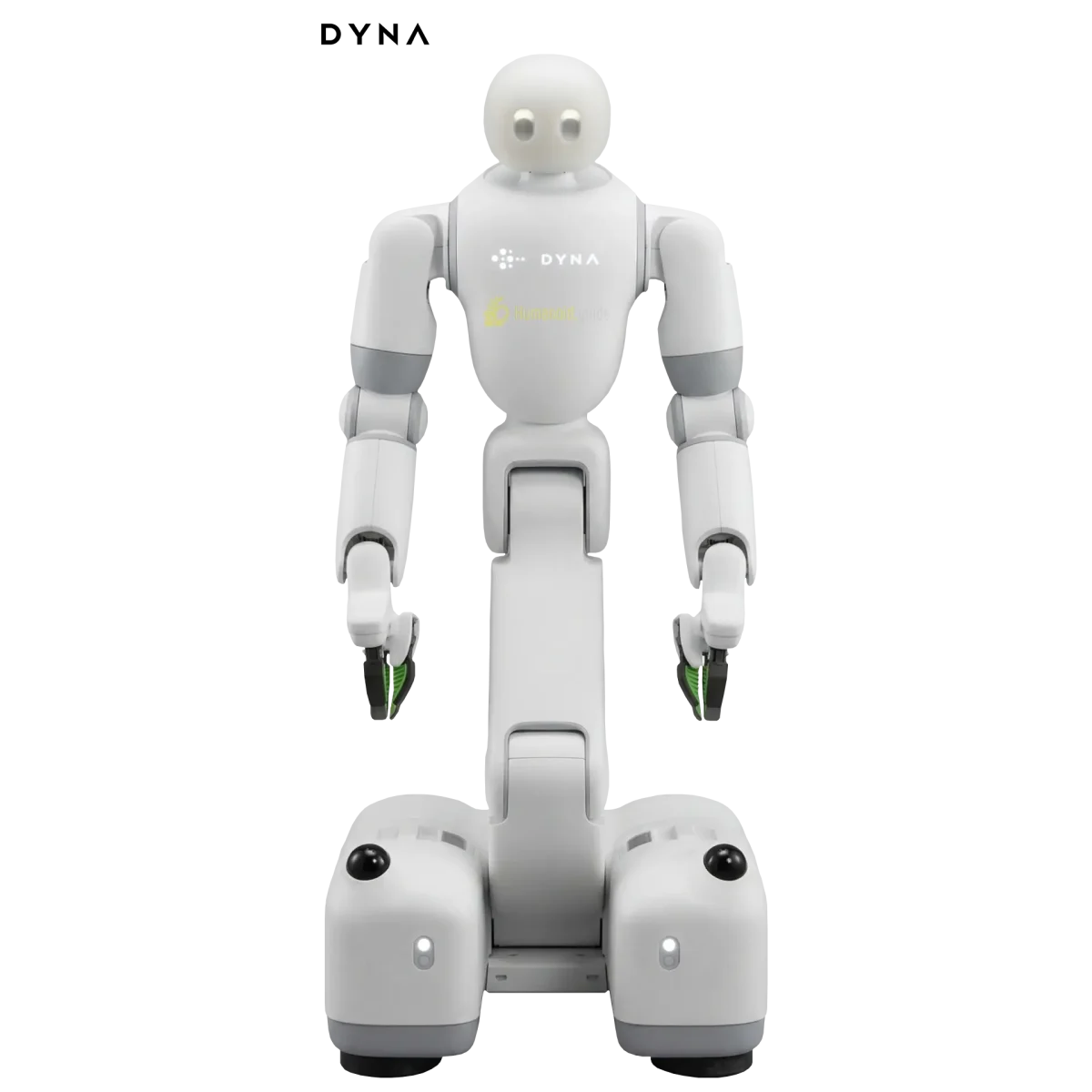
Taku is DYNA Robotics’ wheeled semi-humanoid, unveiled in September 2026 with the Dyna-2.1 AI system. With a 21-DoF upper body, two 7-DoF arms, a folding lower body and four steerable wheels, it autonomously ran an hour-long hotel laundry workflow: washing, drying, folding and shelving towels.
Skill Score
 4


Specifications and details:
| Availability | In production |
|---|---|
| Nationality | US |
| Website | https://www.dyna.co/ |
| Height [cm] | 170 |
| Max speed (km/h) | N/A |
| Strength [kg] | 10 |
| Weight [kg] | N/A |
| Runtime pr charge (hours) | N/A |
| Safe with humans | Designed to work in hotels and restaurants around people, and its four-wheel base cannot tip over |
| CPU/GPU | N/A |
| Ingress protection | N/A |
| Camera resolution | Not disclosed. It senses through vision, touch and proprioception. |
| Connectivity | N/A |
| Operating system | Dyna's own AI stack: a workflow orchestrator, a vision-language model, the DYNA-2 policy and a whole-body controller |
| LLM integration | Yes: Dyna-2.1 with a vision-language model orchestrator, Dyna-2 world-action model (~5 Hz) and RL whole-body controller (100 Hz) |
| Latency glass to action | N/A |
| Motor tech | N/A |
| Gear tech | Low-ratio planetary gears (arms) |
| Main structural material | N/A |
| Number of fingers | 2-finger gripping claws |
| Main market | Commercial services, Hotels, Laundry, Restaurants, Warehouses |
| Color | White |
| Manufacturer | DYNA Robotics |
Description
Taku is a semi-humanoid robot from DYNA Robotics, a US company that builds AI-powered robots for commercial work. DYNA introduced it on September 29, 2026, together with its Dyna-2.1 AI system. The name comes from the Japanese word takumi, meaning master craftsman. Taku has a humanlike upper body with two seven-joint arms on a stable base with four steerable wheels. Its folding lower body lets it crouch to a bottom shelf or reach above head height.
DYNA built Taku to take over whole jobs, not just single tasks. The company learned that customers pay for a role, such as running a laundry room for a full shift. For example, in its debut video Taku ran a hotel laundry room alone for an uncut hour. It loaded the washer, moved towels to the dryer, folded them and stacked them on shelves. Moreover, it paused folding whenever a machine finished, then returned to where it left off.
New! 2026 Humanoid
Robot Market Report
198 pages of exclusive insight from global robotics experts — uncover funding trends, technology challenges, leading manufacturers, supply chain shifts, and surveys and forecasts on future humanoid applications.

now Google DeepMind
Three layers of AI make this possible. A vision-language model plans the workflow and remembers progress, such as how many towels it has folded. Meanwhile, DYNA’s Dyna-2 model turns each step into movements, and a fast controller keeps the whole body coordinated. DYNA trained the system on one million hours of human video plus data from its robot fleet. As a result, Taku learns new skills quickly, and it recovers on its own from mistakes like grabbing two towels at once.
I’m Olivia, Humanoid Analyst at Humanoid.Guide
My mission, together with the team, is to help your organization understand the landscape, compare solutions, and move toward successful robot deployments.
Taku’s design focuses on reach and precision rather than legs. DYNA sized its upper body like an average person, so human demonstrations map easily onto the robot. In addition, its arms use fast, low-ratio planetary actuators that keep up with human-speed motion. Beyond laundry, DYNA has shown it servicing servers and fetching drinks from a fridge. In short, Taku aims to be a “whole employee” for hospitality, logistics and factory work.
Download the Humanoid Robot Market Report here
Website: www.dyna.co