GigaAI SeeLight S1 begins home pilot deployment in Wuhan, China
GigaAI says the GigaAI SeeLight S1 will begin a home pilot program in China, with the first 100 units scheduled for deployment in employees’ homes at the end of this month. According to Fast Company, the company then plans free deployments in Wuhan in the first half of 2027, a step that would put a commercial humanoid robot into domestic settings rather than a factory or lab.
The company describes the SeeLight S1 as a commercial robotic butler for household chores. Fast Company reports that GigaAI expects the robot to reach stores in June 2027 at about $15,000, if the pilot and city rollout proceed as planned.
GigaAI SeeLight S1 home pilot plans
The reported rollout starts with internal testing. GigaAI says employees’ homes will receive the first 100 pilot units, creating a controlled but still real-world environment for a machine intended to work around people, pets, furniture, and the shifting conditions of daily home life.
A broader deployment in Wuhan is planned for the first half of 2027 and, according to the source, those early placements would be free. That gives the company a staged path from pilot operation to public launch, while also generating household data on navigation, manipulation, and safety in spaces that are far less standardized than industrial sites.
GigaAI was founded in 2025 and is funded by Huawei’s investment arm, according to Fast Company. The company developed the robot with the Hubei Humanoid Robot Innovation Centre and the Hubei Humanoid Robotics Industry Alliance, placing the project within a larger state-backed push around embodied intelligence in China.
What the home humanoid is designed to do
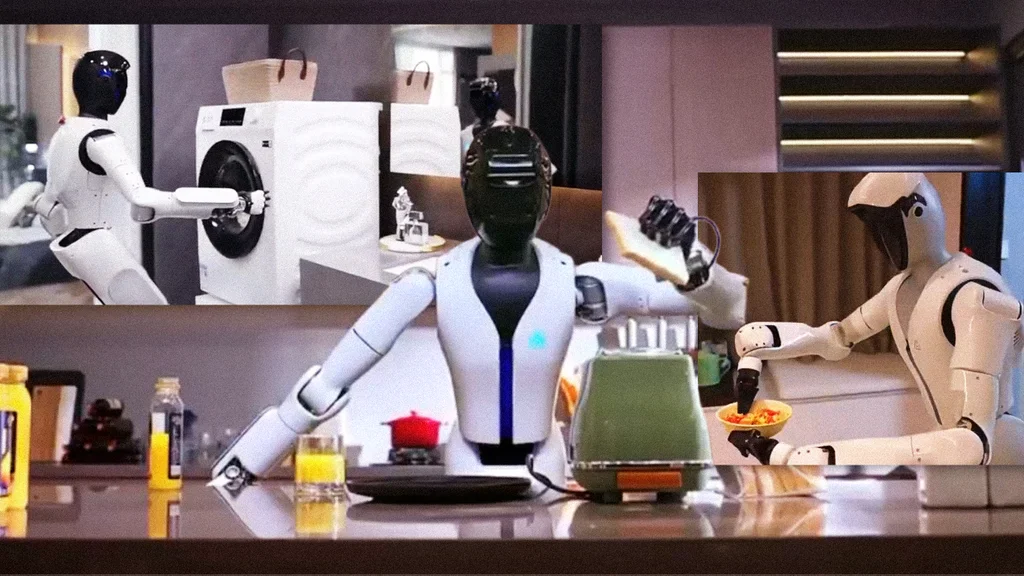
Fast Company describes the SeeLight S1 as a two-armed, wheeled machine aimed at general household work. In company demos, the robot is shown chopping vegetables, frying eggs, loading a washing machine, hanging laundry, making a bed, and opening curtains.
Those tasks matter because they combine navigation with fine manipulation, two areas that remain difficult even for advanced humanoids. A domestic robot has to move through narrow spaces, locate varied objects, and adjust its actions as rooms change from hour to hour.
GigaAI says the robot uses embodied artificial intelligence, meaning perception and decision-making are tied directly to a physical body operating in the environment. The company also says built-in sensors are intended to stop movement immediately if the robot makes contact with a child or a pet, a basic safeguard for a system meant to work in occupied homes.
Why home deployment remains a hard test
The article also highlights the gap between staged demonstrations and reliable household operation. Home environments are not standardized, and the robot would need to handle clutter, moving people, changing object locations, and uneven task conditions without the controlled layouts common in warehouses or production lines.
That is why the SeeLight S1 pilot is notable even before any commercial scale is proven. A wheeled base may simplify balance compared with a fully bipedal humanoid, but domestic work still requires coordinated arm motion, scene understanding, and safe behavior in close proximity to residents.
Fast Company cites outside voices who remain cautious about how quickly humanoids can become useful in homes. The skepticism is less about whether a robot can complete isolated chores in a demo, and more about whether it can repeat those tasks consistently, safely, and with enough autonomy to justify deployment outside supervised trials.
China’s broader humanoid push
The SeeLight S1 arrives amid a broader Chinese effort to accelerate humanoid robot development. Fast Company frames the project as part of a response to demographic pressure and a policy environment that favors embodied AI systems in practical settings.
That context matters for operators and investors tracking where humanoids may find early commercial footholds. Much of the sector’s near-term activity has centered on factories and logistics, but a home-focused pilot introduces a different benchmark, one based less on throughput and more on adaptability, safety, and labor substitution across varied daily routines.
The employee home trials will be an early test of whether chore demos can translate into repeatable work in real residences. If the Wuhan rollout stays on schedule, it could become one of the clearest public indicators of how close domestic humanoids are to supervised everyday use, and how much engineering remains before home deployment can scale beyond pilot programs.
Source: fastcompany.com